Audible Audio Submission Requirements: The 2026 Elite Author’s Guide
The difference between a top-tier audiobook and a rejected file isn't just the quality of your prose. It's a series of invisible numbers that dictate whether your voice ever reaches a listener's ears. You've spent months crafting your manuscript, yet the final hurdle often feels like a cold, technical wall. Navigating the audible audio submission requirements can feel like learning a foreign language while your creative vision hangs in the balance. It's exhausting to face the prospect of audio being rejected after weeks of effort simply because of a noise floor that's a few decibels too high.
We understand that you're a storyteller, not an audio engineer. You shouldn't have to choose between technical compliance and artistic integrity. This guide will demystify the 2026 ACX standards, from RMS loudness to peak levels, ensuring your files are distribution-ready on the first attempt. Beyond mere compliance, we'll explore how professional production transforms a standard recording into a cinematic masterpiece. You'll gain the technical roadmap and the creative confidence to move from a raw manuscript to a polished, elite audiobook that commands attention on the global stage.
Key Takeaways
- Navigate the technical thresholds for 2026, including the essential -60dB noise floor and 192kbps Constant Bit Rate, to align your project with the industry's strictest standards.
- Master the specific audible audio submission requirements to ensure your RMS levels stay within the mandatory -23dB to -18dB range for a smoother ACX review process.
- Understand the vital role of professional signal chains and acoustic treatment in capturing a performance that feels intimate, authoritative, and free from digital artifacts.
- Learn how cinematic post-production, including dialogue EQ and original scoring, transforms technically compliant audio into a high-end media asset that resonates with listeners.
- Identify common rejection triggers like noise spikes and volume fluctuations to protect your production timeline and ensure your work reaches the global market without delay.
Mastering the ACX Technical Standards for 2026
Passing the gatekeepers at Audible's production platform requires more than a great performance. It demands absolute mathematical precision. These technical specifications are the foundation of your media legacy. If your audio fails these automated checks, your project will be sent back for revisions, delaying your launch by weeks. We view these constraints not as hurdles, but as the essential architecture of a professional listening experience.
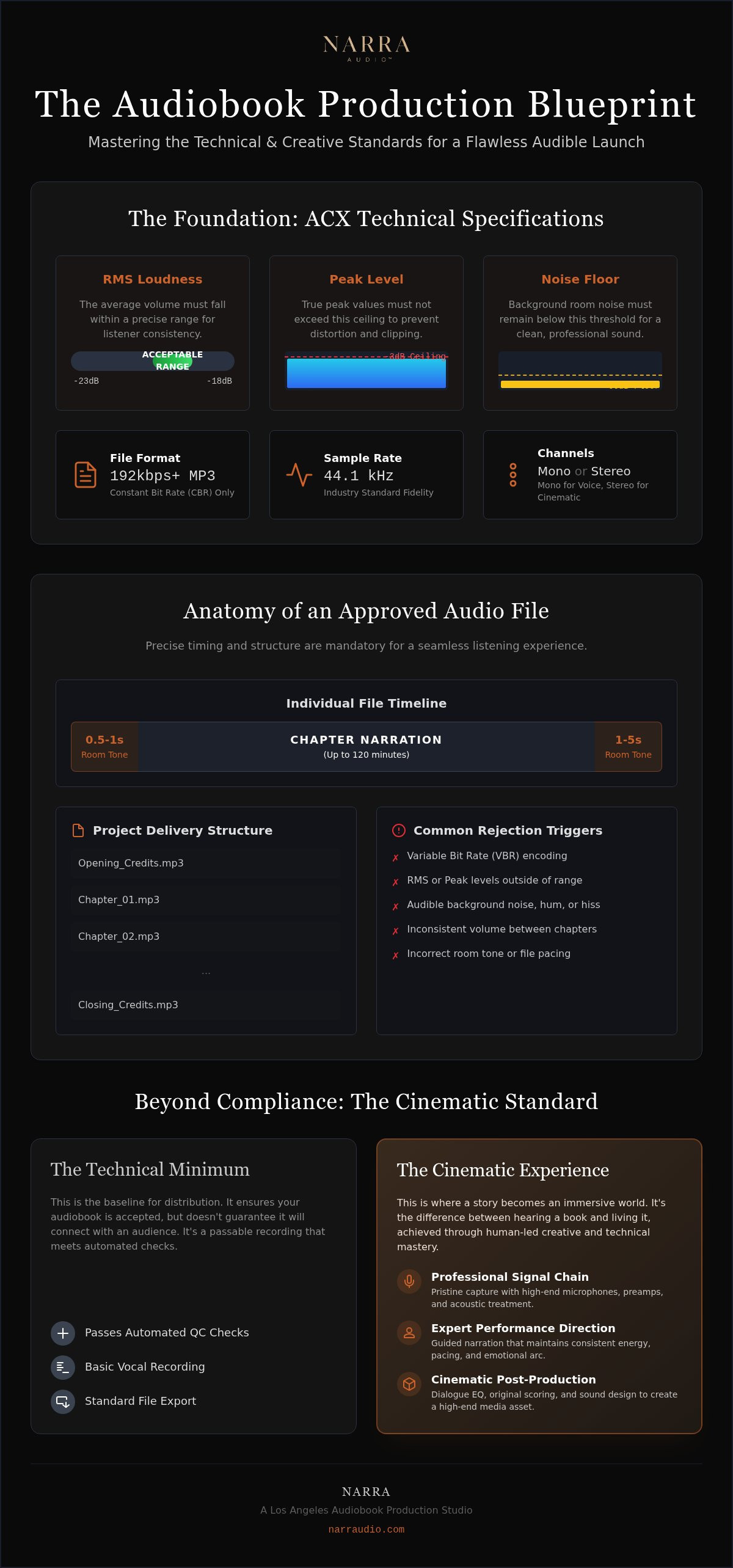
Every file you submit must be a Constant Bit Rate (CBR) MP3 at 192kbps or higher. Variable bit rates are a common reason for rejection because they can cause playback issues on certain devices. Your RMS levels, which measure the average perceived loudness, must stay between -23dB and -18dB. This ensures a consistent volume for listeners switching between titles. To prevent digital clipping, your peak values must never exceed -3dB. Finally, the noise floor, the background level of your recording environment, must be no higher than -60dB RMS. This creates the "black" background that allows your voice to shine without the distraction of hum or hiss.
The Anatomy of Audible Audio Submission Requirements
For voice-led narratives, mono is the preferred choice for vocal clarity and efficient file sizes. However, for a cinematic production featuring original music or sound design, stereo files are essential to preserve the immersive soundstage. Regardless of the channel choice, your sample rate must be 44.1 kHz. This is the global industry standard for high-fidelity audio. You also need exactly 0.5 to 1 second of room tone at the start of every file and 1 to 5 seconds at the end. This silence acts as a digital "breath," allowing the listener's ear to settle before the performance begins. These small windows of room tone are vital for the pacing and natural rhythm of the narration.
Format and Delivery Specifications
Efficiency is key when managing the delivery of your project. You must deliver each chapter as an individual file, including separate files for opening and closing credits. This structure allows the listener to move through your story with ease. Keep your naming conventions simple and sequential to streamline the upload process. While individual files cannot exceed 120 minutes, professional production focuses on pacing and chapter arcs to ensure the listener never feels overwhelmed. At NARRA, we treat these specs as the bare minimum. Our goal is to handle the technical burden entirely, from manuscript breakdown to final delivery, so you can focus on the creative impact of your words.
Capturing the Performance: Professional Recording Specs
Technical compliance is the floor, but performance is the ceiling. To meet the audible audio submission requirements at an elite level, you must record through a high-end signal chain. This starts with a professional large-diaphragm condenser microphone, moves through a discrete preamp, and ends with high-resolution converters. Every link in this chain is designed to preserve the nuance, breath, and weight of your voice. It's the difference between a recording that sounds like a phone call and one that feels like a private conversation.
Many authors attempt to fix substandard audio in post-production. It's a costly mistake. Professional acoustic treatment in a dedicated Los Angeles studio ensures your recording is pristine from the start. Digital cleanup can only do so much before the voice sounds artificial and processed. Adhering to foundational recording principles means capturing a "dry" signal that's free from the room reflections or outside interference that distract listeners. We focus on the source because a clean input is the only way to achieve a cinematic output.
A 10-hour audiobook requires more than just reading. It requires immense stamina. We perform a comprehensive manuscript breakdown to map out emotional arcs and pacing before you ever step into the booth. Performance direction is the bridge between a simple reading and an immersive experience. It's about maintaining consistent energy and tone from the opening credits to the final chapter. Without a director, even the best voices can drift, losing the listener's interest over long-form sessions.
The NARRA Voice Capture System
Our process begins with a 47-minute foundation session to establish your unique sonic identity. This isn't about automated shortcuts. It's about capturing the essential character of your voice under expert supervision. If you choose our time-saving narration options, we require explicit author authorization to ensure your vision remains the priority. Human creative direction stays at the helm of every recorded syllable, ensuring the final performance sounds like you, at your absolute best.
Managing Mouth Noise and Pacing
Technical excellence also depends on physical preparation. Hydration and proper mic technique are essential for minimizing mouth noise. We prefer professional direction over heavy digital filtering, which often strips the life and warmth out of a performance. Pacing varies significantly between genres. Non-fiction requires an authoritative, steady cadence, while fiction demands a more fluid, character-driven rhythm. To see how these elements come together in a finished project, you can review our production process.
Post-Production Architecture: Mixing and Mastering for Audible
Precision in post-production is what separates a bedroom recording from a cinematic masterpiece. Once the raw performance is captured, the focus shifts to sculpting the audio into a form that is both technically flawless and emotionally resonant. This stage is where we ensure your project meets the strict audible audio submission requirements while maintaining the artistic integrity of your voice. It's not just about removing mistakes. It's about architecting a sonic landscape that supports your story from the first sentence to the final credit.
Dialogue clarity is our primary objective. For long-form listening, we employ strategic EQ and compression that prioritize comfort. If a recording is too "bright," it causes ear fatigue. If it's too "muddy," the listener loses focus. We balance these frequencies to ensure every word is crisp without sounding clinical. Unlike music mastering, which often chases maximum loudness, audiobook mastering is about broadcast consistency. We target the specific -23dB to -18dB RMS range with surgical precision, ensuring your book sounds professional on any device, from high-end headphones to car speakers.
The final safeguard is our Quality Control (QC) process. We utilize a rigorous three-pass review. The first pass is technical, verifying that every file meets the -60dB noise floor and -3dB peak requirements. The second pass is narrative, checking the audio against your manuscript for word-for-word accuracy. The third pass is a creative "vibe check," where we ensure the pacing and tone remain consistent throughout the entire arc of the book. This meticulous attention to detail is why serious authors choose professional cinematic production over automated alternatives.
DIY Editing vs. Professional Studio Mastering
Many DIY tools rely on aggressive noise gates or automated "cleanup" plugins. These often result in a robotic, clipped sound that fails the ACX human-review process. We manage the noise floor manually, preserving the natural warmth and breath of your performance. Our team in Los Angeles uses the same high-end signal paths found in major film scoring stages. This human-led approach ensures your voice remains grounded and personal, even after technical optimization.
Chapter Arcs and Cue Placement
Silence is a powerful narrative tool. We use it strategically to define chapter transitions and emphasize key moments in your text. Consistent volume levels are vital, especially when recording sessions take place over several weeks. We align the sonic profile of every chapter so the listener never feels a "jump" in quality. Once the mix is perfected, we export the final files as 192kbps CBR MP3s, ready for a seamless distribution process that gets your work into the ears of your audience without technical delays.
Navigating the Distribution Pipeline and Approval Process
The moment you click submit shouldn't be a gamble. In 2026, the ACX review process remains a rigorous human-led gatekeeping phase. It typically takes 10 to 15 business days for your project to move from "Pending" to "Retail." During this window, technicians scrutinize your files for any deviation from the audible audio submission requirements. Even a minor RMS fluctuation or a single noise spike can trigger a rejection. These setbacks don't just hurt your pride. They disrupt your marketing momentum and push back your revenue targets.
Metadata alignment is another invisible hurdle. Your cover art, copyright holder information, and narrator credits must match your manuscript and distribution contracts exactly. Any discrepancy between your audio files and your digital storefront data will halt the process. While Audible remains the dominant force, we also look toward wider horizons. Managing distribution to platforms like Spotify and Apple Books ensures your intellectual property is accessible to every segment of the global market.
End-to-End Distribution Management
Managing platform uploads is a technical burden that most authors shouldn't carry. We handle the ingestion process, ensuring every chapter, credit file, and retail sample is placed correctly. The reality is that no studio can honestly guarantee that Audible will accept a title, as they are the final arbiters of their own ecosystem. However, our expertise in how to publish an audiobook professionally means your files are built to exceed their baseline expectations. We act as your production partner, navigating the pipeline so you can focus on your next book.
Launch Assets and Social Highlighting
A successful release requires more than just a compliant file. It requires visibility. Our Signature and Cinematic packages provide an expanded suite of launch assets, including cinematic audiobook trailers and high-impact social clips. These assets are designed for LinkedIn, Instagram, and other professional networks, allowing you to share the immersive quality of your work before the listener even buys it. We extract the most compelling cues and chapter highlights to create a narrative hook that drives sales. If you're ready to see how your manuscript can be transformed into a cinematic media asset, you can book a complimentary Vision Call with our team today.
Beyond Technical Compliance: The NARRA Cinematic Standard
Technical specs are the skeleton. Artistry is the soul. While every project we deliver exceeds the audible audio submission requirements, we believe that basic narration is no longer enough for authors who want to leave a lasting impact. High-ticket authors, executives, and visionaries require a medium that mirrors the quality of their message. A dry voice in a silent room can convey information, but it rarely captures the heart. Our human-led philosophy ensures that every breath and every note is placed with intention, creating a bridge between your private creative process and a grand, immersive media experience.
Listener retention is the true metric of success. If a listener feels the emotional weight of a chapter arc through a subtle shift in the soundscape, they won't just finish the book. They'll remember it. We reject the mechanical alternatives that have flooded the market, opting instead for real composers and sound designers who understand the nuance of performance direction. This isn't about using effects for the sake of it. It's about a story-first process where restraint is just as important as a crescendo. We don't just check boxes; we build legacies.
Cinematic Scoring and Sound Design
The impact of a custom score is transformative. It provides a narrative glue that holds disparate chapters together. Our team, led by Mark Rhodes, creates original themes tailored to the specific DNA of your manuscript. We understand when to let the voice stand alone and when cinematic scoring for audiobooks can elevate a transition from a simple pause to a moment of profound reflection. This level of craftsmanship ensures your audiobook feels like a film, even without the screen. It's a meticulous process that respects the written word while expanding its sensory reach.
The NARRA Production Packages
We've designed our production tiers to match the scale of your vision. Every package includes end-to-end management, from manuscript intake to final distribution, ensuring you never have to worry about the audible audio submission requirements yourself. Our packages are structured to provide clarity and elite quality at every level.
- Essential Audiobook ($3,000–$5,000): Focuses on clean, cinematic narration with a turnaround of approximately 1 week.
- Signature System ($6,000–$10,000): Adds custom scoring and high-impact social clips, typically delivered in ~10 days.
- Cinematic Experience ($12,000–$30,000+): Our most immersive tier, featuring a full original score, ensemble casting, and a prestige production environment.
Each tier is built on the same foundation of professional audio engineering and creative empathy. We handle the entire production burden so your project is distribution-ready on the first attempt. This allows you to step away from the technical management and focus entirely on the future of your work. Your book deserves to be heard at its absolute best.
From Manuscript to Cinematic Reality
Mastering the technical landscape is the first step toward reaching your audience. You now understand that meeting the audible audio submission requirements, from the -60dB noise floor to surgical RMS levels, is the baseline for professional distribution. However, your legacy shouldn't be defined by technical compliance alone. It's about the emotional resonance of your voice and the cinematic depth of your story. By shifting the burden of production to a dedicated team, you ensure your work receives the reverence it deserves.
At NARRA, we provide more than just a compliant file. We offer human-led cinematic voice production from Los Angeles studios used by Academy Award-winning film. Our process includes original musical craft and full-service management. You provide the manuscript; we handle the creative direction, scoring, and distribution. It's time to transform your writing into an immersive listening experience that commands attention. To explore how we can elevate your project, book a complimentary Vision Call with NARRA. We're ready to help you bring your vision to life with the precision and power it requires.
Frequently Asked Questions
What are the exact RMS and peak requirements for Audible?
Your audio files must maintain an RMS loudness between -23dB and -18dB to ensure a consistent volume for listeners. Additionally, peak values must not exceed -3dB to prevent digital clipping and distortion. These audible audio submission requirements are the technical foundation for any professional title. Our engineers in Los Angeles and New York use high-end signal processing to hit these targets while preserving the natural emotional weight of your performance.
Can I record my audiobook at home and still pass ACX requirements?
Recording at home is possible but often leads to rejection due to a high noise floor or room reflections. Most residential spaces in cities like Seattle or San Diego aren't built for the -60dB silence that Audible demands. You might spend weeks recording only to find your audio sounds thin or echoey. We provide professional environments and direction to ensure your recording is pristine from the very first session.
How long does it take for Audible to approve my audio submission?
The standard approval window is typically 10 to 15 business days. During this period, the ACX quality assurance team reviews your files for both technical compliance and narrative accuracy. If a file is rejected, the timeline resets once you upload the corrected version. We manage the entire distribution pipeline for our authors, ensuring that every file is optimized to move through the review process without unnecessary technical delays.
What is the noise floor requirement and how do I fix it?
The noise floor must be -60dB RMS or lower, meaning the background silence must be nearly absolute. Fixing a poor noise floor in post-production often results in a robotic, over-processed sound that listeners find distracting. True fixes happen at the source through professional acoustic treatment and high-quality preamps. We utilize Los Angeles studios used by Academy Award-winning film to capture a silent, "dry" signal that naturally meets these strict standards.
Does NARRA guarantee that my audiobook will be accepted by Audible?
No studio can honestly guarantee acceptance because Audible and ACX are the final arbiters of their own platforms. However, our production standards are designed to exceed the baseline audible audio submission requirements. We handle the entire production burden, and if a platform requests a specific adjustment, our team manages the revision process. Our human-led approach ensures your project is built to the highest industry standards before it ever reaches the review stage.
Should I record my audiobook in mono or stereo for submission?
Standard narration is typically recorded in mono to ensure vocal clarity and efficient file sizes. However, if your project involves original music or cinematic sound design, stereo is necessary to maintain an immersive soundstage. ACX accepts both formats as long as they stay consistent throughout the book. For authors in London or San Francisco, we determine the best channel configuration during our initial manuscript breakdown to support your creative vision.
What is the difference between an Essential and a Cinematic production?
The Essential Audiobook package provides clean, cinematic narration and professional mastering with a turnaround of about one week. Our Cinematic Experience is a more immersive tier that includes a full original score, ensemble casting, and advanced scene design. While Essential production ensures a polished, professional read, the Cinematic tier transforms your book into a high-stakes media asset. Both options include full distribution management and our signature creative direction from start to finish.
How much does it cost to have a professional studio handle my Audible submission?
Our Essential Audiobook package is priced between $3,000 and $5,000, covering everything from voice capture to final distribution. For authors seeking custom scoring and social assets, the Signature System ranges from $6,000 to $10,000. Our most prestigious Cinematic Experience starts at $12,000 and can exceed $30,000 for complex ensemble casts. These prices reflect our commitment to human-led craft and the high-end production standards found in major media hubs like Orange County and New York.
Frequently Asked Questions
Your audio files must maintain an RMS loudness between -23dB and -18dB to ensure a consistent volume for listeners. Additionally, peak values must not exceed -3dB to prevent digital clipping and distortion. These audible audio submission requirements are the technical foundation for any professional title. Our engineers in Los Angeles and New York use high-end signal processing to hit these targets while preserving the natural emotional weight of your performance.
Recording at home is possible but often leads to rejection due to a high noise floor or room reflections. Most residential spaces in cities like Seattle or San Diego aren't built for the -60dB silence that Audible demands. You might spend weeks recording only to find your audio sounds thin or echoey. We provide professional environments and direction to ensure your recording is pristine from the very first session.
The standard approval window is typically 10 to 15 business days. During this period, the ACX quality assurance team reviews your files for both technical compliance and narrative accuracy. If a file is rejected, the timeline resets once you upload the corrected version. We manage the entire distribution pipeline for our authors, ensuring that every file is optimized to move through the review process without unnecessary technical delays.
The noise floor must be -60dB RMS or lower, meaning the background silence must be nearly absolute. Fixing a poor noise floor in post-production often results in a robotic, over-processed sound that listeners find distracting. True fixes happen at the source through professional acoustic treatment and high-quality preamps. We utilize Los Angeles studios used by Academy Award-winning film to capture a silent, "dry" signal that naturally meets these strict standards.
No studio can honestly guarantee acceptance because Audible and ACX are the final arbiters of their own platforms. However, our production standards are designed to exceed the baseline audible audio submission requirements. We handle the entire production burden, and if a platform requests a specific adjustment, our team manages the revision process. Our human-led approach ensures your project is built to the highest industry standards before it ever reaches the review stage.
Standard narration is typically recorded in mono to ensure vocal clarity and efficient file sizes. However, if your project involves original music or cinematic sound design, stereo is necessary to maintain an immersive soundstage. ACX accepts both formats as long as they stay consistent throughout the book. For authors in London or San Francisco, we determine the best channel configuration during our initial manuscript breakdown to support your creative vision.
The Essential Audiobook package provides clean, cinematic narration and professional mastering with a turnaround of about one week. Our Cinematic Experience is a more immersive tier that includes a full original score, ensemble casting, and advanced scene design. While Essential production ensures a polished, professional read, the Cinematic tier transforms your book into a high-stakes media asset. Both options include full distribution management and our signature creative direction from start to finish.
Our Essential Audiobook package is priced between $3,000 and $5,000, covering everything from voice capture to final distribution. For authors seeking custom scoring and social assets, the Signature System ranges from $6,000 to $10,000. Our most prestigious Cinematic Experience starts at $12,000 and can exceed $30,000 for complex ensemble casts. These prices reflect our commitment to human-led craft and the high-end production standards found in major media hubs like Orange County and New York.