How to Publish an Audiobook Professionally: The 2026 Elite Author’s Guide
What if your manuscript wasn't just read aloud, but experienced as a private, high-fidelity screening for the ears? For the elite author, the transition from page to ear is where a legacy is either cemented or lost in the digital noise. You understand that your audience doesn't just want to hear your words; they want to be transported by them. Yet, the technical labyrinth of sound engineering and the fear of a low-quality production that damages your reputation can feel paralyzing. You've spent months or years perfecting your prose, and the last thing you want is a recording that sounds like it was captured in a spare bedroom.
We agree that your work deserves more than a standard narration. This guide provides the definitive framework for how to publish an audiobook professionally, shifting the focus from simple recording to cinematic world-building. You'll discover how to navigate the complexities of high-end production and ensure your work rivals major studio releases. We'll walk through the essential stages of elite production, including human-led narration, bespoke scoring, and the seamless distribution requirements for platforms like Audible and Spotify. By the end, you'll have a clear path to turning your book into a polished, market-ready masterpiece that stands out in a saturated market.
Key Takeaways
- Understand the three-pillar architecture of production, engineering, and distribution that separates a standard reading from a high-end cinematic release.
- Master the art of professional narration by selecting the right voice and utilizing time-saving recording models that protect your schedule while elevating your prose.
- Learn how to publish an audiobook professionally by integrating original music and cinematic scoring to create an immersive experience that commands listener attention.
- Navigate the complexities of global distribution and metadata to ensure your work is discoverable and dominant on platforms like Audible and Spotify.
- Discover why elite authors leverage an end-to-end managed production to safeguard their brand equity and ensure a flawless, studio-grade launch.
The Anatomy of a Professional Audiobook Release in 2026
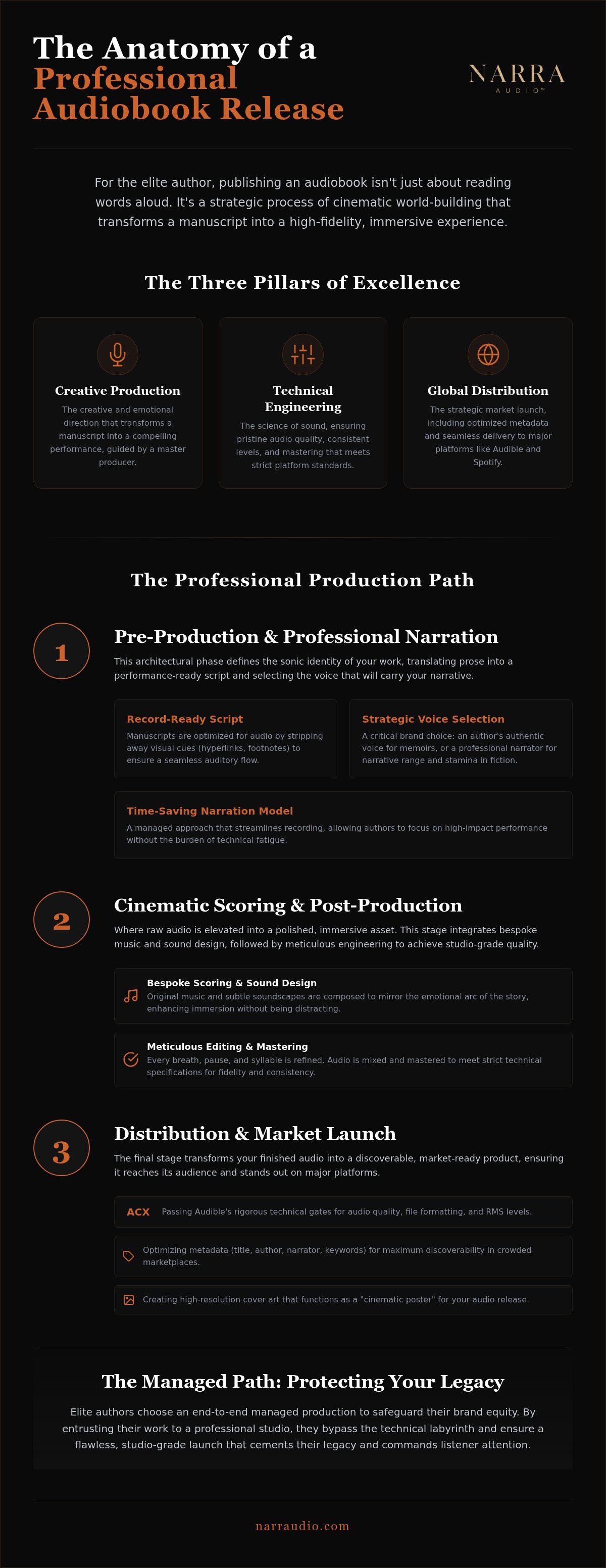
By 2026, the threshold for excellence has shifted. Audiobook publishing is no longer a secondary thought; it's a primary brand asset. To understand how to publish an audiobook professionally, you must move past the idea of a simple reading. Professional publishing is a rigorous, three-pillar process involving production, engineering, and distribution. If one pillar falters, the entire project loses its structural integrity.
Listeners today are sophisticated. They possess ears tuned by high-budget podcasts and cinematic streaming. A "standard narration"—the flat, uninspired reading of text—is no longer sufficient to hold attention. They demand immersive experiences. They want soundscapes that mirror the emotional arc of your words. This transformation requires a specific set of core assets: studio-mastered audio files, optimized metadata for discoverability, and high-resolution cover art that functions as a cinematic poster.
The Quality Standard: Why "Good Enough" Isn’t Enough
In the premium market, audio quality is synonymous with authority. Poor sound doesn't just annoy listeners; it triggers a loss of trust. If your recording includes a noticeable noise floor or inconsistent RMS levels, your reviews will reflect it. Major platforms like Audible and Spotify maintain strict technical gates for a reason. They protect the user experience. You must ensure your audio meets these standards to even enter the arena. Cinematic audio is the bridge between a book and a film.
- Fidelity: Every breath and syllable must be crisp and intentional.
- Consistency: Volume levels must remain stable across hours of content.
- Retention: High-fidelity sound reduces listener fatigue, keeping them engaged until the final chapter.
The Role of the Master Producer
A professional audiobook isn't born in a vacuum. It requires a Master Producer to act as the bridge between your manuscript and the listener’s ears. This role is about more than just technical oversight. It’s about emotional direction. A producer ensures your voice—or your narrator's voice—carries the intended weight of every sentence. They transform raw input into a polished asset.
There's a vast gulf between a home-recorded file and a studio-mastered production. Professional direction provides the pacing and tone that long-form narration requires. It prevents the monotony that often plagues DIY efforts. By choosing a managed studio path, you're not just buying equipment time. You're securing a guardian for your creative legacy.
Step 1: Pre-Production and the Art of Professional Narration
The journey from manuscript to masterpiece begins long before the microphone is powered on. Pre-production is the architectural phase where you define the sonic identity of your work. Your manuscript is a static object; a script is a living performance. To understand how to publish an audiobook professionally, you must first translate your prose into a format optimized for the ear. This involves stripping away hyperlinks, footnotes, and visual cues that disrupt the auditory flow. You need a record-ready script that prioritizes the natural rhythm of speech over the rigid structure of the page.
Elite authors often struggle with the time commitment required for a full-length production. High-end studios solve this through a "Time-Saving Narration" model. This approach streamlines the recording process, allowing busy creators to focus their energy on high-impact performance while a production team manages the technical fatigue. It's about maximizing your creative output without draining your most valuable resource: your time.
Choosing Your Voice: Author vs. Professional
Deciding who speaks your words is a strategic brand choice. For memoirs or personal development titles, your own voice carries an irreplaceable authenticity. It creates an intimate, direct connection with your audience. However, for many authors, "mic-shyness" or a lack of vocal stamina can hinder the final product. This is where professional direction becomes essential. A master producer helps you find your "studio voice," ensuring your delivery carries the intended emotional weight. If marketability is the primary goal for fiction, a professional narrator often provides the range and stamina required to sustain a ten-hour narrative.
The Recording Environment
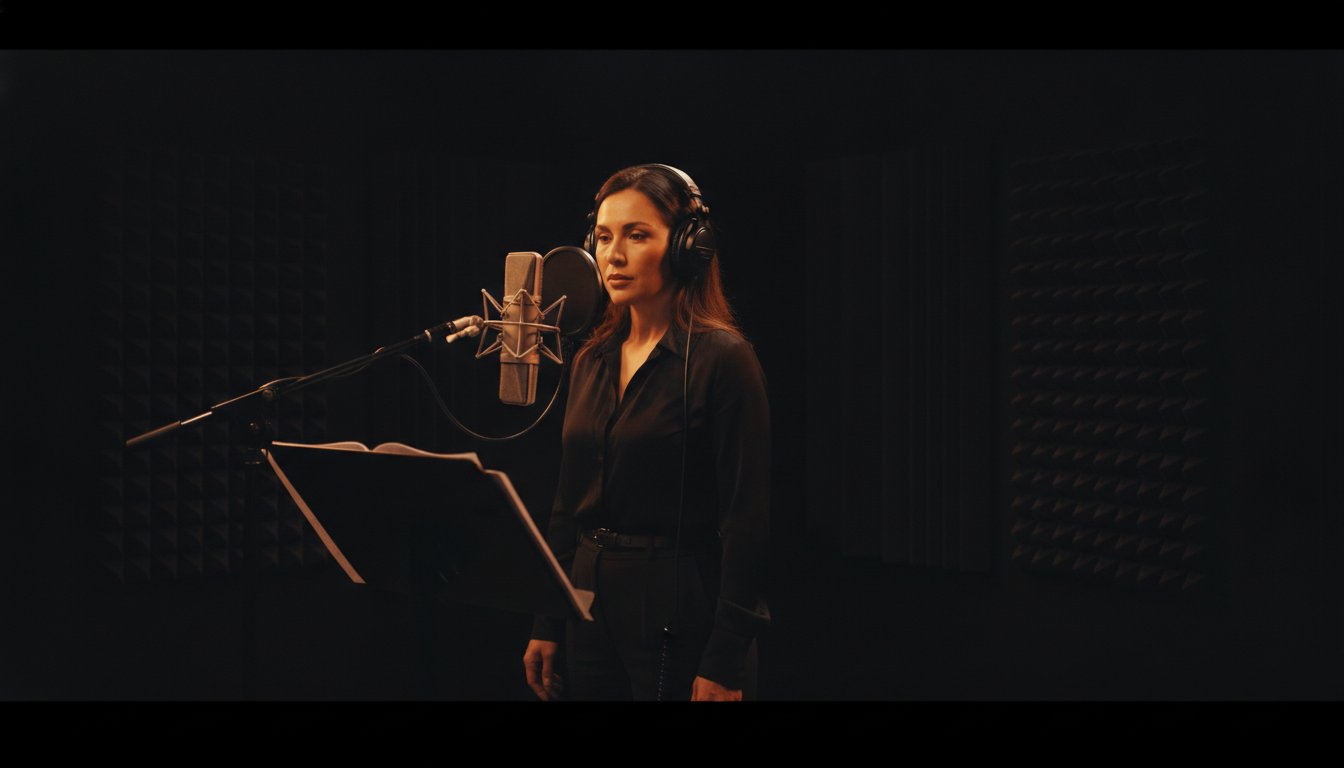
Acoustics are the foundation of your authority. You can't fix a poor recording environment in post-production. A professional studio provides more than just high-end equipment; it provides a controlled, silent canvas. Whether you're recording in media hubs like Los Angeles, NYC, or London, the physical space must be engineered to eliminate noise floors and "slap" echoes. If you are looking for a managed solution that handles these logistics, consider exploring premium voice production options that prioritize human-led quality.
- Acoustic Precision: Professional treatment ensures a "dry" sound, allowing for cinematic mastering later.
- Tonal Consistency: Managed studios ensure your voice sounds identical from the first hour of recording to the last.
- Hub Access: Recording in centers like Seattle or San Francisco connects your project to the highest standards of global media production.
Don't let a substandard environment diminish your legacy. The transition from your private writing world to the public immersive world requires a space that respects the weight of your words.
Step 2: Cinematic Scoring and Post-Production Excellence
Raw audio is a diamond in the rough. It contains the soul of your story, but it lacks the brilliance of a finished gem. To truly master how to publish an audiobook professionally, you must enter the phase of post-production excellence. This is where the NARRA difference becomes tangible. We don't just clean audio; we sculpt it. This stage is about elevating your work from a simple recording to a cinematic brand asset that commands respect in a crowded marketplace.
The post-production phase is where the "Master Producer" persona truly shines. It’s a transition from the solitary act of writing to the grand, immersive world of professional media. We treat your manuscript with artistic reverence, ensuring that every second of sound serves the legacy you're building. This isn't just about meeting technical specs; it’s about creating a sonic signature that is uniquely yours.
Beyond Speech: The Power of Cinematic Scoring
Most distribution platforms suggest that clear speech is the only requirement. We disagree. For the elite author, silence is often a missed opportunity. Original music acts as an emotional anchor, guiding the listener through complex arguments in non-fiction or deeply personal revelations in a memoir. It transforms a lecture into an experience. You can explore more about this in our guide on Cinematic Scoring for Audiobooks. Subtle soundscapes prevent listener fatigue, ensuring that a four-hour deep dive feels like an effortless journey. These scores aren't mere background noise. They're composed to mirror the emotional arc of your narrative.
The Engineering Phase
The technical side of production is unforgiving. Every mouth noise, stray click, or inconsistent breath is a distraction that pulls the listener out of your world. Our rigorous editing process involves a microscopic review of every second of audio. We remove pacing errors and vocal artifacts that a standard home recording would miss. Once the files are pristine, they undergo mastering to meet the "Audible Standard" and beyond. This is the precision work that separates amateurs from industry leaders.
Mastering is about more than volume. It’s about multi-platform compatibility. Your audio must sound as rich on high-end studio monitors as it does on a pair of plastic earbuds in a noisy gym. This requires a precise balance of RMS levels and noise floors. Finally, every project undergoes a third-party Quality Control (QC) proof-listen. This ensures that the final asset meets the exact technical specifications of ACX, Spotify, and Findaway. It guarantees a seamless launch without the frustration of technical rejections.
Step 3: Navigating Distribution and Market Launch
Your cinematic master is complete. The solitary hours of writing and the focused energy of the recording booth have culminated in a high-fidelity asset. Now, you face the final hurdle: the global marketplace. Learning how to publish an audiobook professionally requires a strategic approach to distribution that balances immediate royalties with long-term brand reach. It's the difference between a quiet release and a market-dominating launch.
In 2026, the "Audible-only" mindset is a relic of the past. While ACX exclusivity offers a higher royalty percentage, it locks your work away from a massive segment of the listening public. Wide distribution through partners like Draft2Digital or Findaway opens doors to Spotify, Apple Books, and the critical library markets of OverDrive and Libby. This is where international rights management becomes vital. Your voice shouldn't just be heard in one territory; it should resonate globally. Managing these rights ensures your intellectual property is protected while maximizing your footprint across multiple continents.
Distribution Platforms: Audible, Spotify, and Beyond
Spotify’s integration of audiobooks into premium subscriptions has fundamentally changed listener behavior. Elite authors now prioritize wide distribution to capture this high-growth audience. Metadata is your digital storefront. Your audiobook description shouldn't be a copy-paste of your print blurb. It needs to be an "Elevator Pitch" designed for someone browsing with their ears. Use evocative, sensory language that mirrors the cinematic quality of the audio itself. Keywords and categories must be selected with precision to ensure your work appears in front of the right listeners at the right time.
The Professional Launch Strategy
A professional launch is a synchronized event. You don't just drop a file and hope for the best. You coordinate the audiobook release with your print and ebook versions to create a unified marketing crescendo. High-res audio samples are your best promotional tools. Share these "cinematic trailers" on social media and podcast circuits to build anticipation. Securing early reviews is critical; use promo codes effectively to get your work into the ears of influencers and loyal readers.
Expect a timeline of 10 to 30 days from final submission to "Live" status. This buffer is essential for the platform-level quality checks that ensure your file is flawless. If you want to ensure your launch is managed with precision, you can partner with a studio that handles distribution end-to-end. This managed path removes the technical burden, allowing you to focus on the creative impact of your release.
The Managed Path: Why Elite Authors Choose Professional Studios
You've reached the final crossroad of your publishing journey. You can attempt the technical ascent alone; or you can step into a partnership that elevates your work to a global standard. Understanding how to publish an audiobook professionally isn't just about knowing which buttons to press. It's about recognizing when to let a Master Producer take the lead so your focus remains on the vision. For the elite author, the solitary struggle of DIY production often results in a product that feels unfinished, regardless of the effort invested. A professional studio acts as a guardian of your voice, ensuring the final output is the most realized version of your original intent.
End-to-end management means every detail is handled with precision. From the initial script adaptation to the final distribution check on Audible and Spotify, a dedicated team navigates the technical hurdles for you. This managed path transforms a high-stress technical project into a seamless creative experience. It moves you from the quiet, solitary world of writing to the grand, immersive world of professional media without the burden of learning audio engineering from scratch.
The Opportunity Cost of DIY
Every hour you spend removing mouth noises or adjusting RMS levels is an hour stolen from your next bestseller. For high-net-worth authors, the ROI of a professional production isn't just found in the royalties. It's found in the brand equity you preserve. A DIY recording often carries subtle audio artifacts that signal amateurism to a sophisticated listener. These technical flaws lead to poor reviews and lower listener retention. When you choose a professional partner, you aren't just buying studio time. You're securing a high-fidelity asset that commands a higher market value and builds a lasting legacy.
Partnering with NARRA
At NARRA, we reject the mechanical shortcuts of AI voice synthesis. Our philosophy is rooted in human-led cinematic storytelling. We believe that only a human performance, guided by professional direction, can capture the emotional weight of your prose. With boutique studio locations in media hubs like NYC, LA, and London, we provide the elite tier of production your work deserves. If you're an author in Seattle, San Diego, or Orange County, our managed process offers the local expertise and global reach necessary for a dominant market entry.
Our process begins with a deep-dive consultation to align our cinematic scoring with your narrative vision. We move through production with a rhythmic efficiency that respects your schedule, culminating in a polished reality that rivals any major studio release. Transform your manuscript into a cinematic experience with NARRA.
Secure Your Sound: The Future of Your Story Starts Now
Your manuscript is more than just text; it is the foundation of your creative legacy. By mastering how to publish an audiobook professionally, you've moved beyond the limitations of standard narration into the expansive world of cinematic storytelling. You now recognize that elite production requires a seamless blend of human-led performance, original musical scoring, and expert distribution management. These elements ensure your work doesn't just enter the market; it commands it.
The transition to a grand, immersive media presence is a transformation that defines the modern elite author. You don't have to navigate the technical labyrinth of sound engineering or distribution alone. By choosing a managed path, you preserve your brand equity and focus on your next masterpiece. Start your cinematic audiobook journey with NARRA today.
Our team delivers premium voice production and cinematic scoring that turns every chapter into an immersive experience. We handle the distribution complexity so your voice resonates across Audible, Spotify, and global markets. Your vision deserves a production that matches its ambition. It's time to let the world hear what you've built.
Frequently Asked Questions
How much does it cost to publish an audiobook professionally?
Professional production costs vary based on manuscript length and the complexity of sound design. Factors include studio time in hubs like London or LA, narrator fees, and original music composition. Premium cinematic productions involve higher investment because they require multi-layered engineering. You should evaluate costs based on the brand equity you intend to build. High-fidelity assets offer a better long-term return through increased listener retention.
Can I narrate my own audiobook if I am not a professional actor?
You can narrate your own book, especially if it's a memoir or personal brand title. Non-fiction authors often provide a level of authenticity that a hired voice cannot replicate. However, you must possess the vocal stamina to maintain a consistent tone over many hours. Professional direction is critical here to help you overcome mic-shyness. A producer ensures your performance carries the emotional weight required for a professional release.
How long does the professional audiobook production process take?
A professional audiobook production typically takes between 10 and 12 weeks from the first script read to the final master. This timeline includes pre-production script prep, actual recording sessions, and a rigorous editing phase. Post-production is often the longest stage because it involves microscopic quality control and cinematic scoring. Distribution platforms then require an additional 10 to 30 days to process and go live.
What is the difference between standard narration and cinematic production?
Standard narration is a dry recording of the text with minimal editing beyond removing errors. Cinematic production is an immersive experience that incorporates original music and soundscapes. It treats the audiobook like a film for the ears. This approach is the gold standard for how to publish an audiobook professionally in 2026. It creates emotional anchors that keep listeners engaged through long chapters and complex narratives.
Do I need a separate ISBN for my audiobook version?
Yes, you need a separate ISBN for your audiobook version to distinguish it from print and ebook formats. Each medium is considered a unique product by retailers and libraries. Most authors purchase ISBNs in blocks to ensure all versions of their work are correctly tracked. Proper identification is essential for accurate royalty reporting and global distribution management. It ensures your metadata remains clean across all retail platforms.
How do I get my audiobook onto Audible and Spotify?
You reach these platforms by choosing between exclusive or wide distribution paths. Audible is accessed through ACX, while Spotify and global libraries require a wide distributor like Findaway or Draft2Digital. A managed studio handles these technical uploads and metadata settings for you. This ensures your files meet the specific gatekeeping requirements of each platform. It's the most efficient way to ensure a seamless global launch.
Why should I avoid using AI voices for my professional audiobook?
AI voices lack the emotional nuance and rhythmic variety that a human performer provides. Listeners in the premium market can often detect the mechanical nature of synthetic speech, which diminishes trust in your brand. Human-led production ensures that irony, empathy, and subtle pacing are captured correctly. To understand how to publish an audiobook professionally, you must prioritize the human element. Real voices create a lasting connection that machines cannot replicate.
What technical specifications do I need to meet for professional distribution?
Professional distribution requires files to meet strict standards for RMS levels and peak values. Your audio must have a noise floor below -60dB and a sample rate of 44.1 kHz. Each chapter must be a separate file with a consistent volume level throughout. Meeting these gatekeeping requirements prevents technical rejections during the upload process. A professional engineer ensures your masters are compatible with everything from high-end speakers to mobile earbuds.
Frequently Asked Questions
Professional production costs vary based on manuscript length and the complexity of sound design. Factors include studio time in hubs like London or LA, narrator fees, and original music composition. Premium cinematic productions involve higher investment because they require multi-layered engineering. You should evaluate costs based on the brand equity you intend to build. High-fidelity assets offer a better long-term return through increased listener retention.
You can narrate your own book, especially if it's a memoir or personal brand title. Non-fiction authors often provide a level of authenticity that a hired voice cannot replicate. However, you must possess the vocal stamina to maintain a consistent tone over many hours. Professional direction is critical here to help you overcome mic-shyness. A producer ensures your performance carries the emotional weight required for a professional release.
A professional audiobook production typically takes between 10 and 12 weeks from the first script read to the final master. This timeline includes pre-production script prep, actual recording sessions, and a rigorous editing phase. Post-production is often the longest stage because it involves microscopic quality control and cinematic scoring. Distribution platforms then require an additional 10 to 30 days to process and go live.
Standard narration is a dry recording of the text with minimal editing beyond removing errors. Cinematic production is an immersive experience that incorporates original music and soundscapes. It treats the audiobook like a film for the ears. This approach is the gold standard for how to publish an audiobook professionally in 2026. It creates emotional anchors that keep listeners engaged through long chapters and complex narratives.
Yes, you need a separate ISBN for your audiobook version to distinguish it from print and ebook formats. Each medium is considered a unique product by retailers and libraries. Most authors purchase ISBNs in blocks to ensure all versions of their work are correctly tracked. Proper identification is essential for accurate royalty reporting and global distribution management. It ensures your metadata remains clean across all retail platforms.
You reach these platforms by choosing between exclusive or wide distribution paths. Audible is accessed through ACX, while Spotify and global libraries require a wide distributor like Findaway or Draft2Digital. A managed studio handles these technical uploads and metadata settings for you. This ensures your files meet the specific gatekeeping requirements of each platform. It's the most efficient way to ensure a seamless global launch.
AI voices lack the emotional nuance and rhythmic variety that a human performer provides. Listeners in the premium market can often detect the mechanical nature of synthetic speech, which diminishes trust in your brand. Human-led production ensures that irony, empathy, and subtle pacing are captured correctly. To understand how to publish an audiobook professionally, you must prioritize the human element. Real voices create a lasting connection that machines cannot replicate.
Professional distribution requires files to meet strict standards for RMS levels and peak values. Your audio must have a noise floor below -60dB and a sample rate of 44.1 kHz. Each chapter must be a separate file with a consistent volume level throughout. Meeting these gatekeeping requirements prevents technical rejections during the upload process. A professional engineer ensures your masters are compatible with everything from high-end speakers to mobile earbuds.