Cinematic Soundscapes for Narrative Audio: Elevating the Author’s Voice
Why do some audiobooks feel like a flat recitation of a PDF while others pull you into a living, breathing world you never want to leave? You've spent years perfecting your prose, so it's only natural to worry that a standard narration might fail to capture the soul of your story. You aren't looking for generic background loops or the hollow repetition of AI tools. You want your listeners to feel every pulse of tension and every breath of relief. Integrating cinematic soundscapes for narrative audio is the definitive way to move beyond simple reading and into the realm of high-stakes storytelling.
The technical complexity of sound design shouldn't be a barrier to your creative vision. A professional production house acts as a guardian of your voice, using original themes and intentional pacing to decode the subtext of your manuscript. We'll show you how a story-first approach to audio engineering creates a legacy product that resonates long after the final chapter. You'll discover how professional manuscript breakdowns and cinematic scene design elevate your work into an immersive experience that matches the true depth of your writing effort.
Key Takeaways
- Understand how cinematic soundscapes for narrative audio transform a standard reading into a cohesive sonic environment that mirrors your book's specific world.
- Discover how intentional sound design anchors listener memory and uses the 'theatre of the mind' to trigger deeper emotional engagement.
- Learn why a professional manuscript breakdown is essential for identifying emotional beats and establishing the original themes that define your work's musical DNA.
- Explore the producer's philosophy of sonic restraint; it's how the strategic use of silence ensures your production remains sophisticated rather than cluttered.
- Transition from your manuscript's raw potential to a legacy-quality audio product through a human-led process that manages everything from direction to distribution.
Defining Cinematic Soundscapes in Narrative Audio
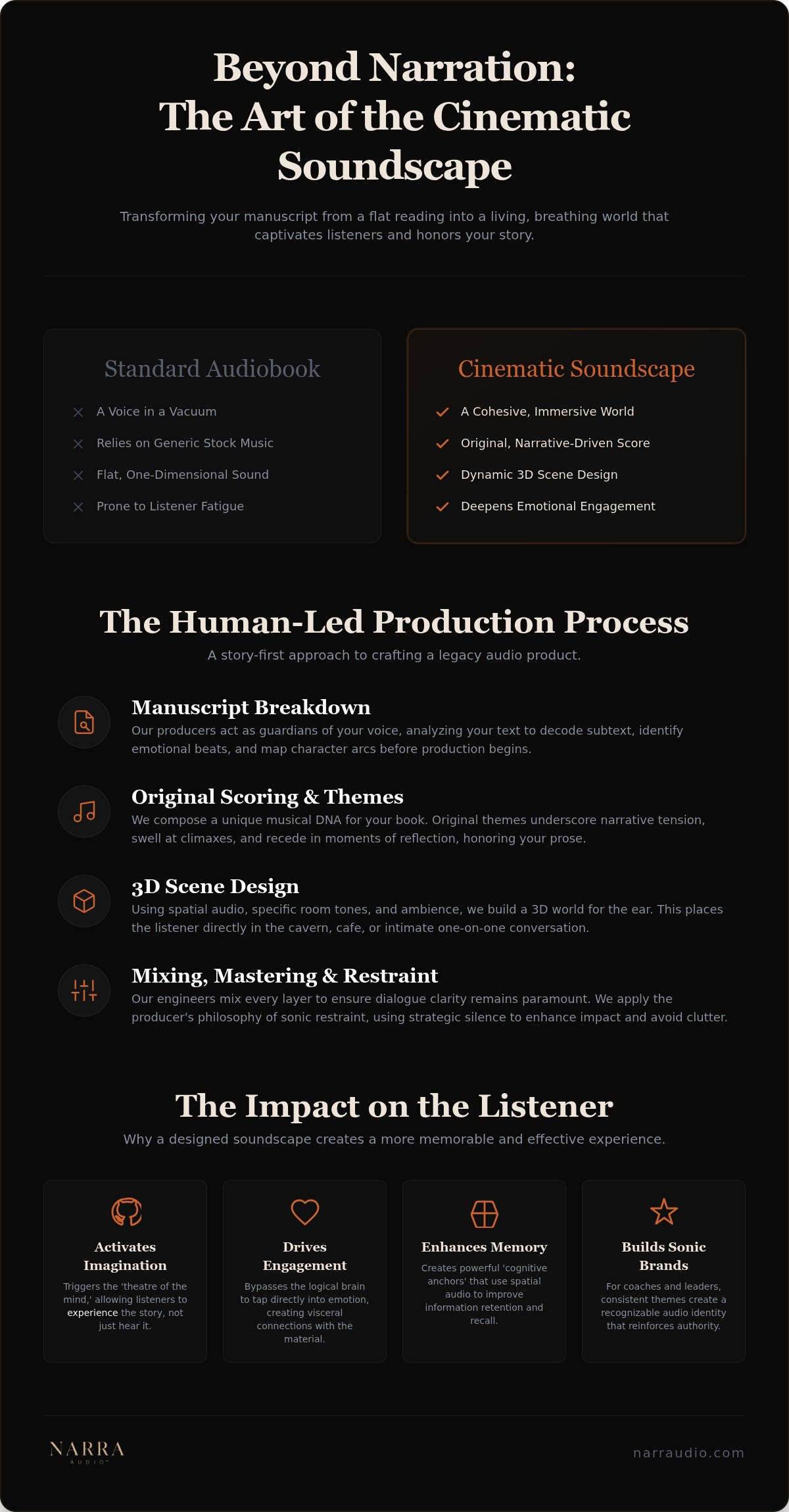
A standard audiobook is often just a voice in a vacuum. A cinematic production, however, is an entire world. When authors explore What is a soundscape?, they often discover it is far more than a collection of sound effects. It is a cohesive sonic environment designed to mirror the specific atmosphere of a manuscript. Integrating cinematic soundscapes for narrative audio ensures your work isn't just heard; it's felt. These soundscapes act as a bridge, connecting your written vision to the listener's imagination through emotional intelligence and intentional direction.
We don't just add noise to fill space. We use sound to decode the subtext of your story. If a scene takes place in a crowded cafe, we don't just play a loop of clinking cups. We design the space to reflect the character's internal state. Is the noise overwhelming or a distant hum? This level of detail requires a producer who understands pacing and chapter arcs, ensuring the audio never distracts from your voice. It's about creating a 'legacy' quality production that matches the years of effort you put into your writing.
The Difference Between Background Music and Scoring
Most DIY apps and cheap marketplaces rely on stock music libraries. These tracks loop mindlessly, often clashing with the emotional shifts in your writing. Original scoring is different. It follows the narrative tension of each chapter. Our composers create original themes that act as a musical DNA for your book. This human-led approach ensures the music swells during a climax and recedes during a moment of reflection. It builds a level of listener trust that automated tools simply cannot replicate. You aren't just buying music; you're investing in a score that honors your prose.
Scene Design: Building a 3D World for the Ear
High-end audio production uses spatial audio and binaural techniques to place the listener in the center of the action. We call this scene design. It involves more than just sound effects; it's about the "air" in the recording. We use specific room tone and ambience to create a 3D world for the ear. In fiction, this might be the subtle echo of a cavern. In non-fiction, it might be a clean, intimate resonance that makes the author feel like a mentor sitting across the table. Every layer depends on a clean technical foundation and expert mixing to ensure dialogue clarity remains the priority.
The Psychology of Immersive Sound: Why Soundscapes Matter
Sound is a visceral experience that bypasses the logical brain to tap directly into emotion. When an author chooses cinematic soundscapes for narrative audio, they're doing more than decorating a file. They're creating a cognitive anchor. Unlike a standard read, which requires constant mental effort to visualize, a designed soundscape triggers the "theatre of the mind" instantly. It allows the listener to stop working and start experiencing. This transition is why immersive audiobooks are often more memorable than their flat counterparts.
Recent research on temporal aspects of sound perception shows that spatial audio affects how we retain information. By placing sounds in a 3D space, we mimic real-world environments, which helps the brain organize and store what it hears. For coaches and thought leaders, this isn't just about entertainment. It's about sonic branding. Using consistent themes creates a recognizable identity that reinforces your authority every time a listener hits play. If you're curious about how this feels in practice, you can hear a sample of our immersive work.
Emotional Resonance and the Listener's Journey
We use specific frequencies and tones to signal shifts in your narrative mood. In a motivational memoir, a subtle crescendo can turn a pivotal realization into a triumphant moment for the listener. By anchoring key concepts with specific musical stings or themes, you ensure your audience remembers the core pillars of your message. This layering doesn't just entertain; it guides the listener through the emotional landscape of your writing with precision and intent.
Combating Listener Fatigue with Dynamic Range
Long-form audio can be taxing. Without variation, the brain begins to tune out. Cinematic soundscapes for narrative audio provide necessary "sonic breaks" that reset the listener's attention span. We maintain engagement through dynamic range and precise broadcast-loudness mastering. This technical rigor ensures clarity without causing ear strain during a ten-hour listen. While the soundscape builds the world, the foundation remains the performance. You can explore our Professional Narration Services for Audiobooks to see how human craft sets the stage for these immersive elements.
Core Elements of a Professional Narrative Soundscape
Every elite production starts with a comprehensive manuscript breakdown. This is where we map out the emotional beats of your story before the narrator even steps into the booth. Sound designers strategically use audio to guide audience attention. For a book, this means highlighting the subtext of your prose without distracting from the words. Cinematic soundscapes for narrative audio rely on high-fidelity foley and ambience to provide texture. However, the mix must be handled with precision. Dialogue clarity is our primary focus. We ensure the voice is never buried under the weight of the production, keeping your message front and center.
Cue Placement and Narrative Pacing
Spotting is the art of deciding exactly where a sound should enter and exit. It requires a deep understanding of narrative pacing and performance direction. We align every audio cue with the narrator's performance, matching the rhythm of their speech and the timing of their breath. This creates a seamless flow that feels organic. A fast-paced thriller might use aggressive, percussive transitions to maintain momentum. Conversely, a meditative business book or a philosophical course requires a gentler touch. We use audio stings to bridge chapters, ensuring the transition feels like a natural evolution of the thought rather than a technical interruption.
Sound Design vs. Sound Effects
Many authors fear that adding sound will make their book feel like a cartoon. This happens when producers rely on literal sound effects, like the clattering of dishes or the literal sound of a car engine. Professional design is often more abstract and sophisticated. We use sound to convey internal emotional states or the specific weight of a silence. By developing original themes, we create a unique musical DNA that belongs only to your work. This level of customization is the core of the cinematic scoring for audiobooks experience. It transforms the project from a simple recording into a realized piece of media that respects your writing. Using cinematic soundscapes for narrative audio ensures that every sonic choice is made with artistic intent, moving the story forward with emotional intelligence.
The Producer’s Philosophy: The Power of Sonic Restraint
A common concern among serious authors is whether a complex production will overwhelm the listener. They worry the sound will compete with their words. Our philosophy centers on sonic restraint. We believe that cinematic soundscapes for narrative audio should serve the story, not distract from it. Silence is often the most powerful tool in a producer's kit. It provides the breathing room necessary for a pivotal concept to sink in. By using a story-first approach, we only add elements that genuinely elevate the text.
We avoid the trap of "mickey-mousing," which is the amateur tendency to over-illustrate every single word with a corresponding sound effect. If your prose describes a character's internal anxiety, we don't need the literal sound of a racing heart. Instead, we might use a subtle, low-frequency shift in the room tone to create a sense of unease. This level of nuance ensures the production feels like a cohesive piece of art rather than a collection of sound clips. If you want to discuss the right balance for your manuscript, you can book a complimentary Vision Call with our team.
When Music Improves the Story (and When it Doesn't)
Music is most effective when it signals transitions or marks pivotal emotional shifts. We use original themes for intros and outros to establish the book's specific world. However, technical non-fiction often benefits from more subtle, atmospheric textures. The goal is to support the author's expertise, not turn the book into a radio play. A creative director guides the density of the soundscape, ensuring that the audio remains a supportive foundation. We know when to let the performance stand on its own and when a score can deepen the impact.
Maintaining Professionalism and Authority
There is a thin line between a gimmicky production and a premium one. Gimmicks rely on cheap, repetitive loops that break the listener's immersion. A premium production uses original themes to build authority and consistent identity. You can explore the nuances of this process in our 2026 Guide: Cinematic Music Scoring. By focusing on restraint and high-end composition, we ensure that the cinematic elements never overshadow your expertise. The final result is a legacy production that feels as realized and professional as the writing itself.
The NARRA Approach: Human-Led Cinematic Production
You've written the book. Now, it's time to build the world. At NARRA, we don't believe in generic templates or automated shortcuts. Our process is led by creative directors Mark Rhodes and Vikiffes, who craft the original sonic architecture for every project. By integrating cinematic soundscapes for narrative audio, we transform your manuscript into a high-stakes media asset. This isn't just about reading words. It's about professional direction, intentional scoring, and an artistic reverence for your prose.
We handle the entire production burden from start to finish. You provide the manuscript, and we deliver distribution-ready files. Our "Cinematic Experience" package represents the elite tier of audio production, involving full original scores and advanced sound design. We utilize Los Angeles studios that are the preferred rooms for Grammy-winning music and Academy Award-winning film. This ensures your work carries a legacy quality that matches the years of effort you put into your writing. It's a partnership where your vision remains the North Star.
Your Voice, Produced Like a Film
We offer flexible paths for narration that prioritize your intent. For authors who want to hear their own voice as the narrator, we provide a guided, optional 47-minute voice capture foundation. This remains under strict human creative direction to ensure the pacing and performance direction are perfect. For fiction or multi-perspective memoirs, we utilize ensemble casting to bring characters to life with professional clarity. You can choose between our Signature System for focused narration or the full "Cinematic Experience" for complete immersion.
The Vision Call: Starting Your Creative Partnership
Every project begins with a human conversation. We don't rely on algorithms to decide the tone of your story. During your Vision Call, we discuss your goals and the emotional DNA of your book. We look at chapter arcs, cue placement, and the specific ambience required to ground your listeners. Once production begins, our turnaround for the Cinematic Experience is approximately 2 weeks. Final delivery includes more than just the audiobook files. We provide launch assets, trailers, and social clips to ensure your work reaches its audience with impact. You can learn more About our story-first process and how we act as the guardian of your creative voice.
Realizing the Full Potential of Your Story
Your manuscript deserves more than a standard reading. It deserves a legacy. We've explored how cinematic soundscapes for narrative audio act as a secondary narrator, using original themes and intentional scene design to pull listeners into your world. By embracing sonic restraint and professional manuscript breakdowns, you ensure your voice remains the focal point while the production builds an immersive atmosphere. This is the difference between a generic audio file and a premium media asset that resonates for years.
NARRA provides a complete, human-led production team in Los Angeles, utilizing the same professional rooms as world-class film and music creators. We handle the entire technical burden so you can focus on your creative vision. Our real composers and sound designers are ready to translate your written word into a lasting auditory experience that honors your prose. You've done the hard work of writing the book. Now, it's time to give it the cinematic life it requires. Book a complimentary Vision Call to discuss your cinematic soundscape and discover how our story-first process elevates your work. Let's create something that stays with your audience long after the final chapter ends.
Frequently Asked Questions
What exactly is a cinematic soundscape in the context of an audiobook?
A cinematic soundscape is a cohesive sonic environment designed to mirror the specific atmosphere of your manuscript. Unlike standard narration, it uses original themes, foley, and spatial audio to build a three-dimensional world for the listener. Integrating cinematic soundscapes for narrative audio transforms the work into a high-stakes media asset. It's about world-building for the ear, ensuring every pulse of tension is felt through intentional sound design and professional direction from our studios in Los Angeles and London.
Will adding music and sound effects distract my listeners from the book's content?
Not when handled with professional restraint and a story-first philosophy. We prioritize dialogue clarity above all else, ensuring your voice remains the primary focus of the mix. Cinematic soundscapes for narrative audio should support the prose, not compete with it. We avoid over-illustrating every word, instead using subtle textures and original themes to anchor key concepts. This level of nuance creates a sophisticated, premium production that deepens listener engagement without causing distraction or ear strain.
Do I need to hire a separate composer for my cinematic audiobook?
No, you don't need to manage multiple contractors. NARRA is a complete production team that includes real composers and sound designers like founder Mark Rhodes and sonic architect Vikiffes. We handle the entire creative burden, including original composition and cinematic scoring. Our work is produced in Los Angeles studios used by Grammy-winning music and Academy Award-winning film. This integrated approach ensures the music is perfectly aligned with your narrative pacing, resulting in a professional final product.
How much does cinematic sound design cost for a standard-length book?
Our Cinematic Experience package typically ranges from $12,000 to $30,000 or more, depending on the complexity of the project. This premium tier includes a full original score, ensemble casting, and advanced scene design. For authors seeking a different level of immersion, our Signature System ranges from $6,000 to $10,000. Every project begins with a complimentary Vision Call to determine the exact scope and architectural needs required to bring your manuscript to life with professional care.
Can I use my own voice for a cinematic production, or do I need a pro narrator?
You have the choice to use your own voice or cast a professional narrator. For authors who want to narrate their own work, we offer a guided 47-minute voice capture foundation priced between $500 and $1,500. This session remains under strict human creative direction to ensure the performance matches the cinematic quality of the production. We also provide ensemble casting options for fiction or multi-perspective memoirs to bring your characters to life with professional clarity.
How long does it take to produce a fully scored cinematic audiobook?
A fully scored Cinematic Experience production generally takes about two weeks to complete. If your project requires a faster turnaround, we offer an expedited 10-day option. This timeline covers everything from manuscript intake and recording to original composition, mixing, and mastering. We move through these production stages with methodical precision, ensuring the final, distribution-ready files meet the high-end standards of major platforms while maintaining your creative intent and the author's unique voice.
What is the difference between NARRA’s Signature System and the Cinematic Experience?
The Signature System, priced between $6,000 and $10,000, includes a custom intro and outro score with selected chapter music and an audiobook trailer. The Cinematic Experience, ranging from $12,000 to $30,000+, is our most immersive offering. It adds a full original score for the entire book, advanced cinematic sound design, and ensemble casting. While both provide distribution-ready files, the Cinematic Experience offers an expanded launch suite and deeper sonic architecture for a truly film-like listening result.
Frequently Asked Questions
A cinematic soundscape is a cohesive sonic environment designed to mirror the specific atmosphere of your manuscript. Unlike standard narration, it uses original themes, foley, and spatial audio to build a three-dimensional world for the listener. Integrating cinematic soundscapes for narrative audio transforms the work into a high-stakes media asset. It's about world-building for the ear, ensuring every pulse of tension is felt through intentional sound design and professional direction from our studios in Los Angeles and London.
Not when handled with professional restraint and a story-first philosophy. We prioritize dialogue clarity above all else, ensuring your voice remains the primary focus of the mix. Cinematic soundscapes for narrative audio should support the prose, not compete with it. We avoid over-illustrating every word, instead using subtle textures and original themes to anchor key concepts. This level of nuance creates a sophisticated, premium production that deepens listener engagement without causing distraction or ear strain.
No, you don't need to manage multiple contractors. NARRA is a complete production team that includes real composers and sound designers like founder Mark Rhodes and sonic architect Vikiffes. We handle the entire creative burden, including original composition and cinematic scoring. Our work is produced in Los Angeles studios used by Grammy-winning music and Academy Award-winning film. This integrated approach ensures the music is perfectly aligned with your narrative pacing, resulting in a professional final product.
Our Cinematic Experience package typically ranges from $12,000 to $30,000 or more, depending on the complexity of the project. This premium tier includes a full original score, ensemble casting, and advanced scene design. For authors seeking a different level of immersion, our Signature System ranges from $6,000 to $10,000. Every project begins with a complimentary Vision Call to determine the exact scope and architectural needs required to bring your manuscript to life with professional care.
You have the choice to use your own voice or cast a professional narrator. For authors who want to narrate their own work, we offer a guided 47-minute voice capture foundation priced between $500 and $1,500. This session remains under strict human creative direction to ensure the performance matches the cinematic quality of the production. We also provide ensemble casting options for fiction or multi-perspective memoirs to bring your characters to life with professional clarity.
A fully scored Cinematic Experience production generally takes about two weeks to complete. If your project requires a faster turnaround, we offer an expedited 10-day option. This timeline covers everything from manuscript intake and recording to original composition, mixing, and mastering. We move through these production stages with methodical precision, ensuring the final, distribution-ready files meet the high-end standards of major platforms while maintaining your creative intent and the author's unique voice.
The Signature System, priced between $6,000 and $10,000, includes a custom intro and outro score with selected chapter music and an audiobook trailer. The Cinematic Experience, ranging from $12,000 to $30,000+, is our most immersive offering. It adds a full original score for the entire book, advanced cinematic sound design, and ensemble casting. While both provide distribution-ready files, the Cinematic Experience offers an expanded launch suite and deeper sonic architecture for a truly film-like listening result.