2026 Guide: Cinematic Music Scoring for Audiobooks
A great manuscript deserves more than a clean recording; it requires a narrative architecture that protects your legacy. While many authors worry that custom music composition for audiobooks might distract the listener or feel like "over-producing," the reality is that silence can be a missed opportunity for emotional depth. You want your work to stand out in a global market projected to hit $14.15 billion this year, yet the technical burden of audio engineering and the confusion between stock licenses and bespoke scores often stall the creative process.
We understand that your primary goal is a cinematic listening experience comparable to high-end film without the headache of managing a complex production. This 2026 guide explores how bespoke musical scores transform standard narration into a prestigious brand asset that captivates listeners. We'll break down the mandatory shift in Audible's royalty models and explain how professional cue placement and original themes keep your audience engaged. From manuscript breakdown to the final master, you'll discover a streamlined path to producing a sophisticated, human-led audio experience that honors your original vision and elevates your professional standing.
Key Takeaways
- Understand why 2026 listeners expect cinematic audio and how original scores protect your narrative legacy by moving beyond dry narration.
- Learn how custom music composition for audiobooks uses original themes and motifs to create a unique "sonic signature" for your protagonists and ideas.
- Discover the latest production trends, including the rise of "Hybrid Memoirs" and full orchestral scores for immersive fantasy and sci-fi.
- Master the collaborative process of manuscript breakdown and cue placement to ensure music enhances emotional beats without overwhelming the performance.
- Explore how a professional Los Angeles studio handles the entire production burden, from original composition to final distribution on major platforms.
Beyond the Spoken Word: Why Custom Music is the New Standard for Premium Audiobooks
Your manuscript represents years of solitary effort. Transitioning that work into the public sphere requires a production that reflects its inherent value. In 2026, the audiobook market has matured; listeners are no longer satisfied with a dry read. They expect a cinematic experience that respects their time and attention. Custom music composition for audiobooks serves as the bridge between your private creative process and the listener's immersive reality. This level of production signals prestige. It tells the audience that this work is significant, a legacy piece worthy of a full-scale production that rivals a feature film.
The psychological impact of a bespoke score is profound. Music isn't just a background element; it's a mnemonic anchor. It aids memory retention and deepens the emotional connection to your message. When a listener hears a specific theme associated with your core thesis or a protagonist's journey, it reinforces the narrative arc. This shift from "narration only" to "cinematic audio" is now the standard for authors who want to protect their intellectual property and stand out in a crowded marketplace.
The Limitations of Stock Music and AI Loops
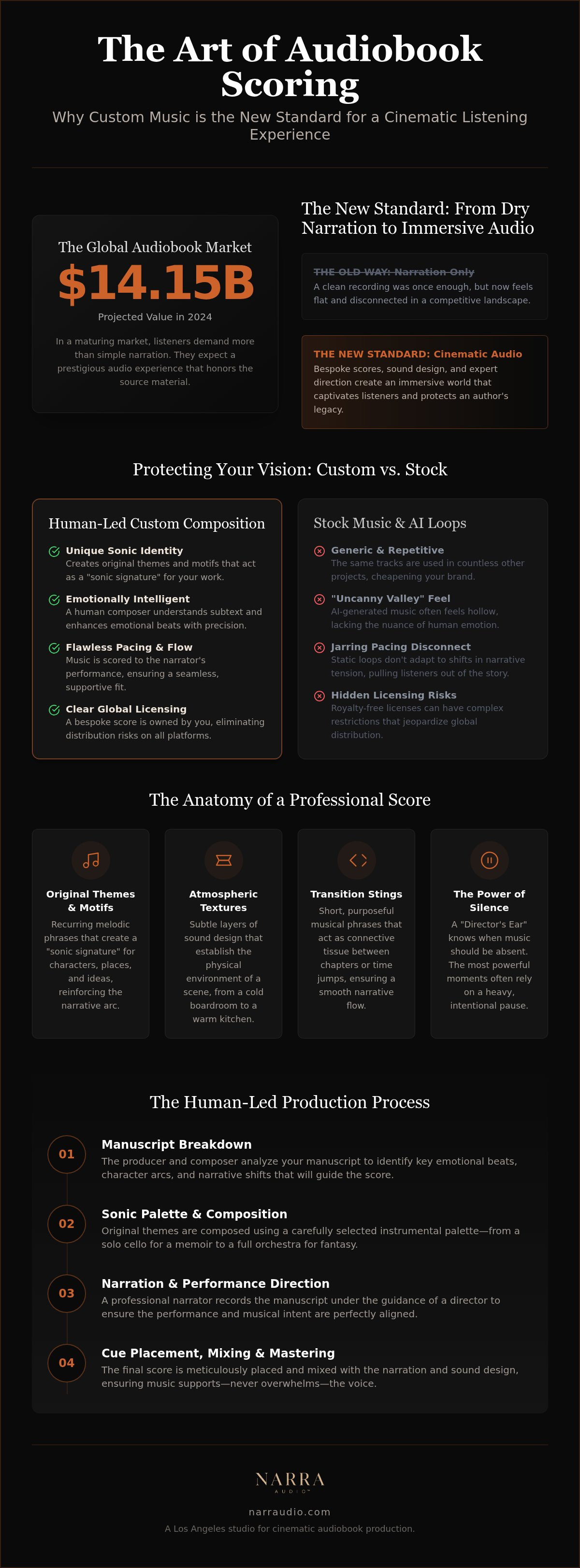
Generic loops often struggle to match the specific pacing of a professional human narrator. When a scene shifts from tension to relief, a stock track keeps looping, creating a jarring disconnect that pulls the listener out of the story. There's also the "uncanny valley" of AI-generated music. While efficient, automation lacks the emotional intelligence needed to understand subtext. It feels hollow or repetitive. Beyond the creative risks, licensing can be a nightmare. Global distribution requires clear rights; standard royalty-free libraries often hide risks that can complicate your distribution to platforms like Audible and Spotify. Human-led composition ensures your score is as unique as your voice.
Cinematic Scoring vs. Background Music
A professional producer uses a "Director's Ear" to view your book as a comprehensive sonic landscape. This involves understanding the role of silence just as much as the music. Sometimes, the most powerful moment in a chapter is the heavy pause after a revelation, not a swelling orchestra. We often look at dramatized versions of the printed book as a benchmark for what's possible when music, sound design, and performance merge into a single vision. Cinematic scoring is a narrative tool that drives the story forward, not a decorative add-on meant to sit behind the voice. It requires an expert hand to ensure the music supports the narrator's performance rather than competing with it.
The Anatomy of a Custom Score: How Original Themes Enhance Narrative Arcs
A custom score is the invisible architecture of your story. While generic music libraries offer static tracks that loop indifferently, custom music composition for audiobooks allows for the creation of character and conceptual motifs. These are recurring melodic "sonic signatures" that identify a specific protagonist or a central idea. When a listener hears a specific arrangement of strings as a character enters a scene, it triggers an immediate emotional response. This level of detail creates a cohesive identity for your work, ensuring the audio version feels like a singular, intentional piece of art rather than a patchwork of stock sounds.
Atmospheric textures and sound design work in tandem with these themes to build a world for the listener. By layering subtle ambient tones beneath the music, a producer can establish the physical environment of a scene, whether it's the cold echo of a boardroom or the warm bustle of a kitchen. Transition stings are equally vital; they act as the connective tissue that moves the listener between chapters or across time jumps. These short, purposeful musical phrases ensure the narrative flow remains unbroken, guiding the audience through the book's structure with professional grace.
Developing a Unique Sonic Identity
A composer's first task is translating your written "voice" into a musical palette. This involves choosing instruments that act as metaphors for your message. A solo cello might be selected to provide gravitas and emotional weight to a memoir, while sharp, rhythmic synths could signal innovation in a business text. The goal is to ensure the score supports the high-end audiobook narration without ever competing for the listener's attention. It's a delicate balance that requires human ears to master.
The Evolution of the Theme
Themes shouldn't remain static; they should grow alongside your narrative. A theme introduced in the first chapter might return in the climax, but with increased intensity or a shift in instrumentation to reflect the character's growth. Achieving this requires technical precision during the mix. We use techniques like "frequency carving" and "ducking" to ensure the music stays out of the way of the voice. For example, a subtle shift in key can signal a major narrative revelation without the narrator having to over-perform the moment. If you're curious about how these motifs might apply to your specific project, you can explore our approach during a Vision Call.
Trends in Audiobook Scoring: From Minimalist Non-Fiction to Orchestral Fiction
The 2026 audiobook market is no longer a monolith of single-voice narration. As the global market expands toward a projected $14.15 billion, the competition for listener retention has intensified. One of the most significant shifts is the "Podcast Influence." Audiences have spent years consuming high-production investigative journalism and audio dramas. They now expect that same level of sonic sophistication in their books. For authors, this means custom music composition for audiobooks is no longer a luxury reserved for celebrities. It's a baseline requirement for anyone serious about their brand prestige and listener engagement.
Sonic Branding for Business and Self-Help Authors
In the non-fiction space, we're seeing the rise of "Modular Scoring." This approach uses music as a functional guide rather than just an atmosphere. Your audiobook intro serves as your brand's "audio logo," establishing immediate authority. Within the chapters, specific musical cues can signal "Action Steps" or "Key Lessons," helping the listener categorize information. This creates a consistent sonic identity that carries over into your courses and podcasts. By using music to highlight frameworks, you ensure your intellectual property is both recognizable and easy to consume. It's about building a professional ecosystem where the sound of your brand is as distinct as the words on the page.
Immersive Soundscapes in Memoir and Narrative Fiction
Fiction and memoirs are pushing boundaries with "Hybrid Memoirs" and full orchestral scores. For fantasy and sci-fi, authors are moving toward ensemble casts supported by cinematic arrangements that rival film scores. In memoirs, the trend involves integrating "found sound" into the musical score for a layer of raw authenticity. Imagine a scene in a childhood home where the faint, rhythmic creak of a porch swing is woven directly into a string arrangement. This level of cinematic audiobook production utilizes spatial audio to place the listener inside the story. Modern thrillers are also evolving, trading tired clichés for bespoke, unsettling textures that keep the audience on edge. These immersive soundscapes transform a simple reading into a visceral event. It ensures your narrative legacy is preserved in a format that feels high-end and deeply personal.
Collaborating with a Composer: The Manuscript Breakdown and Cue Placement Process
The transition from a written manuscript to a cinematic audio experience requires more than just a talented narrator. It demands a deliberate creative alignment. The process begins with a Vision Call, where the composer and producer dive deep into your intent as an author. This isn't a generic briefing. It's a high-level creative session designed to capture the nuance of your voice and the stakes of your message. We treat your book like a film script, identifying the subtext that music can amplify without saying a word.
Through custom music composition for audiobooks, we identify the exact moments where the score should breathe life into the text. This isn't about filling silence. It's about strategic placement. You'll participate in a feedback loop where you review musical drafts, ensuring the tone matches your vision perfectly before the final mix begins. This collaborative approach ensures that the music feels like an extension of your writing, not an external addition.
Identifying the Emotional Cues
A "cue" is a specific production marker where music enters, shifts, or fades. During the manuscript breakdown, we look for emotional pivot points. Does a chapter end on a cliffhanger? Does a memoir move into a moment of quiet reflection? We distinguish between "Wall-to-Wall" scoring, which provides a continuous cinematic backdrop, and "Spot Scoring," where music is used selectively for maximum impact. Central to this is the "Anchor Theme," a core musical signature that grounds the entire project. This theme provides a consistent emotional thread, evolving as the listener moves from the introduction to the climax.
The Role of the Producer in Scoring
The producer acts as the essential bridge between your words and the composer's notes. While the composer focuses on the melody, the producer ensures the music never overshadows the narration. This involves managing the technical delivery, including frequency carving to maintain dialogue clarity and ensuring the final mix meets Audible and Spotify delivery specifications. Managing the timeline is also critical. A human-led professional audiobook production typically integrates this scoring process within a one to two week window, ensuring that the added complexity doesn't delay your launch. We handle the heavy lifting of audio engineering and distribution, allowing you to focus on your next project. If you're ready to see how your manuscript could sound with a bespoke score, we invite you to book a Vision Call to discuss your project's potential.
Elevating Your Legacy: The NARRA Approach to Cinematic Audiobook Production
Your book is more than a collection of chapters; it's a significant piece of intellectual property that deserves a production reflecting its value. At NARRA, we view the audiobook as a premier media asset. Our approach moves beyond simple narration to provide a full-scale cinematic experience. By integrating custom music composition for audiobooks, we ensure your work carries the same emotional weight and professional polish as a high-end film. This isn't a generic service; it's a partnership where we handle the entire production burden from creative direction to final distribution on platforms like Spotify and Audible.
We operate out of Los Angeles studios used by Grammy winning music and Academy Award winning film professionals. This pedigree ensures that every note of your score and every second of narration meets elite industry standards. For authors seeking a sophisticated entry into this world, our Signature System provides custom intro and outro themes that establish immediate brand authority. For those ready for a complete transformation, our Cinematic Experience package offers a full original score and advanced layering. These assets don't stop at the book. You can extend your original score into book trailers, social media assets, and even online course production to create a unified sonic brand.
Human-Led Craftsmanship vs. Automated Solutions
Software and AI tools lack the emotional intelligence required to understand the subtext of a human life or a complex argument. Our composers and producers act as guardians of your voice, ensuring the final output is the most realized version of your original intent. We utilize our 47-minute foundation for optional voice capture, but it remains a human-led process under strict creative direction. This commitment to technical precision and production care is what separates a NARRA production from a generic app. We prioritize the human element of performance over mechanical alternatives, focusing on the nuance that only an experienced producer can capture.
Your Next Steps with NARRA
Transitioning from a manuscript to a distribution-ready masterpiece shouldn't be a technical burden for the author. Our team manages the complexity of sound design, original composition, and mastering within a predictable timeline, typically ranging from one to two weeks depending on the complexity of the score. The first step is determining which scoring package aligns with your vision and budget. Our full cinematic scores typically range from $12,000 to $30,000+, reflecting the high-touch expertise involved. We invite you to book a complimentary Vision Call with our Los Angeles production team. We'll discuss your project, explore your narrative goals, and determine how to best preserve your legacy through sound.
Securing Your Narrative Legacy Through Sound
The distinction between a standard reading and a cinematic experience is undeniable. Listeners in 2026 don't just want information; they want immersion. By embracing custom music composition for audiobooks, you transform your manuscript into a media asset that rivals high-end film. It's a shift from being heard to being felt. We handle the entire production burden, from the initial manuscript breakdown to final distribution. Our Los Angeles team utilizes the same production standards found in rooms used by Academy Award winning film professionals. Whether you choose the custom themes of our Signature System or the full original score of the Cinematic Experience, your work remains in expert hands.
Your story deserves a soundtrack that honors your intent. It's time to move beyond the limits of stock loops and generic production. We're here to act as the bridge between your private creative process and the public's immersive listening experience. Book a complimentary Vision Call to discuss your cinematic score and discover how a bespoke soundtrack can protect your intellectual property for years to come. We look forward to helping you realize the full potential of your work.
Frequently Asked Questions
Does every audiobook need a custom music score?
Not every project requires a full score. We take a story-first approach, recommending restraint when the narration should stand alone for maximum impact. For business authors in New York or London, a custom intro and outro might be sufficient to establish professional authority. Fiction authors often prefer the immersive depth of a full cinematic score. We determine the ideal level of production during your initial Vision Call.
How much does custom music composition for an audiobook cost?
Pricing depends on the level of production complexity. Our Signature System, which includes custom intro/outro themes and selected chapter music, ranges from $6,000 to $10,000. For a complete custom music composition for audiobooks with a full original score and advanced layering, the Cinematic Experience starts at $12,000 and can exceed $30,000. These rates reflect the high-end craftsmanship provided by our professional Los Angeles composers.
Will the music distract the listener from my narration?
Professional scoring is designed to enhance the voice, not overwhelm it. We utilize technical processes like frequency carving and ducking to ensure the narration remains the primary focus throughout the book. Our producers in Los Angeles have experience working in rooms used by Academy Award winning professionals, ensuring the final mix is balanced perfectly. The goal is to provide a cinematic backdrop that deepens the emotional impact without distracting your audience.
How long does it take to compose an original score for an audiobook?
The timeline for original composition is built into our standard production schedules. A Signature System project usually takes about 10 days. For the more complex Cinematic Experience, the timeline is typically 2 weeks, though we can expedite these projects to 10 days if needed. This efficiency allows authors in San Francisco or Seattle to launch their high-end audio assets without lengthy delays in the production cycle.
Can I use my own music or stock music instead of a custom score?
While stock music is an option, it often creates a disconnect between the music's energy and the narrator's performance. Generic loops lack the emotional intelligence of a human-led score. Custom composition provides a unique sonic identity that protects your narrative legacy. It avoids the licensing headaches often found in royalty-free libraries, providing a bespoke sound that distinguishes your work in a competitive global marketplace.
How do you ensure the music matches the tone of my book?
We ensure tonal alignment through a collaborative manuscript breakdown and a detailed Vision Call. This process identifies the specific emotional cues and narrative arcs where music can amplify your message. By discussing your intent directly with our composers, we translate your written voice into a specific musical palette. This human-led direction ensures the final product feels like a singular, intentional piece of art rather than a generic narration file.
Does NARRA handle the licensing and copyright for the original music?
NARRA handles the entire production burden, including all licensing and rights management for your original scores. We provide distribution-ready files that meet the strict technical specifications for major platforms like Audible and Spotify. Authors in San Diego or Orange County don't need to worry about the technicalities of copyright or audio engineering. Our team ensures that your original music is fully authorized and cleared for use across all distribution channels.
Can the same music be used for my podcast and social media trailers?
Your original score is a versatile brand asset. We frequently extend these compositions into book trailers, social media clips, and podcast assets to ensure a consistent sonic identity. This unified approach is especially valuable for coaches and executives who publish content across multiple platforms. Using the same custom music composition for audiobooks across your media ecosystem reinforces your brand prestige and makes your intellectual property immediately recognizable to your global audience.
Frequently Asked Questions
Not every project requires a full score. We take a story-first approach, recommending restraint when the narration should stand alone for maximum impact. For business authors in New York or London, a custom intro and outro might be sufficient to establish professional authority. Fiction authors often prefer the immersive depth of a full cinematic score. We determine the ideal level of production during your initial Vision Call.
Pricing depends on the level of production complexity. Our Signature System, which includes custom intro/outro themes and selected chapter music, ranges from $6,000 to $10,000. For a complete custom music composition for audiobooks with a full original score and advanced layering, the Cinematic Experience starts at $12,000 and can exceed $30,000. These rates reflect the high-end craftsmanship provided by our professional Los Angeles composers.
Professional scoring is designed to enhance the voice, not overwhelm it. We utilize technical processes like frequency carving and ducking to ensure the narration remains the primary focus throughout the book. Our producers in Los Angeles have experience working in rooms used by Academy Award winning professionals, ensuring the final mix is balanced perfectly. The goal is to provide a cinematic backdrop that deepens the emotional impact without distracting your audience.
The timeline for original composition is built into our standard production schedules. A Signature System project usually takes about 10 days. For the more complex Cinematic Experience, the timeline is typically 2 weeks, though we can expedite these projects to 10 days if needed. This efficiency allows authors in San Francisco or Seattle to launch their high-end audio assets without lengthy delays in the production cycle.
While stock music is an option, it often creates a disconnect between the music's energy and the narrator's performance. Generic loops lack the emotional intelligence of a human-led score. Custom composition provides a unique sonic identity that protects your narrative legacy. It avoids the licensing headaches often found in royalty-free libraries, providing a bespoke sound that distinguishes your work in a competitive global marketplace.
We ensure tonal alignment through a collaborative manuscript breakdown and a detailed Vision Call. This process identifies the specific emotional cues and narrative arcs where music can amplify your message. By discussing your intent directly with our composers, we translate your written voice into a specific musical palette. This human-led direction ensures the final product feels like a singular, intentional piece of art rather than a generic narration file.
NARRA handles the entire production burden, including all licensing and rights management for your original scores. We provide distribution-ready files that meet the strict technical specifications for major platforms like Audible and Spotify. Authors in San Diego or Orange County don't need to worry about the technicalities of copyright or audio engineering. Our team ensures that your original music is fully authorized and cleared for use across all distribution channels.
Your original score is a versatile brand asset. We frequently extend these compositions into book trailers, social media clips, and podcast assets to ensure a consistent sonic identity. This unified approach is especially valuable for coaches and executives who publish content across multiple platforms. Using the same custom music composition for audiobooks across your media ecosystem reinforces your brand prestige and makes your intellectual property immediately recognizable to your global audience.