Cinematic Audiobook vs Standard Narration: Choosing the Right Production Tier for Your Vision
What if the greatest threat to your manuscript's legacy isn't a lack of readers, but a lack of immersion? When weighing the choice between a cinematic audiobook vs standard narration, you aren't just comparing production costs; you're deciding how your story lives in the listener's mind. You've poured years into every sentence. It's natural to fear your work sounding flat or generic once it hits the earbuds of a global audience. In a market projected to reach $35.47 billion by 2030, a "good enough" recording often fades into the background noise of millions of other titles.
We'll help you navigate the technical and psychological nuances of these production tiers so you can stop worrying about listener retention and start building a definitive brand. You'll learn the difference between simple scoring and complex sound design, discover which format suits your specific genre, and see how an elite production partner transforms your text into a sensory experience. It's time to move beyond the solitary world of writing and into the grand, professional reality of high-end media. Let's explore how to elevate your manuscript into a masterpiece.
Key Takeaways
- Distinguish between the clean delivery of standard narration and the multi-layered, immersive world of professional cinematic production.
- Identify which production tier-cinematic audiobook vs standard narration-best serves your specific genre and your audience's expectations for immersion.
- Master the psychology of sound to break the "monotony barrier" and trigger deeper emotional resonance and information retention with your listeners.
- Learn how original cinematic scoring and expert sound design elevate your manuscript from a simple recording into a definitive brand asset.
- Discover how a human-led production process handles complex technical requirements and distribution management to protect your creative vision.
The Evolution of the Listening Experience: Standard vs. Cinematic
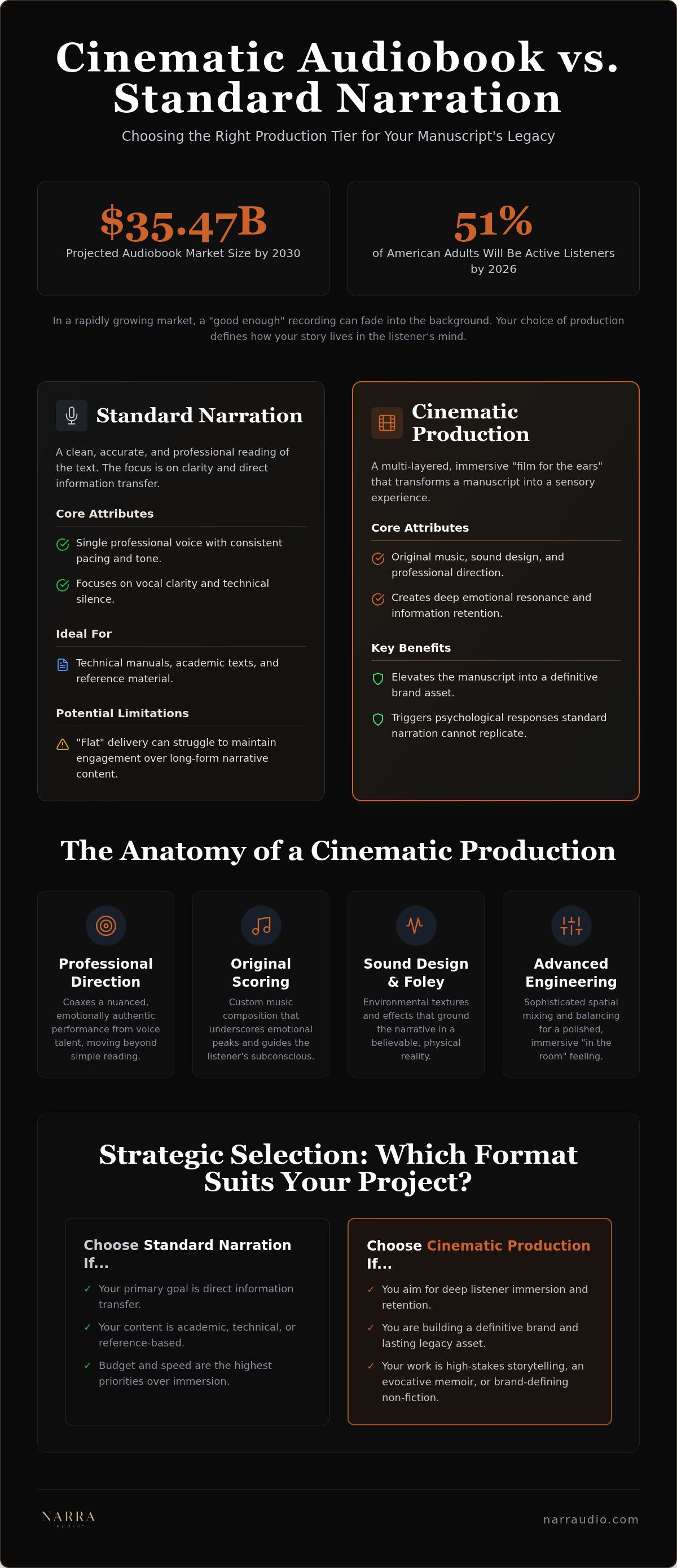
The history of the spoken word is undergoing a radical shift. The evolution of the listening experience has moved from simple vinyl recordings to high-fidelity digital immersion. Today, the choice between a cinematic audiobook vs standard narration is no longer just about budget. It's about the emotional footprint you leave behind. As the audiobook market grows toward a projected $35.47 billion by 2030, listeners are becoming more discerning. They don't just want to hear your words. They want to live inside them.
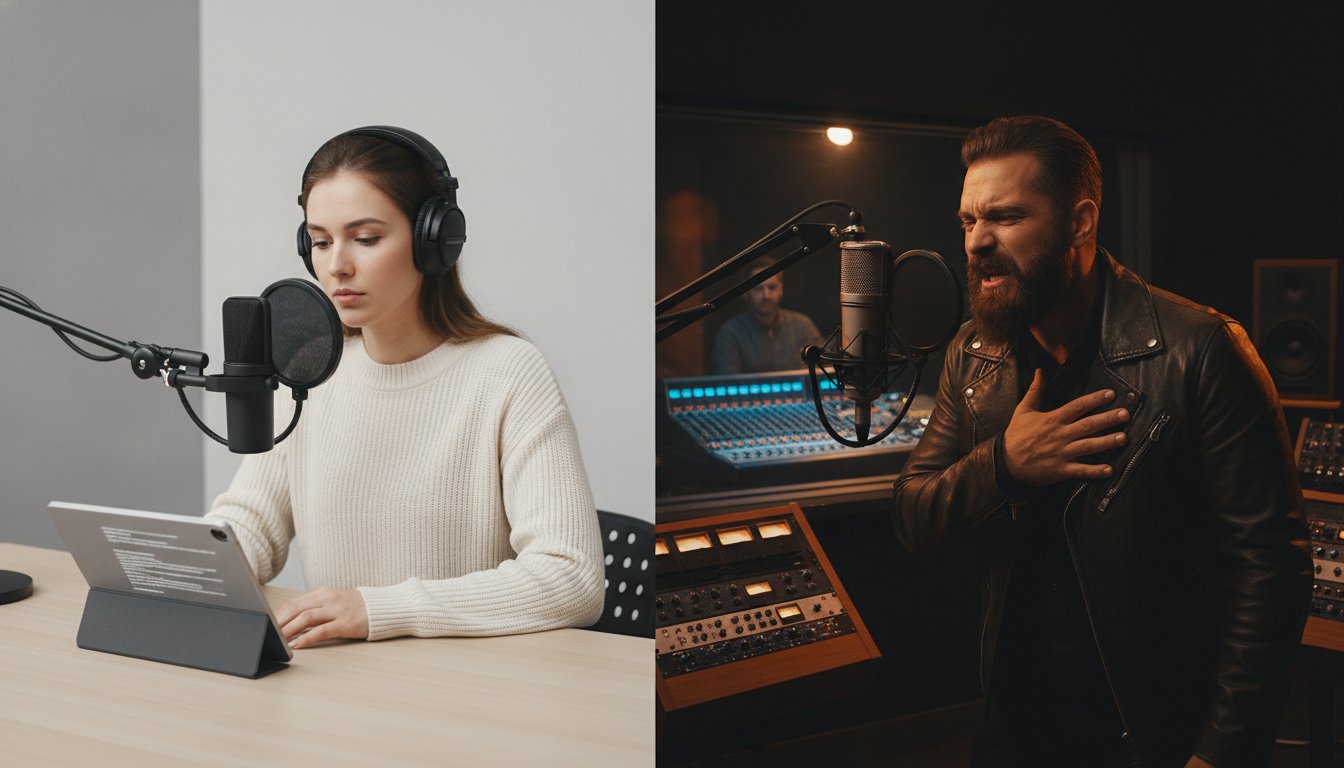
Standard narration has long been the industry baseline. It offers a single professional voice delivering a clean, accurate reading of the text. It's reliable. It's clear. But in a 2026 landscape where 51% of American adults are active listeners, "standard" is quickly becoming the minimum requirement rather than the goal. Cinematic production is the new differentiator. This elite tier involves multi-layered soundscapes, original scoring, and professional direction that transforms a manuscript into a "film for the ears."
The Architecture of Standard Narration
Clarity is the cornerstone here. Standard narration relies on consistent pacing and a steady vocal tone to ensure the listener never misses a word. It's effective. It's efficient. This format remains ideal for technical manuals, academic texts, or straightforward reference material where the primary goal is information transfer. However, the architecture of a standard recording focuses primarily on technical silence and vocal consistency. For high-stakes storytelling or evocative memoirs, this "flat" delivery can struggle to maintain engagement over long-form content. Without the aid of sensory textures, the listener's focus can easily drift.
The Anatomy of a Cinematic Production
True cinematic production is an orchestral feat. It starts with the human element: professional direction that coaxes a nuanced performance from the voice talent. But the real magic lies in the layers. Instead of generic stock tracks, cinematic production utilizes original music and custom scoring designed to underscore emotional peaks. The debate of cinematic audiobook vs standard narration often ends the moment a listener hears a custom-scored sequence. We integrate sound design and environmental textures, known as Foley, to ground the narrative in a physical reality. Whether it's the subtle rustle of a forest or the low hum of a futuristic city, these elements trigger a psychological response that standard narration simply cannot replicate. It isn't just a reading; it's a fully realized vision.
Defining the Cinematic Edge: More Than Just a Voice
While standard narration focuses on the clarity of the spoken word, cinematic production treats your manuscript as a script for a larger sonic experience. The debate of cinematic audiobook vs standard narration often highlights a common misconception: that "cinematic" requires a full cast of twenty actors. It doesn't. It requires a vision that extends beyond the microphone. It's about creating a world where every breath, beat, and silence is intentional. True immersion happens when the audio engineering serves the story, not just the text.
High-end production moves beyond the binary of "on" or "off." It involves spatial mixing and sophisticated frequency balancing to ensure the listener feels present in the narrative. This level of craft adheres to the rigorous industry production standards established by the Audio Publishers Association, ensuring your work sounds polished on everything from high-end home theaters to basic earbuds. If you're looking to move your project from a simple recording to a professional reality, exploring cinematic scoring options can define your brand's unique sound.
Custom Scoring: The NARRA Signature
Original music composition is a safeguard for your intellectual property. Using generic stock tracks risks your book sounding like a thousand others; it dilutes your brand authority and creates a "generic" feel that savvy listeners detect instantly. We believe in matching the musical vibe specifically to the author's voice. This isn't just background noise. Music acts as a structural guide, signaling to the listener's subconscious when to lean in for an emotional peak or when to process a complex idea. It's an elite tier of production that ensures your legacy remains distinct and incomparable.
Professional Soundscapes and Textures
Sound design is the invisible hand of storytelling. We use Foley, the reproduction of everyday sound effects, to anchor listeners in a scene without distracting them from your message. There's a sharp distinction between "sound effects" and "immersive atmospheres." One is often a jarring interruption; the other is a seamless environmental texture that builds a sense of place. For authors seeking the absolute cutting edge, we can implement binaural audio, which is a recording method that uses two microphones to create a 3D stereo sound sensation, mimicking how humans actually hear in real space. This technology transforms the listening experience from a passive activity into a vivid, three-dimensional journey.
The Psychology of Sound: Why Cinematic Scoring Matters for Non-Fiction
A common misconception suggests that immersive production belongs solely to the world of epic fantasy or thrillers. This is a strategic oversight. When comparing a cinematic audiobook vs standard narration for non-fiction, the difference lies in how the brain encodes information. Sound triggers the limbic system, the part of the brain responsible for emotion and long-term memory. By using cinematic elements, you aren't just delivering data. You're engineering an emotional legacy that ensures your message sticks.
High-end production creates a "Masterclass" atmosphere that immediately establishes authority. It breaks the "monotony barrier" that often plagues long-form non-fiction. Even the most compelling narrator can become background noise after an hour of continuous speech. Cinematic scoring provides cognitive resets. Subtle audio cues signal transitions between chapters or key concepts, acting as a structural guide that keeps the listener's focus sharp and engaged.
Emotional Anchoring for Memoirs
Personal stories require a cinematic visionary approach to reach their full potential. A memoir is more than a sequence of events; it's a vulnerable transfer of experience. Music bridges the gap between the written word and the human heart, providing an emotional context that text alone cannot carry. A scored memoir feels authentic and lived-in. It transforms a simple reading into a shared journey, making your story feel like a vivid memory in the listener's own mind. The impact of a scored memoir vs. a standard read is the difference between hearing about a life and feeling it.
Retention and Engagement for Thought Leaders
For thought leaders and educators, production value is a direct reflection of brand authority. If you're selling a high-ticket digital course or a premium script, the audio quality must match the investment. Dynamic production pacing prevents listener fatigue and improves information retention. It's about establishing elite status. When your production value aligns with your high-level insights, you validate the listener's choice to invest in your vision. This approach turns a dry educational text into a professional reality that demands attention.
- Engineering "Aha!" moments through timed musical swells.
- Using environmental textures to ground abstract concepts in reality.
- Matching the sonic aesthetic to your brand's professional identity.
Strategic Selection: Choosing the Format for Your Project
Choosing between a cinematic audiobook vs standard narration isn't a matter of quality; it's a matter of strategic intent. You must evaluate the project's ultimate purpose. Are you providing a tool or an experience? A standard production is a reliable vehicle for information. A cinematic production is a destination in itself. View your audio as a long-term marketing asset. In a crowded digital market, the production tier you select defines your brand authority for years to come.
Consider your listener's environment. Commuters might appreciate the straightforward clarity of a single voice. However, immersive listeners seeking a deep connection with a narrative will find standard readings flat. For those seeking a middle ground, a hybrid approach offers a sophisticated compromise. You can utilize standard narration for the bulk of the text while framing it with cinematic intros and outros to establish immediate prestige. This creates a high-end "Masterclass" feel without requiring a full-scale score for every minute of audio.
When Standard Narration is the Right Choice
Some projects demand a minimalist aesthetic where the voice remains the absolute focus. This format is the gold standard for reference books, dictionaries, and highly technical whitepapers where soundscapes would only distract. It's also the pragmatic choice for projects with extreme turnaround requirements. If you need a rapid recording for a timely news-based script, the simplicity of a single-narrator setup is unbeatable. Precision and speed take precedence here over emotional resonance.
When Cinematic Production is Non-Negotiable
Narrative non-fiction and memoirs thrive in a multi-layered environment. If your goal is to license your work for film or television, a cinematic production acts as a professional proof of concept. It demonstrates the story's visual and emotional potential to producers. High-end masterclasses also require this tier. When student engagement is your primary KPI, you cannot afford the monotony barrier. To ensure your project receives the human-led direction it deserves, book a cinematic production consultation with our master producers today.
- Memoirs and Biographies: Requires emotional anchoring and human connection.
- Creative Non-Fiction: Benefits from atmospheric soundscapes that ground the narrative.
- High-Ticket Courses: Demands production value that matches the premium price point.
- Film/TV Pitch Assets: Uses sound design to showcase the script's cinematic potential.
The NARRA Process: From Manuscript to Immersive Masterpiece
Transitioning from the quiet, solitary world of writing to the grand world of professional media requires more than just a recording booth. It requires a Master Producer. Our process acts as a bridge. We take your raw potential and turn it into a polished, professional reality. With our presence in major creative hubs like Los Angeles, New York, and London, we bring a high-stakes media perspective to every project. This isn't a self-service studio rental where you're left to struggle with technicalities. It's a partnership. We provide time-saving narration options that handle the complexity of project management from the first read to the final file delivery.
Human-Led Artistry vs. AI Automation
In 2026, the market is flooded with AI voice synthesis. It's cheap. It's fast. But it lacks the human element of performance that defines an elite production. When choosing between a cinematic audiobook vs standard narration, you're also choosing between automated efficiency and human-led artistry. AI cannot replicate the subtle quiver of a memoirist's voice or the strategic pause of a thought leader. We avoid AI synthesis because we believe the soul of your work deserves a guardian. Positioning your project as human-led isn't just an ethical choice. It's a premium branding strategy. It signals quality to an audience weary of mechanical alternatives. Precision matters, but emotion sells.
Seamless Publishing and Global Distribution
The final hurdle is the technical reality of the global market. Each platform has its own gatekeepers. We manage these technical requirements for you, ensuring your files meet strict industry standards for Audible, Amazon, and iTunes. This includes maintaining RMS levels between -23dB and -18dB, peak values below -3dB, and a noise floor no higher than -60dB RMS. Whether your vision is a standard reading or a multi-layered masterpiece, your audio must be optimized for everything from high-end systems to mobile devices. We handle the 192kbps MP3 CBR formatting and distribution management so you don't have to. Your legacy is too important to be stalled by a technicality. Book a consultation with our Cinematic Visionaries to start your transformation.
Elevate Your Story into an Immersive Reality
The decision between a cinematic audiobook vs standard narration is the final, most critical choice in your publishing journey. It's the difference between a listener simply hearing your words and a listener truly living your story. You now understand how original cinematic scoring and human-led direction transform a manuscript into a sensory experience that commands authority. Whether you're a thought leader aiming for elite engagement or a memoirist protecting the soul of your narrative, the production tier you select defines your brand's legacy for years to come.
At NARRA, we act as the bridge between your private creative process and a global audience. From our boutique studios in Los Angeles, New York, and London, our master producers ensure every beat and breath serves your vision. We handle the complexity of end-to-end publishing and distribution management so you don't have to. Your work deserves more than a clean reading; it deserves a world built specifically for it.
Transform your manuscript into a cinematic experience and let your voice be heard as it was always intended. Your audience is ready to be immersed.
Frequently Asked Questions
Does cinematic scoring make an audiobook harder to follow?
Professional scoring actually improves clarity by acting as a structural guide for the listener's subconscious. It doesn't distract; it anchors the narrative. By signaling transitions and emotional peaks, these audio cues prevent the mental fatigue often associated with long-form content. It's a precise engineering feat that ensures your message remains the focal point while the atmosphere supports it.
Can I use cinematic production for a business or self-help book?
Cinematic elements are highly effective for non-fiction authors who want to establish an elite "Masterclass" authority. This approach breaks the monotony of technical data and improves information retention. When comparing a cinematic audiobook vs standard narration for business titles, the former creates a premium brand asset that justifies a higher price point for your insights and courses.
How much longer does cinematic production take compared to standard narration?
The production timeline is longer because it involves a multi-layered post-production phase. Standard narration is often a straightforward recording and edit. Cinematic production requires custom musical composition, sound design, and sophisticated spatial mixing. This methodical approach ensures every layer is perfectly balanced, transforming a simple reading into a professional media reality that stands the test of time.
Do I need to hire my own composer for a cinematic audiobook?
You don't need to source outside talent when working with a boutique studio like NARRA. We provide original music composition and cinematic scoring as part of our elite production tier. This ensures the sonic aesthetic is perfectly aligned with your personal voice and creative vision. It's a seamless, end-to-end partnership that protects your brand from the generic feel of stock background tracks.
What is the difference between a full-cast recording and a cinematic production?
A full-cast recording focuses on using multiple actors for different roles, while cinematic production focuses on the immersive environment. You can have a single narrator in a cinematic production that utilizes scoring and soundscapes to create a "film for the ears." While a full cast adds vocal variety, cinematic engineering provides the emotional depth and sensory textures that define a masterpiece.
Is cinematic audio compatible with platforms like Audible and Spotify?
Our productions meet all technical requirements for major distribution platforms, including ACX and Spotify. We ensure every file adheres to strict industry standards, such as 192kbps MP3 CBR formatting and precise RMS levels. Whether you choose a cinematic audiobook vs standard narration, your final work will be optimized for clear playback on everything from high-end home systems to basic mobile earbuds.
Can I upgrade my existing standard audiobook to a cinematic version?
We can transform your existing raw audio files into a fully immersive cinematic experience. If you've already recorded a clean narration, our master producers can layer in original scoring and professional sound design. This is an excellent strategy for authors looking to relaunch a successful title as a premium edition. It breathes new life into your backlist and creates a fresh marketing opportunity.
Do you offer cinematic production for online courses and scripts?
We specialize in voice production for scripts and courses that demand a high-end, professional edge. Standard educational audio can often feel dry or uninspiring for students. By applying cinematic scoring and expert direction, we help you maintain engagement and improve student outcomes. It's about matching your production value to the high-ticket nature of your intellectual property.
Frequently Asked Questions
Professional scoring actually improves clarity by acting as a structural guide for the listener's subconscious. It doesn't distract; it anchors the narrative. By signaling transitions and emotional peaks, these audio cues prevent the mental fatigue often associated with long-form content. It's a precise engineering feat that ensures your message remains the focal point while the atmosphere supports it.
Cinematic elements are highly effective for non-fiction authors who want to establish an elite "Masterclass" authority. This approach breaks the monotony of technical data and improves information retention. When comparing a cinematic audiobook vs standard narration for business titles, the former creates a premium brand asset that justifies a higher price point for your insights and courses.
The production timeline is longer because it involves a multi-layered post-production phase. Standard narration is often a straightforward recording and edit. Cinematic production requires custom musical composition, sound design, and sophisticated spatial mixing. This methodical approach ensures every layer is perfectly balanced, transforming a simple reading into a professional media reality that stands the test of time.
You don't need to source outside talent when working with a boutique studio like NARRA. We provide original music composition and cinematic scoring as part of our elite production tier. This ensures the sonic aesthetic is perfectly aligned with your personal voice and creative vision. It's a seamless, end-to-end partnership that protects your brand from the generic feel of stock background tracks.
A full-cast recording focuses on using multiple actors for different roles, while cinematic production focuses on the immersive environment. You can have a single narrator in a cinematic production that utilizes scoring and soundscapes to create a "film for the ears." While a full cast adds vocal variety, cinematic engineering provides the emotional depth and sensory textures that define a masterpiece.
Our productions meet all technical requirements for major distribution platforms, including ACX and Spotify. We ensure every file adheres to strict industry standards, such as 192kbps MP3 CBR formatting and precise RMS levels. Whether you choose a cinematic audiobook vs standard narration, your final work will be optimized for clear playback on everything from high-end home systems to basic mobile earbuds.
We can transform your existing raw audio files into a fully immersive cinematic experience. If you've already recorded a clean narration, our master producers can layer in original scoring and professional sound design. This is an excellent strategy for authors looking to relaunch a successful title as a premium edition. It breathes new life into your backlist and creates a fresh marketing opportunity.
We specialize in voice production for scripts and courses that demand a high-end, professional edge. Standard educational audio can often feel dry or uninspiring for students. By applying cinematic scoring and expert direction, we help you maintain engagement and improve student outcomes. It's about matching your production value to the high-ticket nature of your intellectual property.