High Quality Script Recording: A Producer's Guide
The most expensive microphone on the market won't save a flat performance or a poorly treated room. Many authors believe that hardware is the primary shortcut to a professional sound, but high quality voice recording for scripts is actually a product of creative direction and acoustic precision. It's the difference between a simple reading and a cinematic experience that resonates with a listener.
You probably know the frustration of capturing a great take only to realize a distant lawnmower or a subtle room echo has ruined the file. Technical confusion over bitrates, mastering, and hardware can quickly drain the joy from your creative process. It's exhausting to act as both the artist and the engineer when you just want your message to be heard with clarity and power. You deserve a process that respects your words rather than burying them in technical hurdles.
This guide provides a professional roadmap to move your project from a raw manuscript to a distribution-ready master. We'll break down the production techniques required to elevate your audio, including performance direction, noise floor management, and the vital role of a master producer. You'll discover how a human-led studio environment transforms a solitary script into a polished, high-fidelity asset that commands attention and preserves your creative vision.
Key Takeaways
- High quality recording is found at the intersection of technical precision and emotional intelligence, ensuring your message carries its intended weight.
- Learn why acoustic treatment and room preparation are more influential than your microphone choice for achieving high quality voice recording for scripts.
- Professional performance direction and intentional pacing are the keys to transforming a raw reading into an immersive, cinematic asset.
- Master the post-production workflow, including multi-track editing and the use of original scoring to create a unique sonic brand for your project.
- Discover how the Signature System handles the entire production burden, allowing you to focus on your vision while professionals manage the technical details.
The Foundation of High Quality Voice Recording for Scripts
High quality voice recording for scripts is more than a technical checkbox; it's the intersection of acoustic precision and emotional intelligence. A raw narration file is merely data. A produced asset, however, is an immersive experience. When you're recording for a high-stakes masterclass or a legacy-defining audiobook, the standards shift. Voice memos or browser-based tools might work for internal notes, but they fail to capture the nuance required for professional distribution. At NARRA, we apply the same rigorous production standards found in our Los Angeles studio to every project, ensuring your voice carries the weight it deserves.
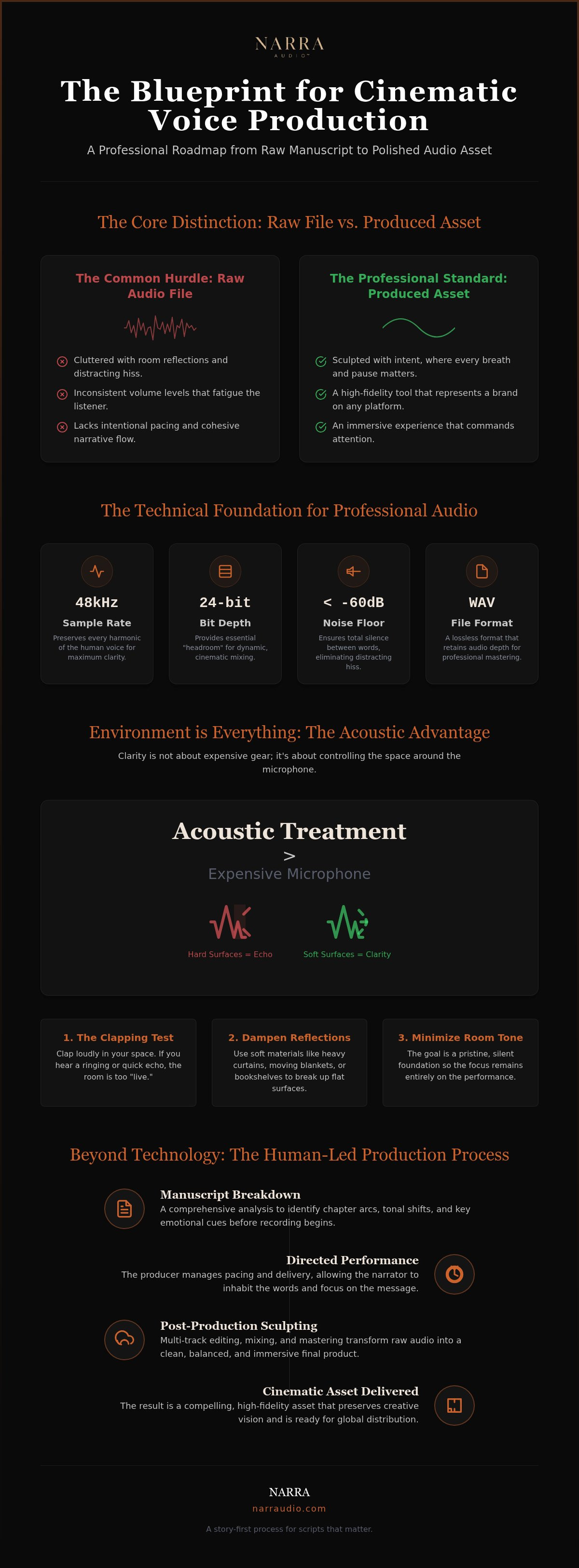
The difference between a "raw file" and a "produced asset" lies in the intent. Raw audio is often cluttered with room reflections, inconsistent volume, and a lack of narrative flow. A produced asset is sculpted. It's the result of a deliberate process where every breath, pause, and inflection is considered. This level of voice production transforms a simple script into a high-fidelity tool that can represent your brand on any global platform.
Technical Standards for Professional Audio
Professional audio requires a specific digital architecture. We record at sample rates of 44.1kHz or 48kHz with a 24-bit depth to ensure every harmonic of the human voice is preserved. This provides the "headroom" necessary for cinematic mixing. The noise floor must remain below -60dB; this ensures total silence between words, removing the distracting hiss that plagues home recordings. We always prioritize WAV files during the production phase. While MP3s are convenient for final delivery, they use lossy compression that strips away the depth needed for professional mastering. By maintaining these high-end specifications, we ensure your audio remains clear and crisp across all playback devices.
The Role of the Producer in Script Recording
A producer acts as the guardian of your vision. Before the microphone even goes live, we conduct a comprehensive manuscript breakdown. This involves identifying chapter arcs, cue placements, and shifts in tone. A self-read often feels flat because the author is focused on the technology rather than the message. A directed performance allows you to inhabit the words while the producer manages the pacing and delivery specifications. Human-led production ensures that the final file isn't just clear; it's compelling. Our story-first process prioritizes the human element, because automation can't understand the emotional weight of a pause or the subtle shift in a transition.
Preparing Your Environment and Hardware for Professional Clarity
A common misconception in audio production is that a premium microphone can compensate for a poor room. In reality, high quality voice recording for scripts depends far more on your acoustic environment than the price tag of your gear. If you record in a space with hard surfaces, your voice will bounce off the walls, creating a "boxy" or "echoey" sound that no amount of post-production can fully fix. Professional clarity isn't about buying the most expensive tools; it's about controlling the air around the microphone.
Creating a Pro-Level Recording Space
You don't need a dedicated vocal booth to achieve professional results, but you do need to manage room reflections. Start with the "clapping test." Stand in your intended recording spot and clap loudly. If you hear a ringing or a quick echo, your room is too "live." You can dampen these reflections by using soft materials like heavy curtains, moving blankets, or even a full bookshelf to break up flat surfaces. The goal is to minimize "room tone," the ambient sound of the space itself, so the focus remains entirely on your performance. At NARRA, we maintain this standard by utilizing Los Angeles studios linked to Academy Award-winning film work, ensuring every recording has a pristine, silent foundation.
Hardware Essentials for Script Narration
When selecting a microphone, you'll generally choose between a condenser and a dynamic mic. Condenser microphones are highly sensitive and excellent for capturing the rich detail of a nuanced script, but they require a very quiet room. Dynamic microphones are more forgiving in untreated spaces and provide a classic, broadcast-style warmth. Regardless of your choice, your signal chain should include a high-quality audio interface and a Preamp to convert your voice into a clean digital signal. To see how these technical elements come together in a professional setting, you can hear our production samples to experience the difference between a home setup and a studio master.
Small tools often prevent the biggest editing headaches. A pop filter is essential to catch "plosives," those harsh "P" and "B" sounds that can clip your audio. A shock mount protects the mic from floor vibrations or desk bumps. You should also use closed-back headphones to monitor your performance in real-time. Hearing yourself exactly as the microphone does allows you to adjust your volume and distance instantly. Be mindful of the "proximity effect," where getting closer to the mic increases the bass in your voice. Finding the right balance ensures your high quality voice recording for scripts feels intimate without becoming muddy.
For authors who prefer a guided approach, we offer a 47-minute voice capture experience. This foundation allows us to gather the necessary vocal data under human creative direction, saving you dozens of hours in the booth while maintaining the integrity of your original performance.
Performance and Direction: Elevating Scripts Beyond Raw Narration
Recording a script is more than reading words aloud; it's an act of translation. You're moving your ideas from the static page into the dynamic world of sound. While some suggest simply recording into a mobile device and editing later, this approach misses the nuance of a directed performance. Achieving high quality voice recording for scripts requires an understanding of narrative energy and listener psychology. It's the producer's job to ensure that the emotional weight of your message isn't lost in the technical process.
Pacing is your most powerful tool for engagement. In educational content, intentional silences allow the listener to process complex information. A rushed delivery can make the most brilliant script feel overwhelming, while a measured pace builds authority. We focus on creating a rhythmic flow that mirrors natural conversation, ensuring your audience stays connected from the first sentence to the final word.
The Anatomy of a Great Vocal Performance
A professional recording session is structured around the manuscript breakdown. This ensures every section of your project receives the attention it deserves. We focus on three critical pillars of performance:
- Managing Chapter Arcs: We ensure the energy at the end of a multi-hour session matches the promise of your introduction. Maintaining consistency is vital for long-form scripts.
- Diction and Dialogue Clarity: Complex technical terms or industry jargon require precise articulation. We guide you through difficult passages to ensure every syllable is clear.
- Strategic Cue Placement: We use subtle vocal shifts to signal transitions, helping the listener follow your logic without needing visual aids.
Vocal fatigue is a real hurdle during long sessions. Your voice is a physical instrument that requires care. We manage this by scheduling regular breaks and monitoring your tone for signs of strain. By pacing the recording process, we preserve the "human-led" warmth that builds trust with your audience. For high-stakes projects where every inflection matters, many authors choose to leverage professional script narration services to ensure their vision is fully realized with cinematic precision.
Overcoming Recording Fears
Many authors feel a sense of "red light fever" the moment the microphone is live. This anxiety often leads to a stiff, robotic delivery. Our role as producers is to remove that burden. We prioritize connection over technical perfection during the initial takes. A small stumble is easily edited, but a lack of genuine emotion is much harder to fix in post-production. We create a supportive environment where you can speak naturally, as if you're addressing a single person rather than a microphone. This shift in perspective transforms the recording from a stressful task into a creative partnership, resulting in a performance that feels both authoritative and accessible.
The Post-Production Workflow: Editing, Mastering, and Delivery
Raw audio is the clay; post-production is the kiln. While basic browser tools offer simple waveform trimming, professional voice production for high ticket courses requires a dedicated multi-track editing workflow. We don't just cut out mistakes. We sculpt the pacing. High quality voice recording for scripts demands the surgical removal of intrusive mouth clicks, harsh sibilance, and inconsistent breaths that pull a listener out of the experience. This technical cleaning creates a transparent canvas where your message can resonate without distraction.
Mastering is the final, essential step that ensures your audio sounds consistent across all playback environments. We target specific broadcast loudness standards, such as the strict -18 to -23 RMS range required by Audible or the -14 LUFS standard for Spotify. Without this technical precision, your audience will constantly struggle with the volume knob. It's the difference between a file that sounds "recorded" and one that feels "produced." High quality voice recording for scripts is only complete when it meets these elite industry benchmarks.
Technical Post-Production Steps
Our engineers apply surgical EQ to remove unwanted room resonances and use multi-stage compression to achieve a warm, authoritative tone. This polished voice isn't an accident. It's the result of a Sonic Architect layering the narration with clinical precision. Every file undergoes a rigorous Quality Control (QC) process to ensure it meets the delivery specifications for major distribution platforms. By the time a file leaves our Los Angeles studio, it is ready for immediate launch. If you want to ensure your audio meets these professional benchmarks, you can book a complimentary Vision Call to discuss your technical requirements.
Adding Cinematic Elements
Sonic branding involves more than just a catchy intro theme. It's about using original music and sound design to reinforce your narrative arc. We believe in the power of restraint. Music should elevate the story, not bury it. When producing immersive non-fiction, we might layer subtle ambience or original themes to ground the listener in a specific setting. These cinematic audiobook production principles ensure your content feels like a high-end media asset rather than a generic lecture. This human-led approach to sound design creates an emotional resonance that automated tools simply cannot replicate.
The NARRA Approach: Cinematic Voice Production for High-Stakes Scripts
The transition from a solitary writer to a professional media creator is often stalled by technical friction. NARRA removes this burden entirely. You provide the manuscript; we manage the creative direction, original scoring, and final distribution. This isn't a narrator marketplace or a DIY app. It's a partnership with a Los Angeles studio built by working professionals who understand the nuance of human storytelling. High quality voice recording for scripts shouldn't feel like a technical chore. It should feel like the ultimate realization of your creative intent.
Our Signature System is designed for high-stakes projects that require more than just clarity. We transform your text into a cinematic asset. For authors who wish to use their own voice but lack the time for multi-week recording sessions, we offer an optional, guided voice capture experience. In just 47 minutes, we capture your unique vocal data under human direction. This allows our team of editors and sound designers to build your project while you remain focused on your next big idea. You don't need to live in a studio to sound like you belong in one.
The Vision Call: Starting Your Professional Audio Journey
The process begins with a complimentary Vision Call. During this session, we analyze your manuscript to determine the most effective production path. We offer tiered options to match the scale of your project. Our Essential package ($3k-$5k) delivers a polished master file in approximately one week. For more complex needs, the Signature package ($6k-$10k) provides a deeper level of production, including original themes, with a turnaround of about 10 days. You can review our full pricing options to find the right fit for your budget and timeline. This roadmap ensures that high quality voice recording for scripts remains efficient, predictable, and premium.
Your Script, Produced Like a Film
We treat your script with the same reverence as a film score. By working with real composers and sound designers in Los Angeles, we ensure your audio has a distinct sonic identity. This legacy-building approach allows you to extend your brand across podcasts, courses, and audiobooks with a consistent, high-end feel. Our story-first process prioritizes the human element of performance over mechanical alternatives. You've already done the heavy lifting by writing the manuscript. NARRA handles the technical weight of bringing it to life, ensuring the final output is the most realized version of your original vision.
Elevate Your Narrative to Cinematic Standards
Transforming a manuscript into a professional audio asset requires more than just a quiet room. It demands the intersection of technical precision and human-led performance direction. You've learned that high quality voice recording for scripts is achieved through a meticulous process of acoustic treatment, manuscript breakdown, and expert mastering. It's the difference between a simple reading and an immersive experience that captures your audience's full attention.
At NARRA, we bring Los Angeles studio standards to your project, leveraging the expertise of professionals who've worked alongside Grammy and Academy Award-winning creators. Our Signature System handles the entire production burden, delivering a distribution-ready master in approximately 10 days. You don't have to navigate the technical complexities of bitrates or sonic branding alone. We act as the guardian of your voice and the architect of your sound, ensuring every inflection carries its intended weight.
Your words deserve a life that resonates with your audience. We're ready to help you move from the solitary world of writing to the grand world of professional media. Book a complimentary Vision Call with NARRA Studio to discuss your project and hear how we can elevate your story. Your vision is the input; a polished, professional reality is the output.
Frequently Asked Questions
How much does high quality voice recording for scripts cost?
Pricing for professional production depends on the depth of the creative services required. NARRA’s Essential package ranges from $3k to $5k, while the Signature package is priced between $6k and $10k. These rates cover the entire production burden, including manuscript breakdown, direction, and mastering. High quality voice recording for scripts is more than a service; it's an investment in a finished asset. We recommend a Vision Call to discuss your specific project goals.
Can I record a professional-sounding script at home?
You can record at home if you prioritize acoustic treatment over hardware. Most professional clarity comes from a room that is "dead" to reflections. Using soft materials like heavy curtains or moving blankets can minimize the boxy sound of a small room. However, achieving a noise floor below -60dB at home is difficult. Most creators find that the technical burden of home recording distracts from the emotional intelligence of their performance.
What is the best microphone for recording scripts?
Microphone choice depends on your recording environment. Condenser microphones are the standard for capturing the rich nuance of a vocal performance in a treated studio. If you're recording in a space with some background noise, a dynamic microphone is often a better choice because it's less sensitive to distant sounds. We focus on matching the right hardware to your specific script type to ensure the raw audio foundation is pristine and ready for post-production.
How long does it take to record and produce a 10,000-word script?
A 10,000-word script generally produces about 80 minutes of finished audio. The recording process typically takes three to four hours to ensure every chapter arc is captured correctly. Once the recording is complete, our production team moves into editing and mastering. Our Essential package offers a turnaround of about one week. For projects requiring original music and cinematic scoring, the Signature package delivers a launch-ready file in approximately 10 days.
What are the technical requirements for Audible and Spotify audio?
Audible requires a noise floor below -60dB and a peak level no higher than -3dB. They also mandate a consistent loudness between -23dB and -18dB RMS. Spotify and other streaming platforms typically target -14 LUFS. Meeting these high quality voice recording for scripts specifications ensures your audio sounds professional on any device. We handle all technical delivery requirements during our mastering phase, so your files are guaranteed to meet every platform's strict standards.
Do I need to hire a professional narrator or can I use my own voice?
Using your own voice is often best for building trust and a human-led connection with your audience. It's particularly effective for coaches, executives, and authors of non-fiction. If the time commitment of recording is a concern, our guided voice capture experience offers a way to gather your vocal data in just 47 minutes. Professional narrators are a better fit for fiction or when you prefer to be completely hands-off during the recording phase.
What is the difference between raw audio and a mastered cinematic file?
Raw audio is the untouched data from the microphone, which often includes mouth clicks, inconsistent pacing, and room echo. A mastered cinematic file is a sculpted asset. It has been through a multi-track editing process where we apply EQ, compression, and noise reduction. We also integrate original music and sound design to create an immersive experience. This transformation ensures the final product feels authoritative and polished, rather than just a simple, unedited reading.
How do I add music to my script recording without it being distracting?
Adding music requires a story-first editorial approach to ensure it doesn't bury the narration. We use frequency-specific ducking to keep the music from competing with your voice. The key is placing musical cues during transitions or pauses to emphasize specific points in the script. Our composers create original themes that match your brand's emotional tone. This creates a cohesive, cinematic feel where the music supports the narrative rather than acting as a distraction.
Frequently Asked Questions
Pricing for professional production depends on the depth of the creative services required. NARRA’s Essential package ranges from $3k to $5k, while the Signature package is priced between $6k and $10k. These rates cover the entire production burden, including manuscript breakdown, direction, and mastering. High quality voice recording for scripts is more than a service; it's an investment in a finished asset. We recommend a Vision Call to discuss your specific project goals.
You can record at home if you prioritize acoustic treatment over hardware. Most professional clarity comes from a room that is "dead" to reflections. Using soft materials like heavy curtains or moving blankets can minimize the boxy sound of a small room. However, achieving a noise floor below -60dB at home is difficult. Most creators find that the technical burden of home recording distracts from the emotional intelligence of their performance.
Microphone choice depends on your recording environment. Condenser microphones are the standard for capturing the rich nuance of a vocal performance in a treated studio. If you're recording in a space with some background noise, a dynamic microphone is often a better choice because it's less sensitive to distant sounds. We focus on matching the right hardware to your specific script type to ensure the raw audio foundation is pristine and ready for post-production.
A 10,000-word script generally produces about 80 minutes of finished audio. The recording process typically takes three to four hours to ensure every chapter arc is captured correctly. Once the recording is complete, our production team moves into editing and mastering. Our Essential package offers a turnaround of about one week. For projects requiring original music and cinematic scoring, the Signature package delivers a launch-ready file in approximately 10 days.
Audible requires a noise floor below -60dB and a peak level no higher than -3dB. They also mandate a consistent loudness between -23dB and -18dB RMS. Spotify and other streaming platforms typically target -14 LUFS. Meeting these high quality voice recording for scripts specifications ensures your audio sounds professional on any device. We handle all technical delivery requirements during our mastering phase, so your files are guaranteed to meet every platform's strict standards.
Using your own voice is often best for building trust and a human-led connection with your audience. It's particularly effective for coaches, executives, and authors of non-fiction. If the time commitment of recording is a concern, our guided voice capture experience offers a way to gather your vocal data in just 47 minutes. Professional narrators are a better fit for fiction or when you prefer to be completely hands-off during the recording phase.
Raw audio is the untouched data from the microphone, which often includes mouth clicks, inconsistent pacing, and room echo. A mastered cinematic file is a sculpted asset. It has been through a multi-track editing process where we apply EQ, compression, and noise reduction. We also integrate original music and sound design to create an immersive experience. This transformation ensures the final product feels authoritative and polished, rather than just a simple, unedited reading.
Adding music requires a story-first editorial approach to ensure it doesn't bury the narration. We use frequency-specific ducking to keep the music from competing with your voice. The key is placing musical cues during transitions or pauses to emphasize specific points in the script. Our composers create original themes that match your brand's emotional tone. This creates a cohesive, cinematic feel where the music supports the narrative rather than acting as a distraction.