Audiobook Narration and Scoring: The 2026 Guide to Cinematic Production
A great manuscript deserves more than a voice reading words off a page; it deserves a pulse. Most authors fear that their work will be flattened by a monotone narrator or cheapened by generic stock music that feels like a distracting afterthought. You've spent years crafting your narrative. Handing it over to a marketplace of disconnected freelancers often results in a disjointed product that lacks a cohesive soul. It's a common frustration for serious creators who want their audiobook narration and scoring to carry the same weight as their prose.
We agree that your intellectual property is too valuable for a "good enough" production. This guide explores how the strategic integration of professional narration and original composition transforms a standard recording into an immersive cinematic experience. You'll discover how a story-first approach, grounded in expert manuscript breakdown and performance direction, creates deep emotional resonance. We'll walk through the process of building a distinct sonic identity for your brand, moving from the solitary act of writing to the grand reality of a polished, professional production handled entirely by experts.
Key Takeaways
- Understand why cinematic production requires a fusion of voice, original score, and sound design to move beyond the limitations of standard, flat narration.
- Learn how professional performance direction ensures that audiobook narration and scoring work in tandem, leaving necessary space for musical themes to breathe.
- Discover the strategic importance of the initial Vision Call in establishing a cohesive creative arc and a distinct sonic identity for your brand.
- Identify the four essential moments for musical cues that maximize emotional impact while protecting the clarity of the authorial voice.
- See how a human-led production process in professional Los Angeles studios removes the burden of managing freelancers and ensures a high-end finished product.
Beyond Flat Narration: The Evolution of Audiobook Narration and Scoring
The medium has shifted. For decades, the goal of an audiobook was simple: clarity. An author provided a manuscript, a narrator read it, and the listener consumed the information. But as we look at the landscape in 2026, clarity is no longer the ceiling; it's the floor. Listeners now demand an experience that mirrors the high production value of prestige film. The Evolution of Audiobook Narration has reached a point where audiobook narration and scoring are treated as a unified creative pillar rather than separate, disjointed layers. This transformation moves your work from a solitary reading into a grand, immersive media event.
The Narrative Ceiling of Voice-Only Projects
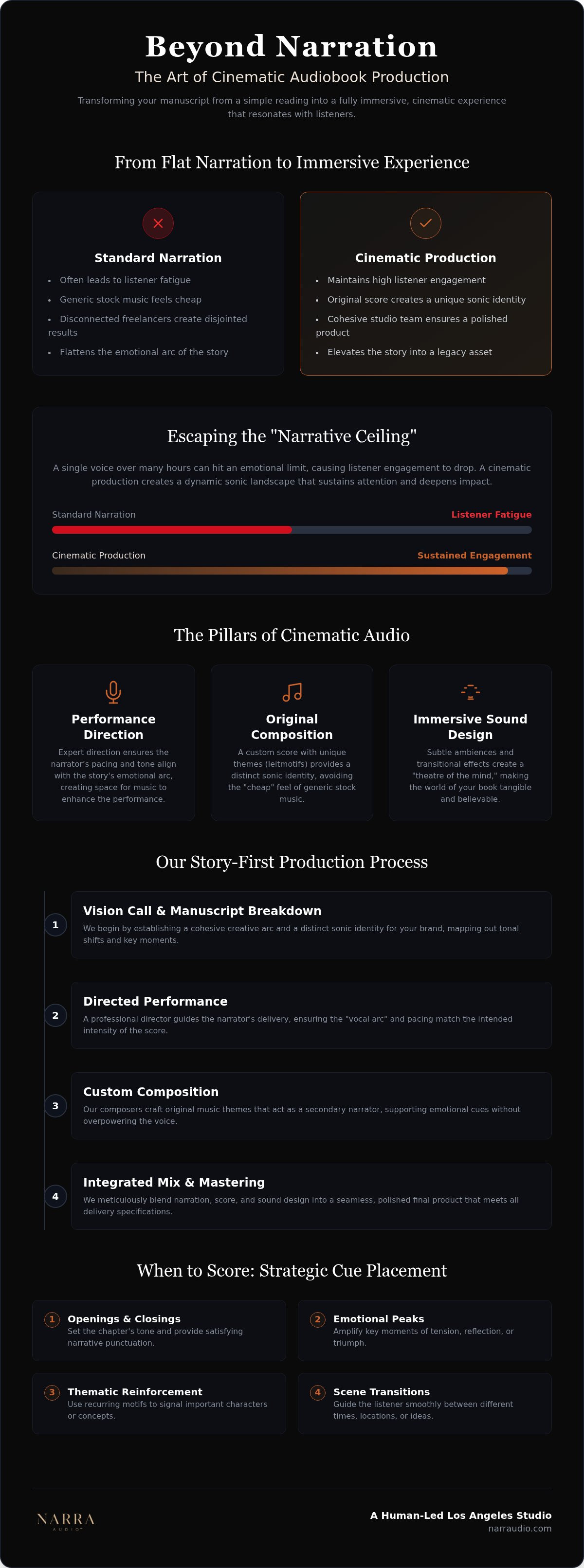
Standard narration often hits a "Narrative Ceiling" where the emotional arc of the text outpaces the capabilities of a single voice. While a talented narrator can convey deep nuance, monophonic delivery over ten hours can lead to listener fatigue. It's a physiological reality. In non-fiction, particularly high-stakes memoirs or business books, "flat" audio often results in lower information retention. The brain craves contrast. Without the shift in frequency and tone that a custom score provides, your most critical insights can get lost in the steady hum of a single vocal performance. A professional producer understands that the human ear needs a dynamic landscape to remain fully engaged with complex intellectual property.
Defining the Cinematic Audiobook Standard
Cinematic production isn't about adding noise; it's about architecting a sonic identity for your brand. This goes far beyond placing generic stock tracks at the beginning of chapters. A true cinematic score is an original composition designed to support the specific emotional cues of your manuscript. It acts as a secondary narrator, guiding the listener's pulse while the voice guides their mind. It ensures the performance feels intentional rather than mechanical.
At NARRA, our human-led process focuses on this holistic integration. By utilizing Los Angeles studios and expert performance direction, we bridge the gap between the author's intent and the listener's imagination. We use sound design to create a "theatre of the mind," employing subtle ambience and transitions that make the world of the book feel tangible. Ultimately, the strategic synergy of audiobook narration and scoring creates a legacy asset that stands apart from the sea of automated, generic content. It's the difference between a book that is simply read and a story that is truly lived.
The Mechanics of Voice and Music Integration
Integrating sound and speech requires more than just layering tracks in a digital workstation. It demands a producer's ear to ensure the two elements never compete for the listener's attention. Success in cinematic production depends on the invisible architecture between the spoken word and the underlying score. When audiobook narration and scoring are treated as separate silos, the result is often a sonic collision that distracts rather than immerses. To avoid this, our process begins with a meticulous manuscript breakdown. We identify specific tonal shifts, chapter arcs, and moments where the text needs the emotional lift of a musical theme. This preparation ensures that every element feels intentional, serving the story rather than just filling silence.
Performance Direction and Vocal Pacing
A professional director acts as the bridge between the narrator and the composer. Their role is to ensure the narrator's delivery matches the intended intensity of the score before a single note is written. This requires precise performance direction. Narrators must understand the "vocal arc," which we define as the deliberate modulation of tone and energy to mirror the narrative's emotional trajectory across a chapter. Pacing is equally critical. A narrator needs to leave "breath," which are intentional pauses that allow for Strategic Cue Placement. These gaps allow the music to swell during transitions, creating a seamless flow that feels like a well-edited film.
The Role of Original Music Themes
Generic stock music often carries a "cheap" signature that can undermine an author’s authority. To build a premium sonic identity, we focus on original music themes. We often employ a "Leitmotif," a recurring musical phrase associated with a specific character, concept, or emotional state. These themes act as structural signposts, subtly signaling to the listener that they are returning to a core idea. This level of detail transforms the listening experience from a simple reading into a realized world. If you want to hear how these elements come together, you can review our production samples to experience the difference for yourself.
By integrating these mechanics, the final product achieves a level of polish that DIY apps or marketplaces simply cannot replicate. It moves the project from a basic recording to a legacy asset. Every cue is placed with purpose. Every breath is timed for impact. This is the human-led craft that defines a truly cinematic production.
Case Study: Architecting the Sonic Landscape of a Memoir
Imagine a high-stakes memoir. It begins with a Vision Call. This isn't a logistical check-in; it's a creative summit where we establish the project's emotional arc. We look for the "why" behind the words. For a recent project, we worked with an author whose manuscript detailed a decade of high-wire corporate acts and personal reckoning. Our goal was to move this from a solitary reading to a grand media event. The transformation is stark. Raw narration, while clear, often feels thin. By integrating professional audiobook narration and scoring, we add a third dimension. The "after" is a cinematic mix where the voice lives within a carefully constructed soundscape.
Mapping Chapter Arcs to Musical Cues
Every chapter has a pulse. We identify the inciting incident, the moment where the stakes change, to trigger a shift in the score. Music acts as a bridge. It softens the transition between a heavy, introspective passage and a lighter, more hopeful beat. This ensures the listener isn't jarred by the shift in subject matter. You can read more about how these layers function in our guide on Cinematic Scoring for Audiobooks: How Music Changes the Story. This deliberate mapping is what separates a professional production from a generic one.
Scene Design and Environmental Ambience
Scene design isn't about literal sound effects at every turn. It's about environmental ambience. We use subtle foley and textures to ground the narration. If a scene takes place in a crowded café, we don't just play clinking cups. We layer in a low-frequency hum that suggests a specific time and place. Dialogue clarity is the priority, but background textures provide the theatre of the mind. Restraint is often our most powerful tool. We use silence as a musical cue itself, allowing the weight of a sentence to land before the score re-enters. This human-led precision ensures the finished product feels immersive rather than cluttered. The synergy of audiobook narration and scoring allows us to highlight the author's vision with absolute clarity.
When to Score: Strategic Cue Placement for Maximum Impact
Deciding when to deploy audiobook narration and scoring is a matter of editorial precision. It isn't about filling every second with sound; it's about highlighting the moments that matter most. A professional producer identifies four key anchor points for music in a cinematic production. First, the bookends: the introduction and conclusion themes that establish your brand's sonic identity. Second, the bridges: chapter transitions that act as organizational "stings" to help the listener navigate the structure. Third, the pivots: shifts in tone, such as moving from a data-heavy passage to a personal anecdote. Finally, the peaks: the emotional or intellectual climaxes where the music swells to reinforce the narrative arc. This strategic placement ensures the score serves the story rather than competing with it.
The "Authorial Voice" protection is our primary concern during the mix. We ensure the music never masks the spoken word. By managing frequency ranges and using subtle ducking techniques, the score sits firmly behind the narration, providing a foundation without sacrificing dialogue clarity. This level of detail requires a human-led approach that generic AI tools simply cannot replicate. The goal is a finished product that feels immersive and expensive, where the music acts as a supportive partner to the narrator's performance.
Identifying Emotional High Points
Every manuscript has "lightbulb moments" where a critical insight is revealed. In a business book or course, a subtle musical cue can signal to the listener that they should pay close attention. It anchors the information in their memory. For memoirs and fiction, music reinforces the climax of a scene, providing the emotional lift that a voice alone might struggle to carry. If you're producing a non-fiction project, you can find deeper insights in our guide on Immersive Sound for Non-Fiction: The 2026 Author’s Guide to Cinematic Audio. These peaks are the moments where audiobook narration and scoring reach their full potential.
The Art of Sonic Restraint
Restraint is often more powerful than constant sound. Wall-to-wall music is exhausting for the listener and can lead to cognitive overload, especially during dense or technical passages. We follow the "Focus Principle," which dictates that the voice must carry the heavy lifting when the content is most complex. A professional producer knows when to cut a cue in the mix to let a significant sentence land in total silence. This contrast creates a dynamic listening experience that keeps the audience engaged for hours. If you're ready to see how these principles apply to your manuscript, you can book a Vision Call to discuss your specific production needs.
The NARRA Cinematic Experience: Your Story, Produced Like a Film
Most authors start with a manuscript and end with a digital file. We start with a vision and end with a legacy. NARRA is a premium Los Angeles studio where your story is treated with the same technical and creative reverence as a feature film. We utilize production rooms linked to Grammy-winning music and Academy Award-winning projects to ensure your work carries the weight it deserves. By choosing a human-led studio, you move beyond the limitations of generic marketplaces and automated tools. You aren't just hiring a voice; you're partnering with a production team that manages the entire creative burden of audiobook narration and scoring.
The transition from writer to media creator is a significant elevation. It requires a partnership grounded in artistic empathy and modern efficiency. We handle every stage of the process, including creative direction, editing, original composition, and sound design. This holistic approach ensures that the final output is the most realized version of your original intent. Your intellectual property deserves a distinct sonic identity that stands apart in a crowded market. It's time to move from simply writing a book to creating a cinematic experience that resonates for generations.
From Manuscript Intake to Mastering
Our process begins with collaborative casting to find the perfect human voice for your text. If you prefer to use your own voice, we offer a guided voice capture method that remains under strict human creative direction. We offer different production tiers to match your goals. Our Signature System provides a polished, professional narrative, while the Cinematic Experience package offers a full-scale production with original scoring and sound design, typically completed in approximately 2 weeks. Every project concludes with technical precision. We provide broadcast-loudness mastering that meets the exact delivery specifications for platforms like Audible and Spotify, ensuring your work sounds flawless on any device.
Booking Your Vision Call
The foundation of every great production is the initial Vision Call. This is a complimentary creative summit where we discuss your manuscript breakdown, pacing, and the emotional cues required for your score. It is the moment where we move from the quiet world of writing to the grand world of professional media. To prepare, think about the core themes of your work and the specific "sonic brand" you want to project to your audience. We'll handle the logistics; you focus on the vision. Take the first step toward your cinematic legacy and Book a complimentary Vision Call with our team today.
Architecting Your Sonic Legacy
Your manuscript is the blueprint for a grander experience. Transitioning from a solitary reading to a fully realized media event requires more than just a clear voice. It demands the intentional fusion of audiobook narration and scoring, where every musical cue and vocal inflection serves the story. By prioritizing human-led craft over automated alternatives, you ensure your intellectual property maintains its emotional resonance and professional authority. This guide has outlined the mechanics of that transformation, from the initial vision to the final master.
At NARRA, we handle the entire production burden. From our professional Los Angeles facilities to the original scores composed by real artists, we provide end-to-end management that includes mastering and distribution. You've done the hard work of writing the book. Now, it's time to transform it into a cinematic reality that captivates listeners on every platform. The path to a distinct sonic identity starts with a single conversation. We invite you to book your complimentary Vision Call with NARRA to discuss your project's potential. Your story is ready for its premiere.
Frequently Asked Questions
Does every audiobook need a full musical score?
No. While cinematic production is our specialty, not every project requires wall-to-wall music. We use an editorial approach to determine where music adds value and where silence is more powerful. For some authors in Los Angeles or New York, an Essential package with clean narration and light sonic branding is the right fit. Others choose the Cinematic Experience for high-stakes narratives that benefit from a full original score.
Can I use my own voice for a cinematic audiobook production?
Yes. We offer a guided voice capture session, often referred to as the 47-Minute Experience, which allows you to provide the vocal foundation without spending weeks in a studio. This process is entirely human-led and requires your explicit consent. Whether you're recording in our Los Angeles studios or remotely from Seattle or London, our producers ensure your performance meets professional delivery specifications for a high-end finished product.
How long does the narration and scoring process take for a full-length book?
Turnaround times depend on the complexity of the project. A standard Essential Audiobook usually takes about one week. For more complex projects involving audiobook narration and scoring, such as our Signature System, the timeline is approximately 10 days. Our most immersive Cinematic Experience typically requires about two weeks, though we offer expedited options for authors in San Diego or San Fransisco who need their files ready for distribution in 10 days.
Is cinematic scoring suitable for non-fiction or business books?
Absolutely. Cinematic scoring is a powerful tool for reinforcing key concepts and maintaining listener engagement in non-fiction. By using subtle musical cues or stings, we can highlight lightbulb moments and structural transitions. This approach turns a dense business book into a memorable audio experience. Authors from Orange County to London use these techniques to ensure their intellectual property stands out in a crowded market of standard, flat recordings.
Will the music distract the listener from my message?
Not when handled by professional producers. Our Authorial Voice protection ensures that music never masks your message. We use advanced mixing techniques and frequency management to keep the score firmly in the background. The goal of audiobook narration and scoring is to provide an emotional foundation that supports the spoken word. We prioritize dialogue clarity above all else, ensuring your insights remain the focal point of the production.
How do you ensure the music matches the tone of my book?
Every project begins with a complimentary Vision Call. This is where our Los Angeles based creative team discusses your manuscript's themes and emotional arc. We don't use generic algorithms; we use real human composers to interpret your intent. Whether your book is a high-stakes memoir or a technical guide, we architect a sonic identity that feels authentic to your brand and resonates with your specific audience.
Does NARRA handle the distribution to Audible and Spotify?
Yes. We provide end-to-end support that includes preparing distribution-ready files for major platforms like Audible and Spotify. While final platform approval is never guaranteed, our technical precision ensures your files meet all broadcast-loudness and mastering specifications. This allows authors in cities like New York or Seattle to focus on their launch strategy while we manage the technical burden of the publishing and distribution process.
What is the difference between original scoring and stock background music?
Original scoring is a custom composition created specifically for your narrative. Unlike generic stock music, which can feel repetitive, a custom score uses recurring themes to reinforce your story's structure. NARRA delivers cinematic voice production from Los Angeles studios used by Grammy-winning music and Academy Award-winning film. This level of craft in audiobook narration and scoring provides a premium feel that stock tracks simply cannot replicate. It ensures your project has a unique sonic identity.
Frequently Asked Questions
No. While cinematic production is our specialty, not every project requires wall-to-wall music. We use an editorial approach to determine where music adds value and where silence is more powerful. For some authors in Los Angeles or New York, an Essential package with clean narration and light sonic branding is the right fit. Others choose the Cinematic Experience for high-stakes narratives that benefit from a full original score.
Yes. We offer a guided voice capture session, often referred to as the 47-Minute Experience, which allows you to provide the vocal foundation without spending weeks in a studio. This process is entirely human-led and requires your explicit consent. Whether you're recording in our Los Angeles studios or remotely from Seattle or London, our producers ensure your performance meets professional delivery specifications for a high-end finished product.
Turnaround times depend on the complexity of the project. A standard Essential Audiobook usually takes about one week. For more complex projects involving audiobook narration and scoring, such as our Signature System, the timeline is approximately 10 days. Our most immersive Cinematic Experience typically requires about two weeks, though we offer expedited options for authors in San Diego or San Fransisco who need their files ready for distribution in 10 days.
Absolutely. Cinematic scoring is a powerful tool for reinforcing key concepts and maintaining listener engagement in non-fiction. By using subtle musical cues or stings, we can highlight lightbulb moments and structural transitions. This approach turns a dense business book into a memorable audio experience. Authors from Orange County to London use these techniques to ensure their intellectual property stands out in a crowded market of standard, flat recordings.
Not when handled by professional producers. Our Authorial Voice protection ensures that music never masks your message. We use advanced mixing techniques and frequency management to keep the score firmly in the background. The goal of audiobook narration and scoring is to provide an emotional foundation that supports the spoken word. We prioritize dialogue clarity above all else, ensuring your insights remain the focal point of the production.
Every project begins with a complimentary Vision Call. This is where our Los Angeles based creative team discusses your manuscript's themes and emotional arc. We don't use generic algorithms; we use real human composers to interpret your intent. Whether your book is a high-stakes memoir or a technical guide, we architect a sonic identity that feels authentic to your brand and resonates with your specific audience.
Yes. We provide end-to-end support that includes preparing distribution-ready files for major platforms like Audible and Spotify. While final platform approval is never guaranteed, our technical precision ensures your files meet all broadcast-loudness and mastering specifications. This allows authors in cities like New York or Seattle to focus on their launch strategy while we manage the technical burden of the publishing and distribution process.
Original scoring is a custom composition created specifically for your narrative. Unlike generic stock music, which can feel repetitive, a custom score uses recurring themes to reinforce your story's structure. NARRA delivers cinematic voice production from Los Angeles studios used by Grammy-winning music and Academy Award-winning film. This level of craft in audiobook narration and scoring provides a premium feel that stock tracks simply cannot replicate. It ensures your project has a unique sonic identity.