Immersive Sound for Non-Fiction: The 2026 Author’s Guide to Cinematic Audio
A standard audiobook narration often feels like a dry lecture that leads straight to listener fatigue. You've spent years refining your expertise; however, without immersive sound for non fiction, your most complex business or self-help concepts can lose their emotional resonance. Many authors worry that adding production elements will make their work sound unprofessional or over-produced. It's a reasonable hesitation. You want your message to be the star, not the sound effects.
When we approach audio as a master producer would a documentary film, the sound becomes a powerful tool for retention rather than a distraction. By using original scoring and intentional pacing, we can transform your manuscript into a cinematic experience that stands out in a crowded market. This guide explores how a human-led production process, rooted in professional studio expertise, uses original themes and expert mixing to bridge the gap between your written words and a high-end listening experience. We'll show you how to achieve premium results while protecting your time and the integrity of your voice.
Key Takeaways
- Understand how Dual Coding Theory uses auditory cues to anchor complex business and self-help concepts in the listener's memory.
- Learn why immersive sound for non fiction relies on subtle scoring and ambience rather than the theatrical sound effects common in fiction.
- Master the rule of restraint to ensure professional sound design supports your authority without distracting from your core message.
- Follow a professional 5-step framework to map your manuscript’s sonic identity and identify high-impact anchor moments for production.
- Discover how film-industry production techniques can elevate a standard narration into a premium, high-retention cinematic experience.
Beyond the Dry Read: Defining Immersive Sound for Non-Fiction
Immersive sound for non fiction isn't about adding bells and whistles to a recording. It's the strategic use of scoring, ambience, and sound design to support a narrative. While fiction often uses audio to build imaginary worlds, cinematic non-fiction focuses on clarity and authority. In 2026, the market is moving away from passive listening. Audiences want active immersion. We think of this as narrative architecture; every sound serves the author’s thesis.
Many authors confuse immersive production with a "radio play." A radio play is theatrical and often literal. Cinematic non-fiction is different. It uses audio to highlight intellectual transitions or deepen the gravity of a case study. It's about enhancing the message, not performing it. By treating the manuscript as a script for a documentary rather than a simple book, we create a space where the listener stays engaged through long, complex chapters.
The Three Pillars of Immersive Non-Fiction Audio
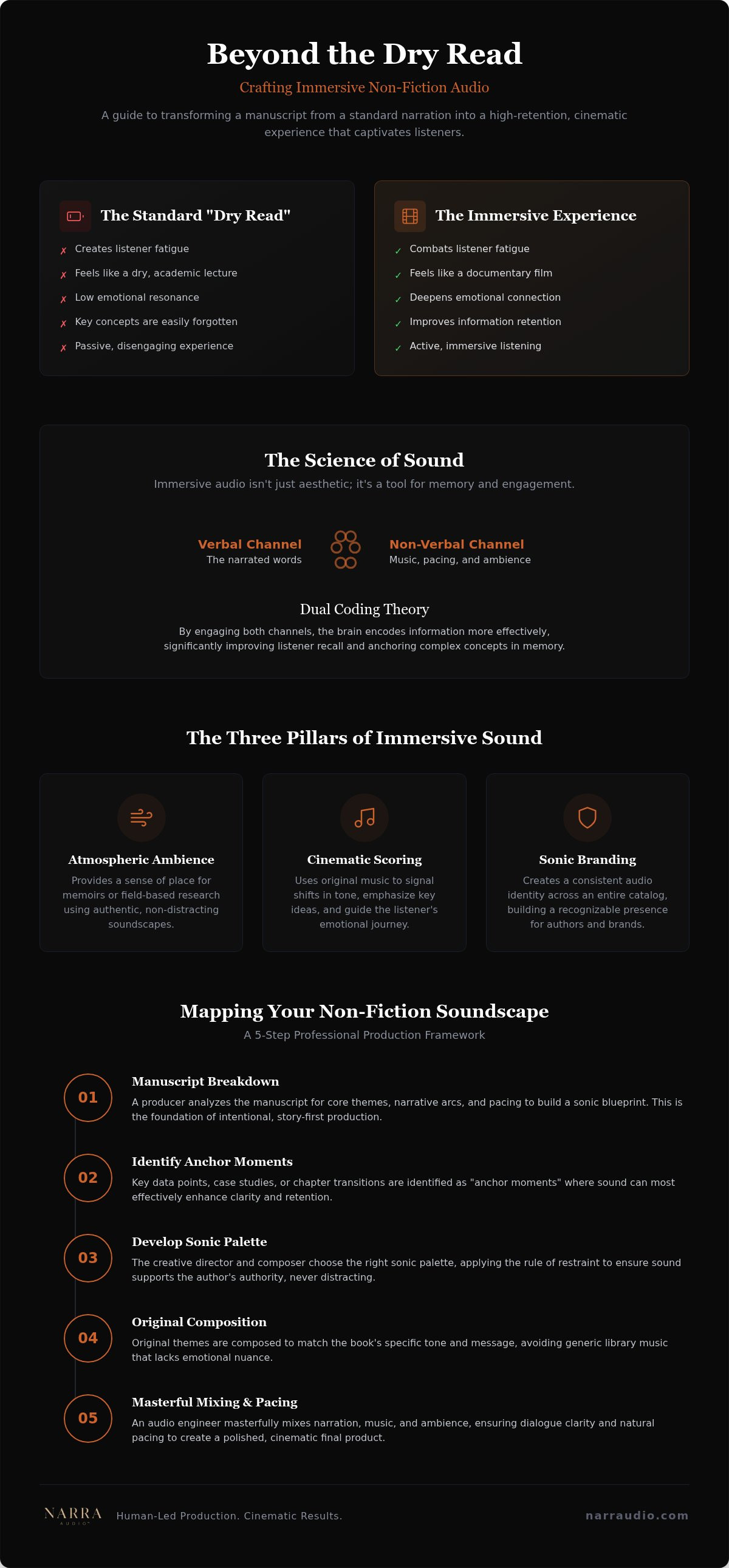
To achieve this level of engagement, we rely on three specific elements that define immersive sound for non fiction. First, atmospheric ambience provides a sense of place for memoirs or field-based research. This involves understanding soundscapes to ensure the background feels authentic rather than stock. Second, cinematic scoring uses original music to signal shifts in tone or importance. Finally, sonic branding creates a consistent audio identity. This helps coaches and executives build a recognizable presence across their entire audio catalog.
Why 2026 is the Year of the Immersive Memoir
Listeners on platforms like Spotify and Audible now expect a premium experience. They've been primed by high-end documentary podcasts. If your memoir sounds like a flat, dry read, you're competing at a disadvantage. Immersive elements help your story carry the same weight as a professional film. This shift is driven by a desire for deeper connection. Authors who invest in professional creative direction find their work resonates longer. Cinematic non-fiction is a hybrid of professional narration and film-style production care that respects the listener’s intelligence.
The Science of Sound: How Immersive Audio Improves Information Retention
Sound isn't just a background element; it's a biological anchor. Dual Coding Theory suggests that the human brain processes verbal and non-verbal information through separate, parallel channels. When you utilize immersive sound for non fiction, you're giving the listener two ways to encode your message. This reduces the cognitive effort required to absorb complex data. Research into audio and information retention shows that strategic sonic cues can significantly improve how well a listener recalls specific details later. Music acts as a mnemonic device. A recurring melodic theme can signal a core business framework or a specific self-help step, making that concept instantly recognizable every time it returns.
Combating Listener Fatigue with Dynamic Pacing
Dense non-fiction chapters can be exhausting for the modern listener. Without variation, the brain eventually tunes out, leading to what producers call listener fatigue. Professional sound design solves this by providing "mental breaks" between informational segments. We use subtle atmospheric shifts to signal a transition from a clinical explanation to a real-world case study. This isn't something an automated tool can handle. It requires human-led direction to ensure the pacing feels natural and the "breath" in the narration remains intact. Removing every pause through automated cleanup makes the delivery feel mechanical and increases the cognitive load. If you're looking to elevate your next project, you can view our cinematic production options to see how we handle these nuances.
Emotional Intelligence in Sonic Design
High-retention audio requires an emotional arc that matches your intellectual one. If your subject matter is serious, the frequency and texture of the score must reflect that weight. AI-generated music often fails here because it lacks the nuance of human experience; it can't understand the "why" behind your thesis. At NARRA, our composers create original themes that evolve alongside your narrative. This builds deep listener trust because the production feels intentional and respectful of the content. For a more technical look at our approach to custom composition, read our 2026 Guide: Cinematic Music Scoring for Audiobooks. By matching the sonic palette to your specific goals, we ensure your message isn't just heard, but felt and remembered long after the chapter ends.
Scoring vs. Sound Effects: Choosing the Right Sonic Palette
A common fear among serious authors is that their work will sound "cartoonish" or over-produced. It's a valid concern. Over-production occurs when sound effects become a distraction, pulling the listener away from your thesis and into a cluttered sonic environment. The rule of restraint is our primary guide here. Sound should always support the voice; it must never compete with it. This is why we employ a Sonic Architect to curate a cohesive palette before a single note is recorded. By identifying when to use literal sounds and when to lean into abstract scoring, we ensure that immersive sound for non fiction remains a tool for clarity rather than a gimmick.
When to Use Literal Soundscapes
Literal soundscapes are most effective in memoirs or narrative-driven case studies. If you're describing a childhood home in a specific city, we don't just use a generic background loop. We focus on perspective and proximity. The goal is to make the listener feel "in the room" with you. This level of cinematic sound design for audiobooks builds authenticity by using subtle textures. A distant siren or the specific rhythm of a local market can ground your story in reality. However, these elements must be mixed with precision. They should feel like a memory, fading in and out to match the emotional weight of your narration without ever obscuring your words.
The Power of Abstract Scoring for Thought Leaders
For business books and educational frameworks, literal sound effects can often feel out of place. Instead, we use abstract scoring to represent recurring ideas. We create original themes that act as sonic anchors for your listeners. When you introduce a core concept, a specific melodic motif can signal its importance. This creates a "prestige" feel that stock music simply cannot replicate. By applying professional narrative audio techniques, we ensure the score follows the manuscript’s arc. A custom score provides a sense of continuity and high-end production value. It transforms a high-ticket course or a complex business book into a realization of your original vision, ensuring the final product reflects the elite tier of your expertise.
How to Map Your Non-Fiction Soundscape: A 5-Step Framework
Mapping a soundscape isn't a task for the author to handle alone. It's a collaborative effort led by a master producer who understands the nuances of narrative architecture. We use a five-step framework to ensure your immersive sound for non fiction is both purposeful and professional. This process moves your project from a solitary manuscript to a high-end media product without placing the technical burden on your shoulders.
- Step 1: Manuscript Breakdown. We dissect the text to find anchor moments where the sound provides the most impact.
- Step 2: Defining the Sonic Identity. we establish a tone that fits your brand, whether it's warm and empathetic or clinical and authoritative.
- Step 3: Cue Placement. We engineer the exact entry and exit points for music and ambience to avoid a cluttered audio environment.
- Step 4: Performance Direction. We guide the narrator to ensure their pacing and delivery align with the intended sonic arc.
- Step 5: The Master Mix. We balance every layer in a professional studio to ensure absolute dialogue clarity while maintaining the immersive feel.
Manuscript Breakdown for Authors
The breakdown is where we identify emotional peaks. These are the moments in your book where a swelling score can amplify a breakthrough or a core truth. Just as importantly, we identify instructional valleys. These are sections of dense data or complex business frameworks where the music must pull back. This allows the listener to focus entirely on the information without distraction. A professional producer should lead this process to ensure the author isn't bogged down in technicalities or sound engineering decisions.
Collaborating with Your Production Team
Your journey into cinematic audio begins with a creative kickoff. During a dedicated Vision Call, you share your long-term goals and we translate that vision into a technical production plan. The director plays a vital role in this collaboration. They ensure the narrator’s performance doesn't just read the words but interacts with the score. This human-led direction is essential for maintaining your unique voice across all sonic layers. It's the difference between a generic recording and a premium audio product that captures your original intent.
If you're ready to see how this framework applies to your manuscript, you can book a Vision Call to discuss your project with our team.
The NARRA Approach: Producing Non-Fiction Like a Film
At NARRA Studio, we don't just record audiobooks; we produce cinematic media. Our Cinematic Experience represents the gold standard for immersive sound for non fiction. Based in Los Angeles, our team utilizes techniques borrowed directly from high-end film production to elevate your manuscript. We operate on a simple, supportive philosophy: you provide the written word, and we handle every technical and creative stage that follows. This isn't a DIY marketplace or a generic app. It is a partnership with a master producer who manages the creative direction, narration, editing, original composition, sound design, mixing, mastering, and distribution of your work.
By treating non-fiction with the same artistic reverence as a feature film, we ensure your message carries weight. Our premium packages include original scores and custom sound design tailored to your manuscript's specific arc. This approach transforms your expertise into a premium product that stands out. We prioritize human-led performance over mechanical alternatives, ensuring the finished work feels immersive and cinematic rather than using effects for effects' sake. You focus on your vision; we handle the production reality.
From Manuscript to Mastered Asset
The transition from a manuscript to a mastered asset is a complex journey. We take on the entire production burden so you don't have to. Our process covers casting the right voice, managing the recording sessions, and providing full distribution-ready files. Because our Los Angeles studios are the same rooms used by Grammy-winning music and Academy Award-winning film professionals, the audio quality reflects an elite tier of craftsmanship. We also provide launch assets such as cinematic trailers and social media clips. These tools are essential for promoting your project and demonstrating the premium nature of your immersive book to your audience before they even hit play.
Your Legacy, Immersively Told
Choosing a human-led studio is about more than just sound quality. It's about protecting the long-term value of your intellectual property. A raw narration file is a simple commodity; a polished cinematic production is a legacy. While generic marketplaces might offer a quick turnaround, they often lack the creative empathy required to capture an author's true intent. Our producers act as guardians of your voice, ensuring that the final output is the most realized version of your original vision. By investing in professional sound design and original themes, you ensure your message remains resonant and authoritative for years to come.
If you're ready to elevate your work, book a complimentary Vision Call to discuss your immersive non-fiction project. We'll explore how our team can transform your manuscript into a premium audio experience.
Elevating Your Manuscript into a Lasting Sonic Legacy
The shift toward cinematic audio represents a fundamental change in how listeners absorb complex ideas. By integrating immersive sound for non fiction, you move beyond the limitations of a dry narration. You provide your audience with a reason to stay engaged through every chapter. We've seen how strategic scoring and intentional pacing act as cognitive anchors. These elements ensure your message is both felt and remembered. Your book becomes more than a recording; it becomes an experience.
NARRA Studio handles the entire production burden. We provide end-to-end support, moving your project from manuscript to distribution. Our human-led creative direction ensures your authority remains the focal point of the production. We utilize Los Angeles studios used by Grammy-winning music and Academy Award-winning film professionals to deliver a product that reflects your status. From original themes to the final master, we protect your voice.
Your expertise deserves a realization that matches its original intent. It's time to transform your written word into a premium audio experience that resonates. We're ready to help you build that legacy.
Book a complimentary Vision Call to explore cinematic production for your book
Frequently Asked Questions
Is immersive sound distracting for non-fiction listeners?
Immersive sound for non fiction is only distracting when it lacks narrative purpose or professional restraint. At NARRA, we ensure every sonic element supports your authority rather than competing with it. We focus on subtle scoring and atmospheric textures that enhance clarity and retention. This approach transforms a dry lecture into a resonant experience that respects the listener's focus while maintaining the integrity of your original message.
Does every chapter in a business book need music and sound effects?
Not every chapter requires a full score or complex sound design. We identify high-impact anchor moments where audio enhancements provide the most value, such as core frameworks or emotional case studies. In contrast, instructional valleys often benefit from a clean, dry read to ensure maximum information retention. Our creative directors guide this selection process during the manuscript breakdown to maintain the perfect balance between engagement and clarity.
How much does cinematic audiobook production cost for non-fiction?
The cost reflects the depth of production required for your vision. Our Cinematic Experience package, featuring a full original score and ensemble casting, ranges from $12,000 to $30,000+. For authors seeking a more focused approach, our Signature System starts at $6,000. These rates cover our end-to-end service in Los Angeles, ensuring you receive a polished product without the burden of managing individual contractors or technical engineers.
Can I use my own voice for an immersive audiobook production?
You can use your own voice without spending weeks in a studio. Our 47-Minute Experience is a guided voice capture session priced between $500 and $1,500, which is credited toward your first production. This human-led process allows us to build a professional vocal foundation with your explicit consent. It's an ideal choice for authors in Los Angeles or Seattle who want to maintain their personal authority while saving time.
How long does it take to produce a cinematic non-fiction audiobook?
Production for a cinematic non-fiction audiobook typically takes about two weeks. This timeframe allows our team to complete the manuscript breakdown, original composition, and advanced layering. If you have a tight launch schedule, we can provide an expedited 10-day turnaround for our premium packages. Because we handle everything from intake to distribution, you can focus on your audience while our Los Angeles team manages the technical execution.
Will my immersive audiobook be accepted by Audible and Spotify?
We handle the entire distribution process to ensure your files meet the technical specifications of major platforms like Audible and Spotify. While we manage the submission and formatting, final platform approval remains at the discretion of the retailers. Our team ensures every file is mastered to broadcast-loudness standards. This provides a polished product that stands up to the highest professional market expectations.
Do I need to provide the music or sound effects myself?
You don't need to provide any audio assets yourself. NARRA is a full-service studio; we handle everything from original music composition to custom sound design. Our team of composers and sound designers creates a unique sonic identity for your book, ensuring the audio is tailored to your specific narrative arc. This removes the burden of sourcing stock music and ensures your project has a premium, cohesive feel.
What is the difference between a standard audiobook and a cinematic experience?
A standard audiobook is a clean narration file, while a cinematic experience is produced like a documentary film. Standard reads often lead to listener fatigue during long non-fiction chapters. In contrast, our cinematic approach uses immersive sound for non fiction to maintain high engagement. We add layers of emotional intelligence and technical precision in our Los Angeles studios, turning your manuscript into a premium media asset.
Frequently Asked Questions
Immersive sound for non fiction is only distracting when it lacks narrative purpose or professional restraint. At NARRA, we ensure every sonic element supports your authority rather than competing with it. We focus on subtle scoring and atmospheric textures that enhance clarity and retention. This approach transforms a dry lecture into a resonant experience that respects the listener's focus while maintaining the integrity of your original message.
Not every chapter requires a full score or complex sound design. We identify high-impact anchor moments where audio enhancements provide the most value, such as core frameworks or emotional case studies. In contrast, instructional valleys often benefit from a clean, dry read to ensure maximum information retention. Our creative directors guide this selection process during the manuscript breakdown to maintain the perfect balance between engagement and clarity.
The cost reflects the depth of production required for your vision. Our Cinematic Experience package, featuring a full original score and ensemble casting, ranges from $12,000 to $30,000+. For authors seeking a more focused approach, our Signature System starts at $6,000. These rates cover our end-to-end service in Los Angeles, ensuring you receive a polished product without the burden of managing individual contractors or technical engineers.
You can use your own voice without spending weeks in a studio. Our 47-Minute Experience is a guided voice capture session priced between $500 and $1,500, which is credited toward your first production. This human-led process allows us to build a professional vocal foundation with your explicit consent. It's an ideal choice for authors in Los Angeles or Seattle who want to maintain their personal authority while saving time.
Production for a cinematic non-fiction audiobook typically takes about two weeks. This timeframe allows our team to complete the manuscript breakdown, original composition, and advanced layering. If you have a tight launch schedule, we can provide an expedited 10-day turnaround for our premium packages. Because we handle everything from intake to distribution, you can focus on your audience while our Los Angeles team manages the technical execution.
We handle the entire distribution process to ensure your files meet the technical specifications of major platforms like Audible and Spotify. While we manage the submission and formatting, final platform approval remains at the discretion of the retailers. Our team ensures every file is mastered to broadcast-loudness standards. This provides a polished product that stands up to the highest professional market expectations.
You don't need to provide any audio assets yourself. NARRA is a full-service studio; we handle everything from original music composition to custom sound design. Our team of composers and sound designers creates a unique sonic identity for your book, ensuring the audio is tailored to your specific narrative arc. This removes the burden of sourcing stock music and ensures your project has a premium, cohesive feel.
A standard audiobook is a clean narration file, while a cinematic experience is produced like a documentary film. Standard reads often lead to listener fatigue during long non-fiction chapters. In contrast, our cinematic approach uses immersive sound for non fiction to maintain high engagement. We add layers of emotional intelligence and technical precision in our Los Angeles studios, turning your manuscript into a premium media asset.