Cinematic Sound Design for Audiobooks: 2026 Author’s Guide
A standard audiobook is a recording. A cinematic production is an environment. Most authors fear their life's work will be reduced to a flat, monotonous voice in a booth that fails to capture the soul of the prose. This is where cinematic sound design for audiobooks changes the equation. It isn't about layering cheap, distracting sound effects over a narrator's voice. It's about building a psychological landscape that reinforces your intent through technical precision and emotional intelligence.
You've likely spent years refining your manuscript. The thought of a production that sounds like a generic, unpolished DIY project is a valid concern. We understand that the transition from the quiet world of writing to the grand scale of professional media requires a delicate hand. In this guide, you'll discover how cinematic sound design transforms a standard narration into a three-dimensional, immersive experience that captivates listeners and improves narrative retention. We'll break down the distinction between music scoring and sound design, explain how original themes elevate your story, and help you identify the professional production standards required to compete in a global market projected to reach $13.8 billion this year.
Key Takeaways
- Learn how cinematic sound design for audiobooks builds a three-dimensional auditory world that significantly increases listener retention and emotional engagement.
- Understand the distinction between standard "dry" narration and an immersive sonic landscape that utilizes original musical themes and ambient layers.
- Discover the manuscript breakdown process used by professional producers to identify key narrative beats and precise cue placements.
- Explore why human-led creative direction is essential for achieving the emotional timing and precision that automated tools cannot replicate.
- Identify how to leverage high-end production standards to transform your intellectual property into a premium, film-level listening experience.
What is Cinematic Sound Design for Audiobooks?
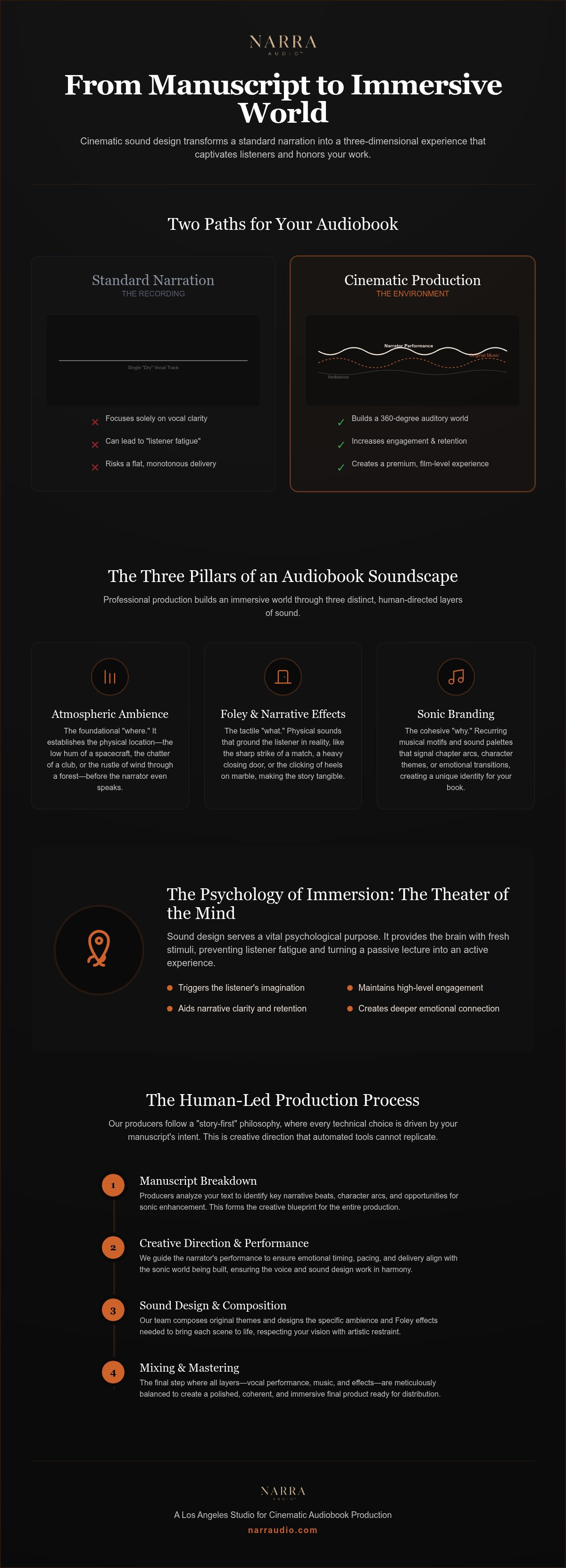
In the film world, sound is often called the "invisible half" of the experience. In a premium audiobook, sound is the entire world. Cinematic sound design for audiobooks is the art of building a 360-degree auditory environment that replaces the visual screen. While a standard "dry" narration focuses solely on the clarity of a single voice in a booth, an immersive landscape uses spatial layering to place that voice within a living, breathing scene. It's the difference between hearing a story read to you and feeling like you're standing in the center of the action.
We view sound design as the "set design" of the audio world. When you write a scene set in a rain-slicked alley, your prose provides the blueprints. Our job as producers is to build the walls, pave the stones, and summon the storm. This isn't about layering generic, "cheap" sounding effects over a recording. It requires intentional, human-led creative direction that respects your original vision and translates your written descriptions into a physical, sonic reality.
The Three Pillars of Audiobook Soundscapes
To create a truly immersive experience, we focus on three distinct layers of audio production:
- Atmospheric Ambience: This is the foundation of the "where." It might be the low hum of a spacecraft, the distant chatter of a 1920s jazz club, or the specific rustle of wind through a pine forest. It sets the physical location before the narrator speaks.
- Foley and Narrative Effects: These are the tactile, physical sounds that ground the listener. The sharp strike of a match, the heavy thud of a closing door, or the rhythmic clicking of heels on marble. These details make the story feel tangible.
- Sonic Branding: We use recurring musical motifs and sound palettes to signal chapter arcs or transitions. This creates a cohesive identity for your book, helping the listener track the movement of the narrative through sound.
Beyond Special Effects: The Producer’s Perspective
Professional production requires a sophisticated level of restraint. A common mistake in DIY or lower-tier audio is over-saturating the mix with loud, jarring effects that distract from the prose. Our producers follow a "story-first" philosophy. We ensure that cinematic sound design for audiobooks always supports the vocal performance rather than competing with it.
The goal is to trigger the "Theater of the Mind." We provide the emotional cues that allow the listener’s imagination to fill in the visual gaps. Our sound designers act as interpreters of your manuscript, deciding exactly when a scene needs a swell of original composition and when it needs the power of absolute silence. By maintaining this balance, we ensure the final product feels like a realized piece of media rather than just a narrated document.
The Psychology of Immersive Storytelling: Why Sound Design Matters
Listening to a voice for ten hours is a cognitive marathon. Without sonic variation, the brain eventually drifts into a state of "listener fatigue," where the words remain audible but the meaning loses its grip. This is where cinematic sound design for audiobooks serves a vital psychological purpose. It provides the brain with fresh stimuli, acting as a mental reset that maintains high levels of engagement and information retention. It's the difference between a lecture and an experience.
We call this the "Theater of the Mind." When a listener hears the distant, hollow echo of a cathedral before the narrator speaks, their imagination has already built the set. This pre-conscious engagement makes the story feel personal. It's no longer just your story; it's a world they inhabit. For non-fiction authors and coaches, this is equally powerful. Sound design can emphasize a "lightbulb moment" or a shift in perspective, making complex concepts more memorable through subtle sonic cues. It turns an abstract idea into a discovery.
Emotional Intelligence in Audio Production
In a memoir, the "sound" of a memory shouldn't be the same as the "sound" of the present. We use frequency shifts and specific textures to signal these emotional transitions. Spatial audio, including the strategic use of panning and depth, creates a sense of intimacy. A whisper that feels like it's inches from the listener's ear creates a visceral connection that a flat, centered recording simply can't achieve.
Aiding Narrative Clarity
Sound design is a functional tool for navigation. We use it to distinguish internal monologue from external dialogue without interrupting the flow with "he thought." Specific sonic transitions can signal time jumps or location changes, allowing the prose to move faster. We also value the "breath" of a production. Sometimes, the most profound choice is absolute silence. By applying cinematic sound design for audiobooks with precision, we transform passive listening into an active memory.
If you're curious about how these psychological layers sound in practice, hearing a production sample can clarify the difference between reading and experiencing.
Cinematic Layers vs. Standard Narration: A Production Comparison
Choosing the right production level for your project is a strategic decision that impacts both your budget and your listener's perception. Not every manuscript requires a full orchestral score, yet every author deserves a product that feels intentional. Cinematic sound design for audiobooks represents the highest tier of this craft, moving far beyond the industry baseline of a standard "clean read."
Standard narration is the foundation of the industry. It prioritizes vocal clarity and technical precision, ensuring the voice is free from artifacts and distractions. It's an excellent choice for straightforward business guides or instructional non-fiction. However, for authors looking to build a brand or tell a deeply personal story, a more layered approach is often necessary to stand out in a market where fiction accounts for 65.3% of the share. A flat production can feel like a missed opportunity to fully realize your vision.
Which Production Tier Fits Your Book?
We've structured our services to match the specific goals of intellectual property owners. Each tier serves a different narrative purpose and level of immersion:
- The Essential Audiobook: Focuses on a high-quality single-voice performance. It's best for straightforward non-fiction where the information must be the primary focus.
- The Signature System: Adds a layer of sonic branding through custom intro and outro scores. It's ideal for thought leaders and executives who want a recognizable audio identity.
- The Cinematic Experience: This is the gold standard of production. Starting at $12,000, it includes full scene design, original scoring, and a multi-dimensional soundscape. This tier is designed for fiction, memoirs, and legacy projects that demand a film-level finish.
The Role of the Composer vs. the Sound Designer
A common point of confusion is the difference between music scoring and sound design. While they work together, they require distinct skill sets. The sound designer is the architect of the physical world, placing footsteps, wind, and environmental cues. The composer is the architect of the emotional world. Understanding how custom music composition for audiobooks works in tandem with sound design is key to a polished result.
Our process involves synchronizing musical themes with environmental effects through complex multi-track mixing. This ensures that a swell in the strings doesn't drown out a crucial piece of dialogue or a subtle Foley effect. It requires the kind of technical precision found in our Los Angeles studios; we use the same professional rooms as Academy Award winning projects to ensure every layer sits perfectly in the mix. This human-led creative direction ensures your story is never lost in the noise.
Designing the Scene: How Sound Effects and Ambience Support Your Manuscript
While film editors work with a visual timeline, our team works with your manuscript. The process of cinematic sound design for audiobooks begins with a deep manuscript breakdown. We don't just look for action; we look for emotional beats that require sonic support. This allows us to determine precise cue placement, ensuring a sound enters and exits exactly when the narrative demands it. If a door slams too early, the suspense is broken. If it slams too late, it's a distraction. Precision is everything.
In our Los Angeles studios, we follow a non-negotiable rule: the voice is the anchor. No matter how complex the soundscape, dialogue clarity is paramount. We maintain the technical standards required for major platforms, ensuring the sound design feels like an extension of the narrator's performance rather than a separate layer. The review process is a collaborative partnership. We provide initial mixes for your feedback, allowing you to hear how the environmental textures and Foley integrate with the performance. This ensures the final output matches the world you envisioned while writing.
The Process of Scene Design
We build our audio worlds in three distinct stages to ensure depth and realism:
- Step 1: Identifying the "Sonic Signature": We define the unique acoustic properties of a location. A high-ceilinged stone cathedral sounds different than a carpeted office, and we establish that vibe before any specific effects are added.
- Step 2: Layering Environmental Textures: We add the "air" of the scene. This includes subtle wind, distant traffic, or the specific room tone that makes a recording feel like a physical space rather than a sterile booth.
- Step 3: Integrating Foley: These are the tactile, human sounds. Footsteps, the rustle of clothing, or the creak of a floorboard ground the listener in the physical reality of the story.
Common Pitfalls to Avoid
The most frequent mistake in cinematic sound design for audiobooks is over-production. When sound effects become a distraction, the story suffers. We avoid the trap of "literalism," where every single verb in the manuscript gets a corresponding sound. You don't need to hear a bird chirp every time a character looks at the sky. Instead, we focus on sounds that move with the narrator's rhythm and support the chapter arcs. If you're ready to see how your manuscript translates to a professional soundscape, you can review our production options to find the right fit for your project.
The NARRA Process: Bringing Film-Level Production to Your Audiobook
NARRA isn't a marketplace or a software suite. We're a human-led studio that takes the full burden of production off your shoulders. While generic AI tools attempt to automate the auditory experience, they lack the emotional intelligence required for high-stakes storytelling. Cinematic sound design for audiobooks is an art of intention. Every footstep, every swell of the strings, and every moment of silence must earn its place in the mix. This "Story-First" philosophy ensures that the final product is a realized version of your original intent.
Our work happens in the same Los Angeles rooms used by Grammy and Academy Award-winning projects. This gives your intellectual property access to an elite tier of production that was once reserved only for major film studios. You provide the manuscript; we handle the creative direction, narration, original composition, and technical mastering. It's a partnership designed to elevate your voice from the quiet world of writing to the grand world of professional media.
Meet the Sonic Architects
The vision behind our soundscapes is driven by experts who understand the intersection of music and narrative. Our founder, Mark Rhodes, orchestrates the musical and technical vision for every project, ensuring the score aligns with the author's voice. Vikiffes provides the technical precision behind the immersive sound design, building the three-dimensional worlds described in previous chapters. This level of human direction is the defining factor in the cinematic audiobook creation process, ensuring that the technology serves the story rather than the other way around.
Your Next Steps to a Cinematic Launch
The journey from a written manuscript to a film-level audio experience begins with a conversation. We offer a complimentary Vision Call to discuss your specific goals, the tone of your work, and the narrative beats that matter most to you. During this call, we can review samples of cinematic scoring and scene design to help you visualize the potential of your project. It's the first step in moving from a raw document to a polished, professional reality.
Efficiency is just as important as quality. We understand that authors operate on strict release timelines. Our team is structured to deliver film-level quality with an expedited 2-week turnaround for many projects. This allows you to move from a raw recording to a polished, professional master without the typical delays of traditional production houses. It's time to transform your book into an immersive experience that resonates with a global audience.
Elevating Your Prose into a Sonic Legacy
Your manuscript is the blueprint for a world that deserves to be heard in full color. By choosing cinematic sound design for audiobooks, you move beyond the limitations of standard narration to create a three-dimensional experience that holds a listener's attention for the long haul. It's the difference between a simple reading and a professional media production that honors the depth of your written word. This transition requires a partner who treats your prose with the same reverence you do.
At NARRA, our human-led production team in Los Angeles bridges the gap between your private creative process and a polished reality. We don't rely on generic tools; we rely on the same professional rooms and experts used in award-winning film projects. With original scores and scene designs crafted specifically around your story, we can deliver a finished master in as little as two weeks. If you're ready to hear your story fully realized, book a complimentary Vision Call with NARRA to discuss your manuscript. Let's build a soundscape that ensures your story is never forgotten.
Frequently Asked Questions
What exactly is cinematic sound design for audiobooks?
It's the art of building a 360-degree auditory world that replaces the visual screen. Unlike a standard dry narration, cinematic sound design for audiobooks uses atmospheric ambience, Foley, and spatial layering to place the voice within a living environment. In our Los Angeles studios, we treat sound as the set design of the audio world. This ensures the listener isn't just hearing a story; they're inhabiting a physical, sonic reality.
Does a non-fiction book really need sound design?
Many non-fiction authors in New York and London use sound design to increase listener retention and emotional engagement. Subtle sonic cues can emphasize lightbulb moments or shift perspectives in a business guide or memoir. It acts as a mental reset during long-form listening, making complex ideas more memorable. By adding these layers, you transform an abstract lecture into a discovery that stays with your audience long after they finish.
How much does cinematic audiobook production cost?
A full Cinematic Experience at NARRA starts at $12,000 and can scale to $30,000 or more depending on the complexity of your manuscript. This tier includes a full original score, scene design, and advanced layering. We also offer Essential and Signature tiers for authors seeking a different balance of production. Every project begins with a Vision Call to determine which production level aligns with your specific goals and your budget.
Will sound effects distract the listener from my narration?
Professional sound design is never about adding effects for effects' sake. We follow a story-first philosophy where the voice remains the anchor of the production. Our producers in Los Angeles use the same technical standards as Academy Award winning films to ensure that soundscapes support the performance rather than competing with it. By maintaining this balance, we trigger the listener's imagination without pulling their focus away from your prose.
Can I use my own voice for a cinematic audiobook?
You can absolutely use your own voice for your production. We offer a guided voice capture foundation that allows you to provide the performance while we handle the entire production burden. This human-led process ensures your unique tone is preserved under professional direction. Whether you record in San Diego or remotely from Seattle, we provide the creative direction and technical mastering required to ensure your delivery meets film-level production standards.
How long does the sound design process take?
Our standard turnaround for a full Cinematic Experience is about two weeks. For authors in San Francisco or Orange County on tighter release schedules, we offer an expedited 10-day turnaround. This timeline is significantly faster than traditional high-end production houses because our team works as a single, integrated unit. We manage everything from the initial manuscript breakdown to the final distribution-ready master, ensuring your launch stays on track without sacrificing quality.
Is cinematic sound design the same as a full cast audiobook?
These are distinct but complementary concepts. A full cast focuses on multiple narrators, while cinematic sound design for audiobooks focuses on the environment and emotional texture of the world. A single-voice performance can feel cinematic if the soundscape is rich and immersive. However, our premium packages often include ensemble casting to add further depth, creating a production that feels more like a movie than a standard reading.
What is the difference between sound design and an original score?
Sound design is the architecture of the physical world, including footsteps, wind, and room tone. An original score is the architecture of the emotional world, using music to signal mood shifts and chapter arcs. In our studio, these two elements work in tandem. Our composers and sound designers synchronize their work to ensure that musical themes and environmental effects never clash, resulting in a cohesive and polished final mix.
Frequently Asked Questions
We've structured our services to match the specific goals of intellectual property owners. Each tier serves a different narrative purpose and level of immersion:
It's the art of building a 360-degree auditory world that replaces the visual screen. Unlike a standard dry narration, cinematic sound design for audiobooks uses atmospheric ambience, Foley, and spatial layering to place the voice within a living environment. In our Los Angeles studios, we treat sound as the set design of the audio world. This ensures the listener isn't just hearing a story; they're inhabiting a physical, sonic reality.
Many non-fiction authors in New York and London use sound design to increase listener retention and emotional engagement. Subtle sonic cues can emphasize lightbulb moments or shift perspectives in a business guide or memoir. It acts as a mental reset during long-form listening, making complex ideas more memorable. By adding these layers, you transform an abstract lecture into a discovery that stays with your audience long after they finish.
A full Cinematic Experience at NARRA starts at $12,000 and can scale to $30,000 or more depending on the complexity of your manuscript. This tier includes a full original score, scene design, and advanced layering. We also offer Essential and Signature tiers for authors seeking a different balance of production. Every project begins with a Vision Call to determine which production level aligns with your specific goals and your budget.
Professional sound design is never about adding effects for effects' sake. We follow a story-first philosophy where the voice remains the anchor of the production. Our producers in Los Angeles use the same technical standards as Academy Award winning films to ensure that soundscapes support the performance rather than competing with it. By maintaining this balance, we trigger the listener's imagination without pulling their focus away from your prose.
You can absolutely use your own voice for your production. We offer a guided voice capture foundation that allows you to provide the performance while we handle the entire production burden. This human-led process ensures your unique tone is preserved under professional direction. Whether you record in San Diego or remotely from Seattle, we provide the creative direction and technical mastering required to ensure your delivery meets film-level production standards.
Our standard turnaround for a full Cinematic Experience is about two weeks. For authors in San Francisco or Orange County on tighter release schedules, we offer an expedited 10-day turnaround. This timeline is significantly faster than traditional high-end production houses because our team works as a single, integrated unit. We manage everything from the initial manuscript breakdown to the final distribution-ready master, ensuring your launch stays on track without sacrificing quality.
These are distinct but complementary concepts. A full cast focuses on multiple narrators, while cinematic sound design for audiobooks focuses on the environment and emotional texture of the world. A single-voice performance can feel cinematic if the soundscape is rich and immersive. However, our premium packages often include ensemble casting to add further depth, creating a production that feels more like a movie than a standard reading.
Sound design is the architecture of the physical world, including footsteps, wind, and room tone. An original score is the architecture of the emotional world, using music to signal mood shifts and chapter arcs. In our studio, these two elements work in tandem. Our composers and sound designers synchronize their work to ensure that musical themes and environmental effects never clash, resulting in a cohesive and polished final mix.