Narrator vs. TTS: The Author's Guide to Audio Quality
A book is a transfer of emotion, not just a transfer of information. When you stand at the crossroads of choosing a professional narrator vs text to speech, you're deciding how your legacy will sound for decades to come. It's natural to feel overwhelmed by the technical steps of recording or the fear that a cheaper, automated route might make your life's work sound hollow. You want a streamlined production process that captures the nuance of your writing without requiring you to become a DIY audio engineer.
We agree that your story deserves to be heard in its most realized form. This guide explores why the choice between human performance and AI synthesis determines your book's emotional impact and long-term value. We'll examine the technical realities of manuscript breakdown, performance direction, and why a producer-led approach ensures your voice carries the weight it deserves. You'll discover how to achieve a professional, immersive listening experience that honors your vision while protecting your intellectual property in a market that surpassed $7 billion in revenue last year.
Key Takeaways
- Learn how a professional manuscript breakdown identifies the emotional subtext and pacing that keeps listeners engaged for hours.
- Evaluate the critical trade-off between a professional narrator vs text to speech to ensure your intellectual property maintains its value for decades.
- Discover why managing the production burden of editing and sound design yourself often costs more in time than it saves in capital.
- Understand the role of original cinematic scoring in creating an immersive atmosphere that elevates your spoken word into a premium media asset.
- Gain a selection framework to help you choose the right production level based on your project's shelf-life and creative vision.
Professional Narrator vs. Text to Speech: The Core Trade-off
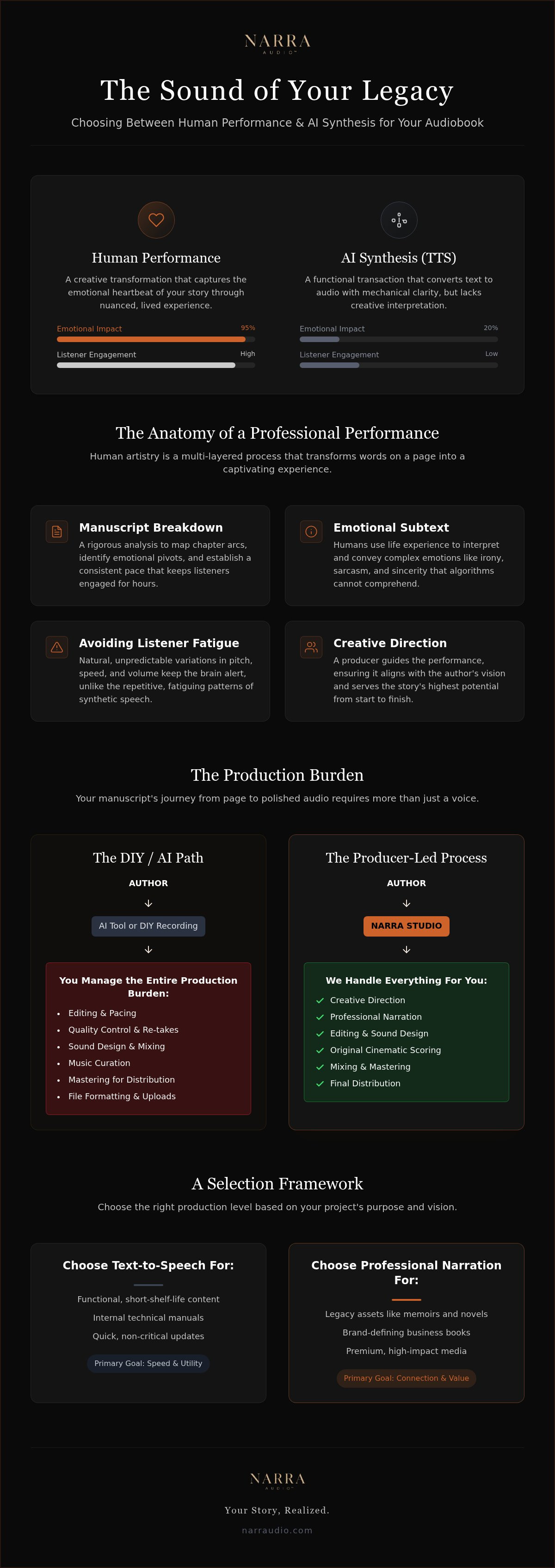
The debate often centers on speed and efficiency, but the real stakes are emotional. Choosing a professional narrator vs text to speech isn't a binary choice between human and machine; it's a choice between a transaction and a transformation. Synthetic voices have reached a level of mechanical clarity that can deceive the ear in short bursts. However, clarity is a baseline, not a destination. A narrator brings a professional manuscript breakdown to the table, identifying the hidden subtext that gives a chapter its heartbeat. They don't just read. They perform.
Authors often mistake "clarity" for "connection" during early tests. While an AI might pronounce every syllable perfectly, it lacks the emotional intelligence to sustain a ten hour narrative arc. This is where the uncanny valley of audio becomes a liability. When a voice sounds almost human but misses the mark on empathy or irony, the listener's brain works harder to bridge the gap. This leads to listener fatigue. Instead of being immersed in your story, the audience becomes acutely aware of the delivery. A human-led production ensures that the performance feels like a natural conversation between the author and the reader.
The Purpose of Your Audio
The medium dictates the craft. If you are producing a technical manual or a short instructional update with a fleeting shelf life, synthetic tools might serve a functional purpose. But for serious authors, executives, and memoirists, the stakes are significantly higher. Your audiobook is a legacy asset. Business and memoir authors face a unique pressure for authenticity; your voice is your brand's signature. A professional production turns a solitary reading experience into a grand media event. It ensures that every pause and inflection reinforces your credibility rather than undermining it with robotic repetition.
The Evolution of Voice Technology in 2026
Current Speech synthesis technology has made remarkable strides in mimicking the surface textures of human speech. By late 2026, these tools can handle complex pronunciation with surprising ease. Yet, they remain automated apps focused on input to output speed. They lack the creative direction found in a boutique Los Angeles studio. A master producer doesn't just record words. They curate a performance. They oversee the original themes, transitions, and dialogue clarity that software cannot perceive. At NARRA, we bridge the gap between your private creative process and a polished, professional reality. We handle the entire production burden, from creative direction to final distribution, ensuring your work is the most realized version of your original intent.
The Anatomy of Performance: Why Humans Excel at Subtext
A professional narrator doesn't just open your book and start talking. They perform a rigorous manuscript breakdown. This process involves mapping chapter arcs and identifying the emotional pivot in every scene. It's a level of creative labor that remains invisible until you hear the result. When comparing a professional narrator vs text to speech, the difference lies in the "why" behind the words. A human understands that a pause before a reveal carries more weight than the reveal itself. They know when to drive the narrative forward and when to let a concept breathe.
Subtext and Emphasis
Irony and sarcasm are the ultimate tests for any voice. A single sentence like "That's a great idea" can be a sincere compliment, a biting insult, or a weary dismissal. A human narrator uses their life experience to choose the right one. Automated tools often miss the point because they process language as data points rather than lived experiences. This lack of nuance impacts more than just art. Recent research on TTS and comprehension suggests that listeners struggle to retain information when the delivery lacks human led prosody. Without the correct emphasis, the brain works harder to decode the meaning; this leaves less energy for actual understanding.
Listener Fatigue and the Robotic Nuance
Long form storytelling is an endurance sport. Maintaining energy and consistency over a ten hour production requires a level of stamina that machines mimic but cannot truly replicate. Humans bring a natural imperfection to the booth. We vary our pitch, speed, and volume in unpredictable ways that keep the human brain alert. In contrast, synthetic speech often falls into predictable rhythmic patterns. This creates listener fatigue. Your audience starts to tune out not because the content is boring, but because the delivery is too repetitive.
Performance direction is the invisible hand in this process. At our Los Angeles studio, we provide the creative direction that ensures a narrator's delivery matches your specific specifications. It's about more than just changing pitch for different characters. It's about finding the soul of the story. You can listen to the difference by reviewing our production Samples, where every cue placement and transition is handled by working professionals. We take the burden off you, moving your project from a raw manuscript to a polished, cinematic reality.
The Production Burden: Management vs. DIY
Many authors lean toward automated tools because they promise speed. They envision a world where a book is converted to audio in minutes. However, the reality of the DIY trap quickly sets in. Generating a raw audio file is only the first five percent of the process. When you choose a professional narrator vs text to speech, you aren't just choosing a voice. You're choosing who carries the production burden. Automated apps require you to become the producer, director, and editor. You'll spend dozens of hours prompting the software, re-generating glitchy sentences, and manually stitching files together.
Professional production begins long before a microphone is turned on. It starts with manuscript intake and preparation. We map out pronunciation guides for complex terms and identify the chapter arcs that require specific emotional shifts. In a boutique Los Angeles studio, this creative labor is handled for you. Instead of managing a software interface, you're partnering with a master producer who protects your vision. The hidden cost of "cheap" tools is your own time; time that should be spent writing your next project.
Technical Precision and Mastering
A raw AI file is rarely a finished product. Major retailers like ACX and Spotify have strict delivery specifications that automated tools often fail to meet. Professional audio engineering involves more than just hitting record. It requires precise noise reduction, the application of consistent room tone, and meticulous mastering for dialogue clarity. If your files don't meet these technical standards, they'll be rejected by distribution platforms. We ensure every second of your audio meets industry specifications, providing a polished reality that sounds at home alongside award winning productions.
The NARRA Workflow: You Write, We Produce
Our process is designed to take the weight off your shoulders. You provide the manuscript, and we handle the creative direction, original themes, and sound design. For authors who want the intimacy of their own voice without the exhaustion of a weeks long recording schedule, we offer a guided 47-minute voice capture system. This optional, human led method allows us to build a performance that remains under professional creative direction. It's a streamlined way to learn how to publish an audiobook professionally without the DIY headache. We move your work from the quiet world of writing to the immersive world of professional media, ensuring the final output is the most realized version of your intent.
When to Choose Each: A Selection Framework
Not all audio is created equal. Your decision between a professional narrator vs text to speech should start with one question: how long do you want this to last? If you're producing a temporary internal bulletin or a technical update with a three month shelf life, automated tools might suffice. But for a book intended to build a legacy, "good enough" is a dangerous strategy. High quality audio is an investment in your intellectual property. A robotic delivery doesn't just sound cheap; it dilutes the authority you've worked years to establish.
Budget considerations often drive the initial inquiry, but they should be balanced against the value of your brand. We offer tiers ranging from our Essential production ($3k-$5k) to the peak of human led craft in our Cinematic Experience ($12k-$30k+). While synthetic options are inexpensive, they cannot protect your brand identity. A human performance creates a bridge of trust. It positions you as a premium creator in a market where audio now accounts for approximately 25% of all book revenue. In this context, choosing a professional narrator vs text to speech is a declaration of quality that listeners recognize instantly.
For Business and Self-Help Authors
For executives and coaches, your voice is your currency. Authority requires a human element to build genuine rapport with the listener. High end narration doesn't just sell books. It influences speaking engagement opportunities and high stakes consulting leads. If you're looking for recurring content, our authorized voice systems provide a guided, human led way to scale your presence without losing the personal connection that defines your leadership. Every chapter arc and performance specification is designed to reinforce your professional standing.
For Memoir and Fiction Authors
Immersion is the primary goal for storytellers. Fiction requires character depth and ensemble casting that a machine simply cannot conceive. We believe cinematic scoring and original themes are non-negotiable for stories that need to move the heart. You can explore why professional narration services for audiobooks are essential for protecting the emotional arc of your narrative. We handle the entire production burden, ensuring the finished product feels like a grand media event rather than a mechanical recital. To find the right path for your project, we invite you to book a complimentary Vision Call with our Los Angeles team.
The Cinematic Difference: Why Narration is Only Half the Story
Standard audiobooks often feel like a two dimensional recital. Even with a high quality voice, a production that lacks cinematic architecture can feel flat over several hours. When you evaluate a professional narrator vs text to speech, you are choosing the foundation of your project. However, the voice is only the first step in creating a grand media event. True immersion requires a 3D world where the listener forgets they are hearing a recording and feels they are witnessing a story. This is the difference between a functional audio file and a cinematic legacy.
Our Cinematic Experience package moves beyond simple narration. We employ ensemble casting and original themes to ensure every character and chapter has a distinct identity. While automated tools focus on the mechanical output of words, a master producer focuses on the atmosphere. We use sound design and scene design with intentional restraint. This ensures the ambience and transitions support your vision rather than distracting from it. The result is a polished, professional reality that stands apart from the crowded marketplace of generic audio.
Original Music and Cue Placement
Music is the emotional glue of a great production. We don't use stock music loops that feel repetitive or disconnected from your prose. Instead, we work with real composers to create original themes that underscore your narrative. This is where the choice of a professional narrator vs text to speech becomes even more critical. A human narrator provides the emotional cues that a composer needs to place a musical swell or a profound silence. You can learn more about how cinematic scoring for audiobooks changes the way a listener perceives your story. These original compositions are designed to mirror the emotional arc of your manuscript, turning chapter transitions into seamless, high energy movements.
Los Angeles Craft: The NARRA Studio Advantage
Our studio is built by working professionals who understand the high stakes of media production. We provide access to the same rooms and engineering standards used by Grammy and Academy Award winning talent. You aren't just hiring a voice; you are partnering with a sonic architect. We handle the entire production burden, from initial creative direction to final distribution ready files. This partnership ensures that your intellectual property is protected by the highest standards of audio engineering and dialogue clarity. Your story deserves more than an automated app. It deserves a producer who acts as a guardian of your voice. To explore how we can elevate your manuscript into an immersive listening experience, we invite you to book a complimentary Vision Call with our Los Angeles team today.
Securing Your Literary Legacy in Audio
The decision between a professional narrator vs text to speech is ultimately a decision about connection. While synthetic tools can replicate the sound of a voice, they cannot replicate the soul of a performance. Your book is more than a sequence of words; it's a transfer of emotion and authority that requires human led creative direction. By choosing a producer led approach, you ensure that every chapter arc and musical cue serves your original intent, transforming your manuscript into a grand media asset.
We handle the entire production burden in our Los Angeles studio, a space used by award winning music and film professionals. Whether you need a full original score or an Essential production with a turnaround in about one week, we provide a polished reality that protects your intellectual property. You don't have to navigate the technical complexities alone. We invite you to Book a complimentary Vision Call to discuss your project and hear how your story can sound in its most realized form. Your work deserves a voice that carries weight.
Frequently Asked Questions
Is text-to-speech (TTS) legal for commercial audiobook publishing?
Yes, it is legal. Major retailers including Audible, Google Play Books, and Apple Books accept AI narrated audiobooks in 2026. However, you must follow specific disclosure policies and meet strict quality standards. Many authors in creative hubs like New York and London find that while legal, the synthetic label can impact perceived value. We focus on human led production to ensure your work carries a premium signature without the need for these technical disclosures.
How much does it cost to hire a professional narrator vs. using AI?
Professional narrators typically charge between $250 and $500 per finished hour. For a standard 80,000 word book, this often totals $2,250 to $4,500 for the voice alone. AI generation costs significantly less, often under $100. When choosing between a professional narrator vs text to speech, the real cost is your time. Our Essential packages start at $3,000, handling the entire production burden so you don't spend 100 hours editing raw files yourself.
Can I use my own voice for my audiobook if I am not a professional?
Absolutely. Many authors in San Diego and Seattle use our optional 47-minute voice capture system. This guided session allows you to provide the foundation of your own voice without living in a recording booth for weeks. It remains under human creative direction to ensure the final performance matches your professional specifications. It's a time saving method that preserves the authenticity of your personal brand while our Los Angeles team handles the technical engineering.
Do listeners actually notice the difference between AI and human narrators?
Listenership data shows that audiences notice the lack of emotional nuance. Human narrators identify the subtext and pacing that a machine misses. Research suggests that human led reading results in higher comprehension than synthetic speech. Predictable prosody in AI often causes listener fatigue. Authors in San Francisco and Los Angeles prioritize human led craft to ensure their audience stays immersed in the story for the full duration of a ten hour book.
How long does it take to produce a professional audiobook compared to TTS?
Text to speech generation is nearly instant, but the required manual editing can take up to 100 hours for a full book. This is the DIY trap many authors overlook. Our professional production process is much more efficient for the creator. An Essential audiobook at our studio takes about one week. We move your project from manuscript to distribution ready files while you focus on your next book or business goals.
What are the technical requirements for uploading an audiobook to Audible?
Platforms like Audible have strict ACX specifications for noise floor, peak levels, and RMS power. Every file must be free of extraneous sounds like mouth clicks or room hiss. Meeting these delivery specifications is part of the production burden we handle for you. Our engineering team masters every chapter to ensure it passes technical review on the first attempt, saving you from the frustration of repeated file rejections and distribution delays.
Can I add music and sound effects to my AI-generated narration?
You can, but the results often feel disjointed. Original music and sound design work best when they respond to the emotional shifts of a human performance. We don't provide services for AI generated files because we believe in a story-first editorial point of view. Our Cinematic Experience includes full original scores created by real composers. This creates a 3D world for the listener that automated loops and generic effects simply cannot replicate.
Why do most premium authors still choose human-led production over automation?
Premium authors prioritize legacy and brand protection. An AI voice might save money today, but it can dilute your authority over the long term. Authors in London and New York choose human led production to ensure their work sounds like a grand media event. They want a partner who acts as a guardian of their voice. We handle everything from manuscript intake to distribution, providing a polished reality that generic automation cannot achieve.
Frequently Asked Questions
Yes, it is legal. Major retailers including Audible, Google Play Books, and Apple Books accept AI narrated audiobooks in 2026. However, you must follow specific disclosure policies and meet strict quality standards. Many authors in creative hubs like New York and London find that while legal, the synthetic label can impact perceived value. We focus on human led production to ensure your work carries a premium signature without the need for these technical disclosures.
Professional narrators typically charge between $250 and $500 per finished hour. For a standard 80,000 word book, this often totals $2,250 to $4,500 for the voice alone. AI generation costs significantly less, often under $100. When choosing between a professional narrator vs text to speech, the real cost is your time. Our Essential packages start at $3,000, handling the entire production burden so you don't spend 100 hours editing raw files yourself.
Absolutely. Many authors in San Diego and Seattle use our optional 47-minute voice capture system. This guided session allows you to provide the foundation of your own voice without living in a recording booth for weeks. It remains under human creative direction to ensure the final performance matches your professional specifications. It's a time saving method that preserves the authenticity of your personal brand while our Los Angeles team handles the technical engineering.
Listenership data shows that audiences notice the lack of emotional nuance. Human narrators identify the subtext and pacing that a machine misses. Research suggests that human led reading results in higher comprehension than synthetic speech. Predictable prosody in AI often causes listener fatigue. Authors in San Francisco and Los Angeles prioritize human led craft to ensure their audience stays immersed in the story for the full duration of a ten hour book.
Text to speech generation is nearly instant, but the required manual editing can take up to 100 hours for a full book. This is the DIY trap many authors overlook. Our professional production process is much more efficient for the creator. An Essential audiobook at our studio takes about one week. We move your project from manuscript to distribution ready files while you focus on your next book or business goals.
Platforms like Audible have strict ACX specifications for noise floor, peak levels, and RMS power. Every file must be free of extraneous sounds like mouth clicks or room hiss. Meeting these delivery specifications is part of the production burden we handle for you. Our engineering team masters every chapter to ensure it passes technical review on the first attempt, saving you from the frustration of repeated file rejections and distribution delays.
You can, but the results often feel disjointed. Original music and sound design work best when they respond to the emotional shifts of a human performance. We don't provide services for AI generated files because we believe in a story-first editorial point of view. Our Cinematic Experience includes full original scores created by real composers. This creates a 3D world for the listener that automated loops and generic effects simply cannot replicate.
Premium authors prioritize legacy and brand protection. An AI voice might save money today, but it can dilute your authority over the long term. Authors in London and New York choose human led production to ensure their work sounds like a grand media event. They want a partner who acts as a guardian of their voice. We handle everything from manuscript intake to distribution, providing a polished reality that generic automation cannot achieve.