Audiobook Metadata Optimization: The 2026 Elite Discovery Guide
In 2026, your cinematic masterpiece is effectively invisible if the algorithm cannot decode its value. You've poured your vision into a production featuring human-led narration and original scoring, yet the fear remains. You worry that this significant investment will be buried under the sheer volume of low-quality, AI-generated noise flooding retail platforms. Mastering audiobook metadata optimization is the only way to ensure your work is found by the right listeners, rather than lost in a sea of unsearchable assets.
You understand that your book is more than just a digital file; it's a legacy. This guide provides the professional blueprint for elite discovery to ensure your project commands top-tier visibility on Audible and Spotify. We'll show you how to navigate complex categorization for niche audiences and bridge the gap between creative excellence and global discovery. We'll break down the technical specifications and strategic positioning required to turn your metadata into a high-performance commercial engine. The journey from a private creative process to a public global reality starts with precision.
Key Takeaways
- Understand how metadata acts as an invisible discovery layer that bridges the gap between your creative vision and a global audience.
- Master the art of audiobook metadata optimization to align your cinematic production with the specific search behaviors of high-ticket listeners.
- Discover why human-curated metadata avoids the generic content flags that often plague automated, low-quality submissions in 2026.
- Learn to navigate platform-specific nuances to ensure your work thrives within Audible’s ecosystem and Spotify’s subscription-based discovery.
- Explore how managed distribution handles the technical heavy lifting, allowing your artistic legacy to remain the central focus of your publishing journey.
Audiobook Metadata Optimization: The Invisible Discovery Layer
Metadata is the silent pulse of your project. It is the strategic alignment of your cinematic audio assets with the descriptive data that retailers use to index your work. To truly grasp the core concepts of metadata, you must look beyond simple tags. It is a sophisticated discovery system. In 2026, the global audiobook market is projected to reach 13.9 billion dollars. This scale means retailers like Audible and Spotify are more selective than ever. They prioritize high-fidelity, human-led productions because these projects represent the premium tier of their digital libraries.
The studio is silent. The work is done. But the journey to the listener's ear has only just begun. Your distribution strategy must inform your choices from day one. If you wait until the files are exported to think about discoverability, you've already lost momentum. Effective audiobook metadata optimization ensures that when a listener searches for immersive historical fiction or a cinematic thriller, your work isn't just an option. It's the destination. It turns a static file into a living, searchable asset.
The Impact of Production on Discovery
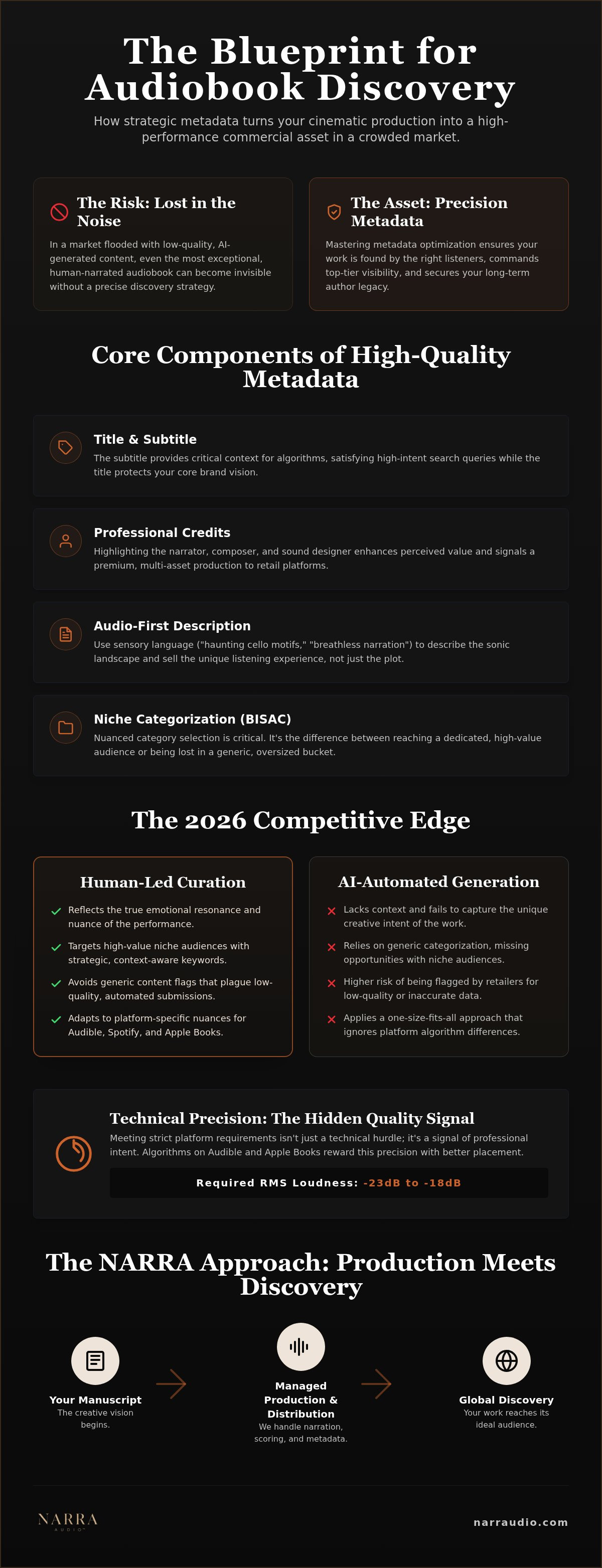
Cinematic scoring and immersive sound design act as hidden quality signals for modern algorithms. When a file meets the strict -23dB to -18dB RMS loudness standards required by Audible, it signals professional intent. Retailers like Apple Books and Audible reward this technical precision with better placement in their curated sections. There's a direct relationship between listener retention and metadata accuracy. If your data promises a cinematic experience and the audio delivers it, the algorithm notes that satisfaction and boosts your visibility. Poorly mastered audio or mismatched tags lead to bounces; precision leads to charts.
Metadata as a Strategic Asset
It's time to move beyond the mindset of simple data entry. Think of metadata as high-level audience targeting. While self-service aggregators offer a one-size-fits-all approach, elite authors lean into managed distribution. This allows for a more nuanced application of audiobook metadata optimization that reflects the actual emotional resonance of the performance. It ensures your work reaches the high-ticket, niche audiences who value human storytelling over mechanical alternatives. Your metadata is your digital footprint. It secures your long-term author legacy in an increasingly crowded market, protecting your investment for years to come.
Core Components of High-Quality Audiobook Metadata
Your metadata is the architecture of your prestige. It transforms a simple audio file into a discoverable asset that commands attention on global stages. The title and subtitle must perform a delicate dance; they should protect your brand vision while satisfying high-intent search queries. While the title captures the soul of the work, the subtitle provides the context that algorithms crave. This isn't just about labels. It's about ensuring your audiobook metadata optimization strategy reaches the specific niche audiences searching for high-end, immersive content.
Trust is built through transparency and professional credits. Highlighting professional voice talent is essential. Listeners in 2026 look for names they recognize or voices that resonate with authority. Don't stop at the author and narrator. Include cinematic credits for original music and scoring to enhance the perceived value of the production. Citing these elements aligns your work with the technical standards found in the W3C Audiobook specification, signaling to platforms that your project is a premium, multi-asset production.
Navigating BISAC codes requires a nuanced touch. For premium non-fiction and memoirs, accurate categorization is the difference between being found by a lifelong fan or being lost in a generic bucket. Choose categories that reflect the specific emotional and intellectual weight of your narrative. When you partner with a professional production and distribution team, these technical hurdles are managed with the precision your legacy deserves.
Crafting the Audio-First Description
An audiobook description shouldn't just summarize the plot; it must describe the sonic landscape. Use sensory language to emphasize the listening experience. Describe the "haunting cello motifs" or the "breathless, high-stakes narration" to signal quality to the listener. With Spotify Premium users now receiving 15 hours of listening per month, your description must be optimized for mobile-first scrolling. Break up text into punchy, evocative fragments that highlight the cinematic nature of your audio.
Strategic Keyword Optimization
Elite discovery in 2026 relies on identifying high-intent keywords that AI-generated noise often misses. Move beyond broad terms like "thriller" or "business." Instead, focus on cinematic niche terms such as "immersive soundscape," "full-cast performance," or "original orchestral score." These keywords attract listeners who are willing to pay for high-ticket, human-led productions. Avoid the trap of keyword stuffing. Instead, weave these terms naturally into your narrative metadata to maximize search visibility without sacrificing the professional polish of your brand.
Human-Led vs. AI Metadata: The 2026 Competitive Edge
AI is fast. It's also remarkably blind to the soul of a story. In 2026, premium retailers are increasingly aggressive about filtering out low-effort, automated content. Automated metadata often triggers "generic content" flags on high-end platforms because it lacks the specific emotional nuance that human listeners crave. True audiobook metadata optimization requires an understanding of sub-genres and atmospheric resonance that an algorithm simply cannot replicate. It's the difference between a sterile summary and a compelling invitation to listen.
Your cinematic vision deserves protection from automated compression and data loss. When metadata is generated by a machine, it often misses the subtle cues of your original orchestral score or the specific gravitas of your narrator's performance. Professional oversight ensures your work meets the industry standard for audiobooks, preventing the technical rejections that plague automated workflows. This level of care is a core component of the professional audiobook production process. It guarantees that the technical data reflects the artistic reality of the work.
The Risk of Automation in Distribution
Self-service aggregators struggle with complex metadata for multi-asset cinematic projects. If a machine mislabels a chapter or misses a crucial keyword, the time-cost of fixing these errors in a global distribution queue can be devastating. Elite authors avoid this frustration by choosing a "Master Producer" model for quality control. It's about precision. You shouldn't have to spend weeks chasing support tickets to fix a basic categorization error that a human would have spotted instantly. Precision at the start saves your reputation at the finish.
The Premium Advantage of Human Curation
For thought leaders and masterclass creators, categorization is a surgical tool. Human curators identify the exact intersections of philosophy, business, and narrative that AI overlooks. This precision also optimizes for voice-first search queries. When a listener asks Siri or Alexa for a "cinematic business memoir," your metadata needs to be ready. Ensuring your data reflects the prestige of a high quality audiobook distribution strategy is what separates a temporary project from a lasting legacy. You're not just filling out forms; you're building a digital monument.
Platform-Specific Optimization: Audible, Spotify, and Apple Books
Each distribution platform possesses a unique algorithmic DNA. To maximize your reach, your audiobook metadata optimization must be tailored to these individual environments. Audible remains the legacy giant, demanding rigorous technical adherence and precise categorization. With the 2026 transition to a 50% exclusive royalty rate under the new Member Value model, your metadata acts as the primary filter for high-value listeners. If your data is sloppy, your royalty potential shrinks. Precision is the currency of the Audible ecosystem.
Apple Books caters to a minimalist, high-end iOS demographic. Here, less is often more. Clean, evocative descriptions and high-resolution cover art metadata are essential to capture the attention of sophisticated Apple users. Conversely, library distribution through OverDrive and Libby requires a shift toward institutional metadata. Librarians and educators rely on specific BISAC codes and curriculum-aligned tags to justify their acquisitions. Your cinematic vision needs to be translated into these institutional terms to unlock the massive potential of the global library market.
Navigating Spotify’s 2026 Algorithm
Spotify has transformed the landscape by blurring the lines between podcasts and audiobooks. Their algorithm often groups cinematic audio projects with similar high-production podcast assets. This creates a unique opportunity for playlist-style discovery. By using consistent Series metadata, you maintain brand continuity across multiple releases, ensuring a seamless listener journey. Strategic metadata can even drive direct-to-consumer interactions by leading listeners from a Spotify chapter back to your own digital ecosystem. It’s about building a bridge, not just a file.
Optimizing for Global Reach
The world is your audience, but it doesn't all speak the same search language. Translating metadata for international markets like the UK or Australia requires more than just a dictionary; it requires cultural resonance. Managing global rights and ISBNs is a critical step for anyone utilizing professional audiobook publishing services. A localized keyword strategy for New York might focus on high-stakes finance, while London audiences might respond better to cinematic historical drama. These subtle shifts in vocabulary ensure your work feels local, no matter where it's played.
Navigating these platform-specific nuances is a full-time commitment to your legacy. If you're ready to move beyond the basics, partner with a master producer who understands the intricate mechanics of global discovery. Your masterpiece deserves to be heard on every stage.
The NARRA Approach: Where Production Meets Discovery
Discovery is not a separate phase; it is the final act of your production. At NARRA, we integrate metadata strategy directly into our cinematic production workflow. This ensures that every nuance of your performance is translated into searchable, high-converting data. We believe that audiobook metadata optimization should be as intentional as the original orchestral score we compose for your narrative. This holistic approach to audiobook metadata optimization ensures that your work is not just stored, but discovered. Your vision is protected. Your original music and scoring are properly credited and legally shielded. This meticulous attention to detail is the foundation of how to publish an audiobook professionally. Art and data must exist in harmony.
The technical "heavy lifting" shouldn't rest on your shoulders. Managed distribution is our promise to you. We bridge the gap between the private creative process and the public listening experience. By handling the complex technical requirements of global platforms, we allow you to remain focused on your creative voice. Our team acts as the guardian of your intent. We ensure the final output is the most realized version of your legacy. You provide the vision; we provide the global infrastructure to support it.
White-Glove Distribution Management
We offer personalized metadata audits for every retail platform. This isn't a batch process. It's a surgical one. Our human-led quality control exceeds standard aggregator benchmarks because we understand the high stakes of elite media. Every chapter, every credit, and every keyword is scrutinized for accuracy. Our management includes:
- Precise categorization for niche, high-ticket audiences.
- Rigorous verification of technical specifications for Audible and Spotify.
- Strategic placement of cinematic credits for composers and sound engineers.
With studio-level support in Los Angeles, Seattle, and Orange County, we provide a local, personal touch to a global reach. We don't just upload files. We manage a cinematic launch that respects the weight of your words.
Securing Your Audio Legacy
A cinematic approach ensures your work stands the test of time. In a market saturated with disposable, low-quality audio, human-led production is the ultimate differentiator. Moving from the recording studio to a global market presence requires a partner who values precision as much as you do. Your project is raw potential until it is polished and presented with authority. The crescendo of your work is its discovery by a global audience. It is the moment your private narrative becomes a public masterpiece.
Your masterpiece is ready for the world. Partner with NARRA for an end-to-end cinematic experience that honors your voice and secures your legacy. Let us turn your manuscript into a professional reality that resonates across every global platform.
Securing Your Place on the Global Stage
The shift from a private manuscript to a public masterpiece requires more than just high-fidelity audio. It demands a strategic alignment of your creative vision with the technical engines of the world's largest retailers. Mastering audiobook metadata optimization ensures that your cinematic production doesn't just exist; it thrives. By prioritizing human-led precision over automated shortcuts, you protect your legacy from being buried in the noise. You ensure your voice reaches the elite audiences it was meant for.
With studios in LA, NY, London, and Seattle, NARRA provides the human-led cinematic excellence your work deserves. We handle the end-to-end publishing and distribution management so you can remain focused on your craft. Elevate Your Audiobook with NARRA’s Managed Distribution. Your story is ready for its crescendo. Let's make sure the world is listening.
Frequently Asked Questions
What is the most important metadata field for audiobook discovery?
The subtitle is often the most powerful tool for SEO. While the title establishes the brand, the subtitle allows you to weave in high-intent keywords like "immersive" or "cinematic." It acts as the primary hook for algorithms. By focusing on audiobook metadata optimization at the subtitle level, you capture specific search queries that a generic title might miss. It's the bridge between your artistic vision and the listener's intent.
Can I update my metadata after my audiobook has been distributed?
Yes, you can update your metadata, but the timeframe for these changes to reflect varies by platform. Most retailers like Apple Books and Audible process updates within five to ten business days. However, frequent changes can disrupt your ranking momentum. It's better to finalize your strategy during the production phase. Managed distribution services handle these updates precisely; they ensure your legacy remains intact across all global retail platforms without technical lag.
How do I optimize metadata for an audiobook with cinematic scoring?
You should list your composer and sound designers in the primary contributor fields. This signals to the algorithm that your work is a multi-asset production rather than a simple narration. Use the description to highlight "original orchestral scoring" or "immersive soundscapes." These terms attract high-end listeners who seek a film-like experience. This specific type of audiobook metadata optimization differentiates your professional production from the flood of low-quality, automated content in 2026.
Do I need a separate ISBN for my audiobook version?
Yes, you must have a unique ISBN for your audiobook version. Retailers and libraries use this identifier to distinguish between print, digital, and audio formats. Using the same ISBN for different formats will cause critical distribution errors and metadata conflicts. A dedicated ISBN ensures that your sales and reviews are tracked accurately. It's a foundational requirement for any professional publishing strategy aiming for global reach and institutional library access.
How does Spotify’s metadata requirements differ from Audible?
Spotify prioritizes "Series" metadata and "Playlist" style discovery, while Audible relies heavily on traditional BISAC categories and internal search algorithms. Spotify’s ecosystem is also more integrated with podcast assets. This means your metadata should emphasize "show-like" continuity. Audible requires strict technical adherence to RMS loudness levels between -23dB and -18dB. Navigating these differences requires a nuanced approach to ensure your cinematic project thrives in both a subscription pool and a retail store.
What are the best keywords for a high-end non-fiction audiobook?
Focus on transformation and authority. Keywords like "masterclass," "definitive guide," and "immersive narrative" perform well for elite audiences. Avoid broad, generic terms that get lost in the noise. Instead, target high-intent phrases that reflect the specific value of your expertise. Using terms like "cinematic memoir" or "executive leadership audio" helps the algorithm place your work in front of high-ticket listeners who value human-led, professional insights over AI alternatives.
How can I ensure my metadata passes retail QC checks?
Ensure your metadata perfectly matches the information contained within your audio files and cover art. Discrepancies between the title on your cover and the title in your digital form are the leading cause of rejections. Your audio must also meet technical specs, such as a noise floor at or below -60dB. Professional oversight during the submission process catches these errors before they reach the retailer. This precision guarantees a seamless launch without the frustration of technical delays.
Does professional narration impact how I should write my metadata?
Absolutely. When you feature professional voice talent, your metadata should highlight their name and credentials to build immediate trust. Listeners often search for specific narrators they admire. Use the description to characterize the performance, using words like "authoritative," "empathetic," or "commanding." This connects the human element of the performance to the technical data. It transforms your metadata from a simple list of facts into a compelling narrative that reflects your production's prestige.
Frequently Asked Questions
The subtitle is often the most powerful tool for SEO. While the title establishes the brand, the subtitle allows you to weave in high-intent keywords like "immersive" or "cinematic." It acts as the primary hook for algorithms. By focusing on audiobook metadata optimization at the subtitle level, you capture specific search queries that a generic title might miss. It's the bridge between your artistic vision and the listener's intent.
Yes, you can update your metadata, but the timeframe for these changes to reflect varies by platform. Most retailers like Apple Books and Audible process updates within five to ten business days. However, frequent changes can disrupt your ranking momentum. It's better to finalize your strategy during the production phase. Managed distribution services handle these updates precisely; they ensure your legacy remains intact across all global retail platforms without technical lag.
You should list your composer and sound designers in the primary contributor fields. This signals to the algorithm that your work is a multi-asset production rather than a simple narration. Use the description to highlight "original orchestral scoring" or "immersive soundscapes." These terms attract high-end listeners who seek a film-like experience. This specific type of audiobook metadata optimization differentiates your professional production from the flood of low-quality, automated content in 2026.
Yes, you must have a unique ISBN for your audiobook version. Retailers and libraries use this identifier to distinguish between print, digital, and audio formats. Using the same ISBN for different formats will cause critical distribution errors and metadata conflicts. A dedicated ISBN ensures that your sales and reviews are tracked accurately. It's a foundational requirement for any professional publishing strategy aiming for global reach and institutional library access.
Spotify prioritizes "Series" metadata and "Playlist" style discovery, while Audible relies heavily on traditional BISAC categories and internal search algorithms. Spotify’s ecosystem is also more integrated with podcast assets. This means your metadata should emphasize "show-like" continuity. Audible requires strict technical adherence to RMS loudness levels between -23dB and -18dB. Navigating these differences requires a nuanced approach to ensure your cinematic project thrives in both a subscription pool and a retail store.
Focus on transformation and authority. Keywords like "masterclass," "definitive guide," and "immersive narrative" perform well for elite audiences. Avoid broad, generic terms that get lost in the noise. Instead, target high-intent phrases that reflect the specific value of your expertise. Using terms like "cinematic memoir" or "executive leadership audio" helps the algorithm place your work in front of high-ticket listeners who value human-led, professional insights over AI alternatives.
Ensure your metadata perfectly matches the information contained within your audio files and cover art. Discrepancies between the title on your cover and the title in your digital form are the leading cause of rejections. Your audio must also meet technical specs, such as a noise floor at or below -60dB. Professional oversight during the submission process catches these errors before they reach the retailer. This precision guarantees a seamless launch without the frustration of technical delays.
Absolutely. When you feature professional voice talent, your metadata should highlight their name and credentials to build immediate trust. Listeners often search for specific narrators they admire. Use the description to characterize the performance, using words like "authoritative," "empathetic," or "commanding." This connects the human element of the performance to the technical data. It transforms your metadata from a simple list of facts into a compelling narrative that reflects your production's prestige.